
Why Affiliate Marketing Matters in Digital Marketing?
Introduction
A business can have a great product, but reaching the right customers is still a challenge. This is where Affiliate Marketing can make a meaningful difference.
Affiliate Marketing is a performance based approach where individuals or businesses promote another company’s products or services and receive a commission when their promotion results in a defined action, usually a sale or lead.
What makes Affiliate Marketing interesting is the relationship between brands and people who already have an audience. A content creator, blogger, influencer, website owner, or industry expert can introduce a product to people who trust their recommendations.
For small businesses, ecommerce brands, influencers, and growing companies, this model can become an effective part of a wider digital marketing strategy when it is planned carefully.
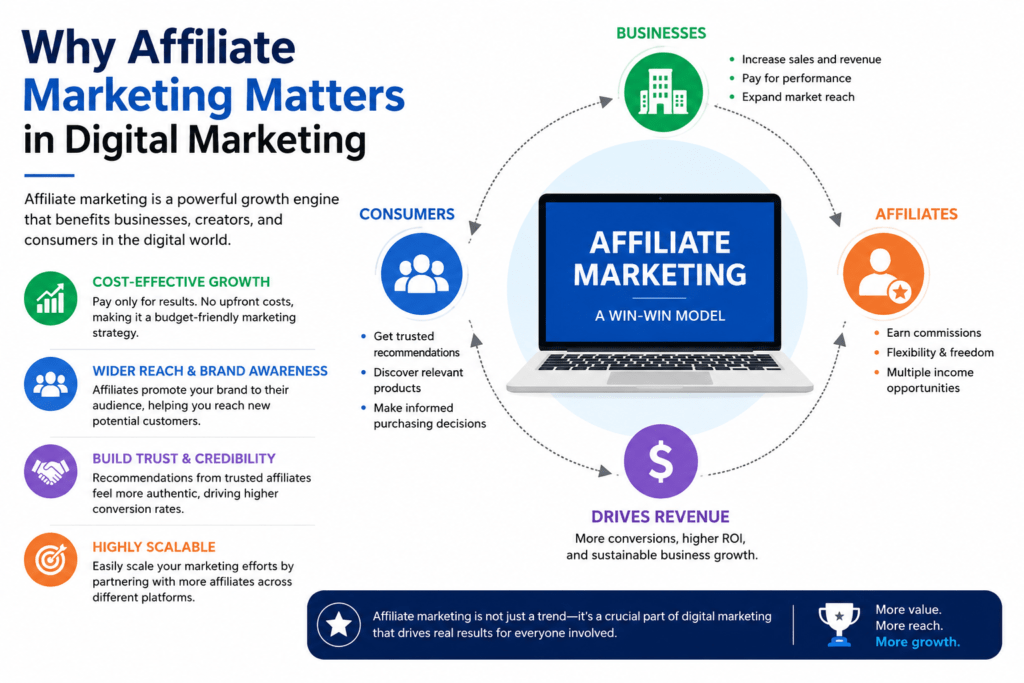
Table of Contents
What Is Affiliate Marketing?
Affiliate Marketing is a partnership between a business and a person or organization that promotes its products or services.
The basic process is simple:
- A brand creates an affiliate program.
- An affiliate joins the program.
- The affiliate receives a unique tracking link or code.
- The affiliate promotes the product or service.
- A customer clicks the link and completes the required action.
- The affiliate receives a commission according to the program terms.
The action could be a purchase, registration, enquiry, subscription, or another conversion.
This model gives businesses access to new audiences while allowing affiliates to earn from their content and recommendations.
How Does Affiliate Marketing Work?
A typical Affiliate Marketing system involves four key participants.
| Participant | Role |
|---|---|
| Brand | Provides the product or service |
| Affiliate | Promotes the offer |
| Customer | Takes the desired action |
| Affiliate Network | May manage tracking, reporting, and payments |
Not every program requires an affiliate network. Some brands manage partnerships directly through dedicated software.
The important part is accurate tracking. Businesses need to know which affiliate generated a conversion so commissions can be calculated correctly.
Why Affiliate Marketing Is Important
One major reason Affiliate Marketing is valuable is that it can connect a brand with audiences it may not reach efficiently through traditional advertising alone.
An affiliate may already have years of trust with a specific audience.
For example, imagine a fitness creator reviewing workout equipment. Their audience is already interested in fitness products. A relevant recommendation can feel more natural than a random advertisement shown to someone who has no connection with the category.
Affiliate Marketing also gives businesses a performance focused structure because commissions are generally connected to measurable results.
1. It Expands Brand Reach
An affiliate can introduce your business to an audience you may not have reached through your own channels.
This is particularly useful for new brands that are still building awareness.
2. It Can Support Customer Acquisition
Businesses are constantly looking for efficient ways to acquire customers.
With a well designed affiliate program, brands can work with multiple partners who promote products through blogs, videos, social media, newsletters, reviews, and other content formats.
3. It Creates Performance Based Opportunities
Traditional advertising may require spending money before knowing whether a campaign will produce a sale.
Affiliate Marketing can create a different structure because affiliates are often rewarded after a tracked action takes place.
That does not mean there are no costs. Businesses still need to manage commissions, technology, creative materials, customer support, and program administration. However, the model can provide a clearer connection between marketing activity and results.
4. It Builds on Trust and Recommendations
People often pay attention to recommendations from creators, experts, and publishers they already follow.
This is especially relevant to influencer marketing and content marketing.
A useful product review can help a customer understand how a product works, who it is suitable for, and what limitations it may have.
That type of content can be more useful than a simple promotional message.
Benefits of Affiliate Marketing for Businesses
Affiliate Marketing can provide several practical benefits when the program is properly managed.
| Benefit | Why It Matters |
| Wider reach | Access to new audiences |
| Measurable results | Easier conversion tracking |
| Flexible partnerships | Work with different creators and publishers |
| Customer acquisition | Generate sales or leads |
| Brand exposure | Increase visibility across multiple channels |
| Content opportunities | Encourage reviews and educational content |
However, results depend heavily on the quality of affiliates.
A business should not simply recruit as many partners as possible. It should look for affiliates whose audience, content, reputation, and values match the brand.
Benefits of Affiliate Marketing for Affiliates
The model is not only useful for brands.
Content creators, bloggers, influencers, website owners, and niche publishers can use Affiliate Marketing to monetize relevant content without creating their own products.
For example, a technology creator can recommend software tools, cameras, laptops, or accessories that are genuinely useful to their audience.
The strongest affiliate relationships usually come from relevance and trust.
Promoting products simply because they offer a high commission can damage credibility. Once an audience feels that every recommendation is purely commercial, trust can decline quickly.
Affiliate Marketing and Performance Marketing
Affiliate Marketing is closely connected to performance marketing because both focus heavily on measurable outcomes.
Performance marketing may include paid advertising, lead generation, affiliate programs, and other channels where campaigns are evaluated through specific actions and results.
The difference is that Affiliate Marketing relies heavily on external partners to promote the offer.
For example:
Affiliate partnership → Content or recommendation → Click → Website visit → Conversion → Commission
This creates a measurable path from promotion to business result.
Real World Example
Consider a skincare brand that wants to increase online sales.
Instead of relying only on paid advertisements, the brand works with beauty creators who produce product reviews and educational videos.
Each creator receives a unique affiliate link.
One creator may generate 100 sales while another generates only 10. The business can compare performance, identify the most effective partnerships, understand which content performs well, and refine the program accordingly.
The lesson is simple. Affiliate Marketing works best when businesses treat affiliates as strategic partners rather than simply another advertising channel.
Common Mistakes to Avoid
Several mistakes can reduce the effectiveness of an affiliate program.
Choosing Affiliates Only by Follower Count
A smaller creator with a highly relevant audience may produce better results than a large account with weak audience relevance.
Ignoring Content Quality
Poor reviews, misleading claims, or copied content can hurt both the affiliate and the brand.
Failing to Track Conversions
Without proper tracking, it becomes difficult to understand which partners and campaigns are producing results.
Offering Poor Communication
Affiliates need clear information about products, commissions, payment terms, promotional guidelines, and support.
Promoting Every Product
Affiliates should recommend products that genuinely fit their audience. Relevance is often more valuable than volume.
Best Practices for Affiliate Marketing
A strong Affiliate Marketing strategy usually includes a few basic principles.
First, define clear program goals. Decide whether you want more sales, leads, subscriptions, or brand exposure.
Second, create transparent commission and payment terms.
Third, select partners based on audience relevance, content quality, trust, and engagement rather than follower count alone.
Fourth, provide useful product information and promotional assets.
Finally, monitor conversion rates, revenue, commission costs, customer quality, and partner performance.
Affiliate Marketing should be treated as an ongoing business relationship, not a quick promotional tactic.
Frequently Asked Questions
Yes. Small businesses can use affiliate partnerships to reach niche audiences without depending entirely on their own audience or advertising channels.
Affiliates generally earn a commission when someone completes a qualifying action through their unique tracking link or code.
Not exactly. Influencer marketing often involves paying creators for promotional content, while Affiliate Marketing usually connects compensation to tracked results. Some campaigns can combine both models.
Businesses can track clicks, conversion rates, sales, leads, revenue, commission costs, customer acquisition, and individual affiliate performance.
Conclusion
Affiliate Marketing has become an important part of digital marketing because it connects businesses with people who already have relevant audiences and trusted relationships.
Its value is not simply the possibility of generating more sales. A well managed affiliate program can help brands expand their reach, create useful content partnerships, understand customer behavior, and build a measurable acquisition channel.
At the same time, success depends on choosing the right partners, maintaining transparency, tracking results properly, and protecting customer trust.
For businesses, the goal should not be to create the biggest affiliate network. It should be to create the right one.