
How to Measure Content Marketing ROI: A Practical Guide for Businesses
Learn how to measure Content Marketing ROI using traffic, leads, conversions, customer value, and revenue instead of relying only on views and engagement.
Introduction
Creating blog posts, videos, guides, case studies, and social media content requires time and money. But how do you know whether that effort is actually helping your business?
This is where Content Marketing ROI becomes important.
Many businesses measure content through page views, impressions, likes, or followers. These numbers can tell you whether people are seeing your content, but they do not always show whether the content is contributing to business growth.
A better approach is to connect your content with meaningful outcomes such as qualified leads, conversions, customer acquisition, sales, and revenue.
Measuring Content Marketing ROI does not mean that every blog post must generate an immediate sale. Some content builds awareness, answers customer questions, supports SEO, or influences a decision that happens much later.
The key is understanding what role each piece of content plays and measuring it against the right objective.
The source material emphasizes that marketing performance should be connected to the original goal, with useful measures including qualified leads, conversion rate, customer acquisition cost, engagement quality, returning visitors, email clicks, and revenue influenced by campaigns.
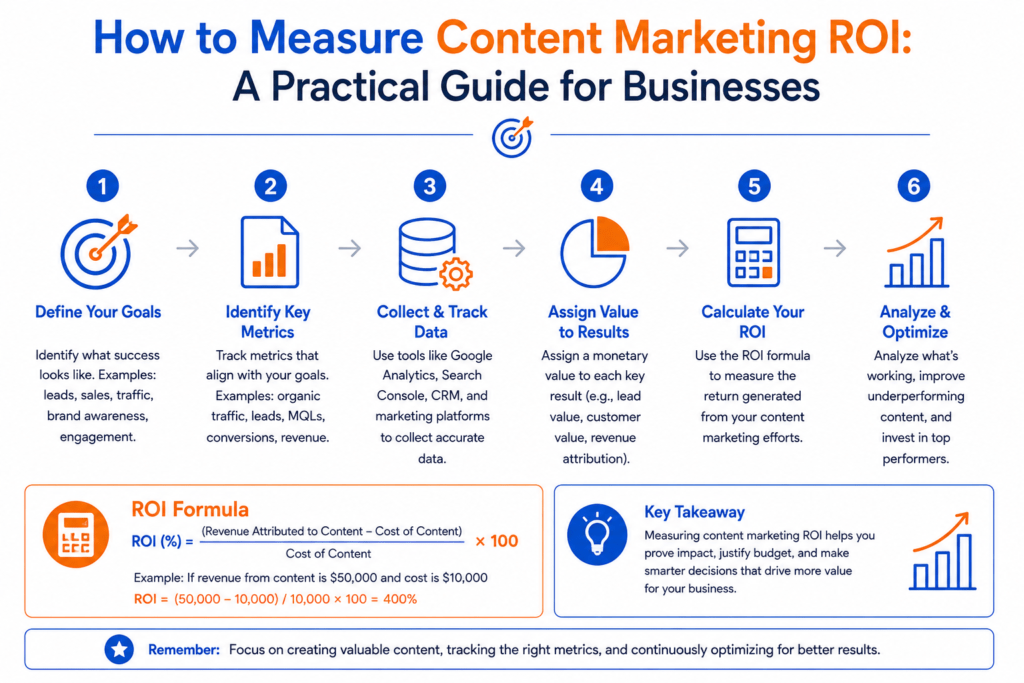
Table of Contents
What Is Content Marketing ROI?
Content Marketing ROI refers to the business value generated by content compared with the resources invested in creating and promoting that content.
A simple ROI formula is:
ROI = (Return from Content minus Content Investment) ÷ Content Investment × 100
For example, imagine a business spends ₹50,000 creating and promoting content and eventually attributes ₹1,50,000 in revenue to that content.
The calculation would be:
(₹1,50,000 minus ₹50,000) ÷ ₹50,000 × 100 = 200%
This gives you a basic financial view.
However, content does not always create revenue immediately. A blog may bring organic visitors for months, generate email subscribers, influence a sales conversation, and eventually contribute to a purchase.
That is why measuring Content Marketing ROI requires more than looking at one number.
Why Measuring Content ROI Matters
Without measurement, content marketing can become a production exercise.
A business might publish twenty articles every month without knowing which topics attract the right audience or generate meaningful outcomes.
Effective measurement helps you answer questions such as:
- Which content attracts qualified visitors?
- Which topics generate leads?
- Which pages influence conversions?
- Which content supports sales?
- Which channels produce valuable traffic?
- Where should we invest more resources?
- Which content should be improved or discontinued?
The source material recommends comparing results over time rather than reacting to one unusual day. Measurement is most useful when it leads to a decision about what to improve, stop, test, or scale.
What Metrics Should You Track?
The right metrics depend on your goal.
| Business Goal | Useful Content Metrics |
|---|---|
| Awareness | Impressions, reach, branded searches |
| Website growth | Organic traffic, returning visitors |
| Lead generation | Qualified leads, form submissions |
| Engagement | Time on page, meaningful interactions |
| Sales | Conversions, revenue influenced |
| Efficiency | Cost per acquisition, content cost |
| Retention | Repeat visits, email engagement |
Traffic
Traffic tells you whether people are reaching your content.
It is useful, but traffic alone cannot tell you whether those visitors are valuable.
The source material specifically notes that traffic can demonstrate reach but does not necessarily show whether the audience is valuable.
Qualified Leads
For service businesses, qualified leads can be much more meaningful than raw traffic.
A dental clinic may receive 5,000 visitors but only 30 appointment enquiries.
Those enquiries may tell you far more about the commercial value of the content.
Conversion Rate
Conversion rate measures the percentage of visitors who complete a desired action.
The action could be:
- Booking an appointment
- Requesting a quote
- Calling a business
- Downloading a resource
- Purchasing a product
- Submitting an enquiry
How to Calculate Content Marketing ROI
Start by calculating your total content investment.
This could include:
- Writer costs
- Design costs
- Video production
- SEO tools
- Content promotion
- Editing
- Freelancer fees
- Employee time
Then estimate the value generated by that content.
For example:
Content investment: ₹1,00,000
Attributed revenue: ₹3,00,000
Content Marketing ROI: 200%
However, attribution should be handled carefully.
Not every sale can be credited entirely to one blog post.
A customer may discover your brand through Google, follow you on Instagram, read three articles, receive an email, and finally speak with your sales team.
Content influenced the journey, but it may not have been the only factor.
How to Measure ROI at Different Stages
A useful way to understand Content Marketing ROI is to measure content according to the stage of the customer journey.
Awareness Content
Examples include:
- Educational blogs
- Social media posts
- Videos
- Industry guides
Focus on reach, relevant traffic, branded searches, and audience growth.
Consideration Content
Examples include:
- Case studies
- Comparison articles
- Detailed guides
- Webinars
Focus on engagement, returning visitors, enquiries, and assisted conversions.
Decision Content
Examples include:
- Service pages
- Product pages
- Testimonials
- Pricing guides
Focus more heavily on leads, conversions, sales, and revenue.
This approach prevents you from judging every piece of content using the same metric.
Attribution and the Customer Journey
A customer rarely interacts with only one piece of content before purchasing.
Consider this journey:
Google Search → Blog Article → Service Page → Case Study → Consultation → Purchase
The blog may not receive the final conversion credit, but it helped introduce the customer to the business.
Therefore, businesses should consider assisted conversions and the broader customer journey when evaluating Content Marketing ROI.
This is consistent with the source material’s broader view that marketing becomes more predictable when activities connect from attracting people through education, trust, action, and follow up.
Practical Example
Imagine a real estate company publishes a detailed article titled:
“How to Choose the Right Property for Investment.”
Over six months, the article receives 15,000 organic visits.
It generates:
- 250 enquiries
- 70 qualified leads
- 15 property visits
- 5 purchases
The company should not judge the article only by its traffic.
The more useful question is:
Did this content contribute to valuable business outcomes?
If several customers interacted with the article before contacting the sales team, the article may have significant business value.
The company can then create more content around related property investment questions.
Common Measurement Mistakes
Measuring Only Traffic
Traffic is useful, but it does not automatically equal business value.
Focusing on Vanity Metrics
Likes and views can provide context, but they should not be the final measurement when the business objective is revenue or lead generation.
Ignoring Content Costs
ROI calculations are incomplete if you only measure revenue and ignore writing, design, promotion, tools, and team resources.
Expecting Immediate Revenue
Some content is designed to build awareness or educate customers before they become ready to buy.
Using One Metric for Everything
Different content serves different purposes.
The source material recommends measuring performance against the original goal instead of using the same measurement approach for every marketing activity.
Frequently Asked Questions
Content Marketing ROI measures the business value generated by content compared with the investment made to create and distribute that content.
There is no single metric that works for every business. Qualified leads, conversion rate, customer acquisition cost, and revenue can be important for performance focused campaigns, while reach and engagement may matter more for awareness goals.
It depends on the type of content and the customer journey. Some campaigns can be measured quickly, while SEO and educational content may influence results over a much longer period.
Yes. If the resources invested in content produce less business value than the cost of creating and promoting it, the calculated ROI can be negative.
Start with a few meaningful metrics such as qualified leads, conversion rate, website traffic, content assisted conversions, and revenue. Keep the measurement system simple enough to maintain consistently.
Conclusion
Measuring Content Marketing ROI is about connecting content activity with business outcomes.
Do not stop at views, impressions, or traffic. Look at what happens after someone discovers your content.
Does the visitor become a lead?
Does the content influence a sales conversation?
Does it support a conversion?
Does it bring customers back?
Does the revenue generated justify the investment?
The answers will give you a much clearer picture of whether your content strategy is working.
The most effective measurement system is not necessarily the most complicated one. It is the one your team can consistently maintain and use to make better decisions.
As the source material emphasizes, the purpose of measurement is not simply to collect numbers. It is to determine what should be improved, stopped, tested, or scaled.