
How to Build a Lead Generation Funnel That Converts
Learn how to attract the right prospects, capture their interest, build trust, nurture leads, and create a lead generation funnel that supports real business growth.
Introduction
Getting people to visit your website or social media page is only the first step. The bigger challenge is turning attention into genuine enquiries and qualified prospects.
This is where a lead generation funnel becomes valuable.
A lead generation funnel is a structured process that moves a potential customer from discovering your business to showing enough interest to become a lead. Depending on the business, the final action could be submitting a form, requesting a quote, booking a consultation, calling the company, or scheduling an appointment.
For a digital marketing agency, the journey may begin with a Google search and end with a consultation call. For a dental clinic, it may start with an educational article and finish with an appointment request. For a real estate company, it could begin with a property search and continue through an enquiry and site visit.
The strongest funnels are built around audience understanding, useful information, clear next steps, and measurable outcomes.
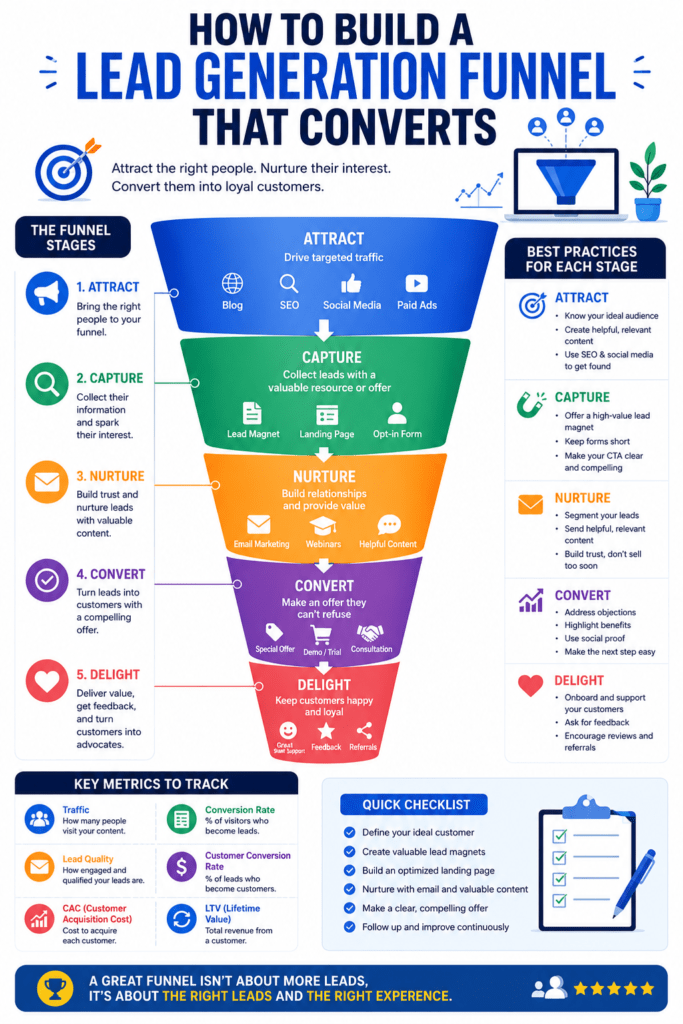
Table of Contents
What Is a Lead Generation Funnel?
A lead generation funnel is a framework that helps businesses move potential customers through different stages before they become qualified leads.
A simple funnel can look like:
Awareness → Interest → Consideration → Lead → Sales Conversation
At each stage, the customer’s needs are different.
Someone discovering your brand for the first time may need education.
Someone comparing your service with competitors may need proof and detailed information.
Someone ready to contact you needs a simple and clear path to action.
The funnel helps businesses create the right experience for each stage.
Why Is a Lead Generation Funnel Important?
Without a structured funnel, marketing can become disconnected.
A business may generate traffic through SEO, receive engagement on social media, run advertisements, and publish content, but still struggle to generate consistent leads.
A well designed lead generation funnel connects these activities.
| Funnel Stage | Customer Need | Suitable Marketing Activity |
|---|---|---|
| Awareness | Discover a problem or solution | SEO, social media, content |
| Interest | Learn more | Blogs, videos, guides |
| Consideration | Compare options | Case studies, reviews |
| Lead | Take action | Forms, calls, consultations |
| Nurturing | Build confidence | Email, follow up |
| Sales | Make a decision | Sales conversation |
The source material recommends mapping marketing from discovery to education, trust, action, and consistent follow up.
Stages of a Lead Generation Funnel
1. Awareness
At this stage, people may not know your business.
They may discover you through:
- Google Search
- Social media
- Blog posts
- Videos
- Paid advertisements
- Referrals
Your goal is to attract relevant people rather than everyone.
2. Interest
Now the visitor wants more information.
Useful content can include:
- Educational guides
- FAQs
- Tutorials
- Case studies
- Comparison articles
- Videos
3. Consideration
The visitor is evaluating whether your business is right for them.
This is where trust becomes important.
Show:
- Reviews
- Testimonials
- Credentials
- Results
- Case studies
- Service information
4. Lead Conversion
The visitor becomes a lead by taking a meaningful action.
For example:
Book a Call
Request a Quote
Book an Appointment
Submit an Enquiry
The next step should be obvious.
How to Build a Lead Generation Funnel
Step 1: Define Your Ideal Customer
Start with the audience.
Identify:
- Problems
- Goals
- Motivations
- Objections
- Budget
- Location
- Buying behavior
- Preferred platforms
The source material recommends studying customer conversations, search queries, comments, reviews, and sales questions to identify patterns.
Step 2: Define Your Lead Goal
Decide exactly what counts as a lead.
For example:
- Completed contact form
- Phone call
- Appointment
- Consultation
- Quote request
- Demo request
This makes your funnel measurable.
Step 3: Choose Your Acquisition Channel
Select channels based on where your audience spends time.
Possible options include:
- SEO
- Google Ads
- Social media
- Content marketing
- Email marketing
- Referral marketing
Do not choose a channel simply because it is popular.
Choose one that fits your customer’s behavior.
Step 4: Create a Relevant Offer
Give prospects a reason to continue.
Examples include:
Free Consultation
Property Investment Guide
Dental Treatment Consultation
SEO Website Audit
Marketing Checklist
The offer should be genuinely useful and closely connected to what the prospect needs.
How to Attract the Right Prospects
The quality of your leads starts before someone reaches the landing page.
Suppose a dental clinic publishes an article targeting the search “how to maintain healthy teeth.”
It may attract a large audience.
But a more service focused article targeting “dental implant consultation near me” may attract fewer visitors while generating more enquiries.
This is why relevance matters.
The source material emphasizes that content should answer real questions and match user intent rather than simply generating activity.
Creating an Effective Lead Capture Page
Your landing page should make the desired action clear.
A strong structure can include:
Headline
Clearly explain the offer.
Supporting Copy
Explain why it matters.
Benefits
Show what the visitor will receive.
Trust Signals
Use genuine reviews, credentials, results, or relevant evidence.
Call to Action
Tell the visitor what to do next.
Lead Form
Ask for the information you genuinely need.
For example:
Name
Phone
Business Website
Requirement
Avoid asking for unnecessary information.
Lead Nurturing
Not every lead will be ready to buy immediately.
A person may submit an enquiry and need additional information before making a decision.
This is where lead nurturing becomes important.
You can use:
- Email follow up
- Helpful educational content
- Retargeting
- Sales calls
- Relevant case studies
- Product or service information
The objective is not to repeatedly pressure the prospect.
It is to provide useful information that helps them make a decision.
How to Qualify Leads
Not every enquiry deserves the same sales effort.
Lead qualification helps identify which prospects are the best fit.
You can evaluate:
| Factor | Question |
|---|---|
| Need | Does the prospect need the service? |
| Budget | Can they realistically afford it? |
| Authority | Can they make or influence the decision? |
| Timing | Are they ready to act? |
| Fit | Does the business meet their requirements? |
A qualified lead is usually more valuable than a large collection of poorly matched enquiries.
Measuring Funnel Performance
A lead generation funnel should be measurable at every important stage.
Useful metrics include:
- Website traffic
- Landing page visits
- Conversion rate
- Leads
- Qualified leads
- Cost per lead
- Customer acquisition cost
- Sales
- Revenue
The source material recommends focusing on meaningful measures such as qualified leads, conversion rate, cost per acquisition, engagement quality, returning visitors, email clicks, and revenue rather than traffic alone.
Common Mistakes
Targeting Everyone
A broad audience can produce irrelevant leads.
Using a Weak Offer
People need a clear reason to take action.
Complicated Forms
Every additional field can introduce unnecessary friction.
Poor Follow Up
A good lead can be lost when nobody responds properly.
Measuring Only Traffic
More visitors do not automatically mean more customers.
Ignoring the Customer Journey
The experience after the initial click needs to remain connected to the intended action.
Practical Example
Imagine a real estate company wants more enquiries for residential properties.
Its lead generation funnel could look like:
Google Search → Property Buying Guide → Property Listing Page → Customer Reviews → Enquiry Form → Sales Call → Property Visit
Each stage has a specific purpose.
The article attracts the audience.
The property page provides information.
Reviews build trust.
The enquiry form creates the lead.
The sales team handles the next conversation.
This is much stronger than simply running an advertisement and sending everyone to the homepage.
Frequently Asked Questions
What is a lead generation funnel?
A lead generation funnel is a structured process that moves potential customers from their first interaction with a business toward becoming qualified leads.
What are the stages of a lead generation funnel?
Common stages include awareness, interest, consideration, lead conversion, nurturing, and sales.
How do I create a lead generation funnel?
Define your ideal customer, choose a clear goal, select suitable marketing channels, create a useful offer, build a conversion focused landing page, capture leads, nurture prospects, and measure results.
What is the best channel for lead generation?
There is no universal best channel. SEO, Google Ads, social media, content, email, and referrals can all work depending on your audience and business model.
How can I improve my lead generation funnel?
Improve audience targeting, offer clarity, landing pages, calls to action, forms, trust signals, lead nurturing, and measurement.
Why am I getting leads but not sales?
The problem may involve lead quality, pricing, sales follow up, offer positioning, customer fit, or the sales process. A lead generation funnel should therefore be evaluated beyond the initial enquiry.
Conclusion
A lead generation funnel gives your marketing a clear path from attention to enquiry.
Instead of treating SEO, advertising, content, social media, landing pages, and follow up as separate activities, connect them into one customer journey.
Attract the right audience.
Give them useful information.
Build trust.
Make the next action obvious.
Follow up consistently.
Then measure which stages are producing results.
The strongest funnel is not necessarily the most complicated. It is the one that understands the customer and removes unnecessary friction between their first interaction and the next meaningful action.