
How to Qualify Marketing Leads Before Your Sales Team Contacts Them
Learn how to identify high quality prospects, score marketing leads, reduce wasted sales time, and create a smoother handoff between marketing and sales.
Introduction
Generating leads is important, but generating the right leads is even more important.
Imagine your sales team receives 100 enquiries in one month. It sounds excellent. But after speaking with those prospects, the team discovers that many cannot afford the service, are outside the service area, have no immediate need, or simply misunderstood the offer.
The problem is not necessarily lead generation.
It is lead qualification.
Knowing how to qualify marketing leads before handing them to sales can help businesses prioritize valuable opportunities and reduce wasted time.
This is particularly useful for digital marketing agencies, real estate companies, clinics, B2B businesses, consultants, and other service providers where sales conversations require time and attention.
The process should not be designed to reject as many people as possible. It should help identify prospects who are a realistic fit and are more likely to benefit from the offer.
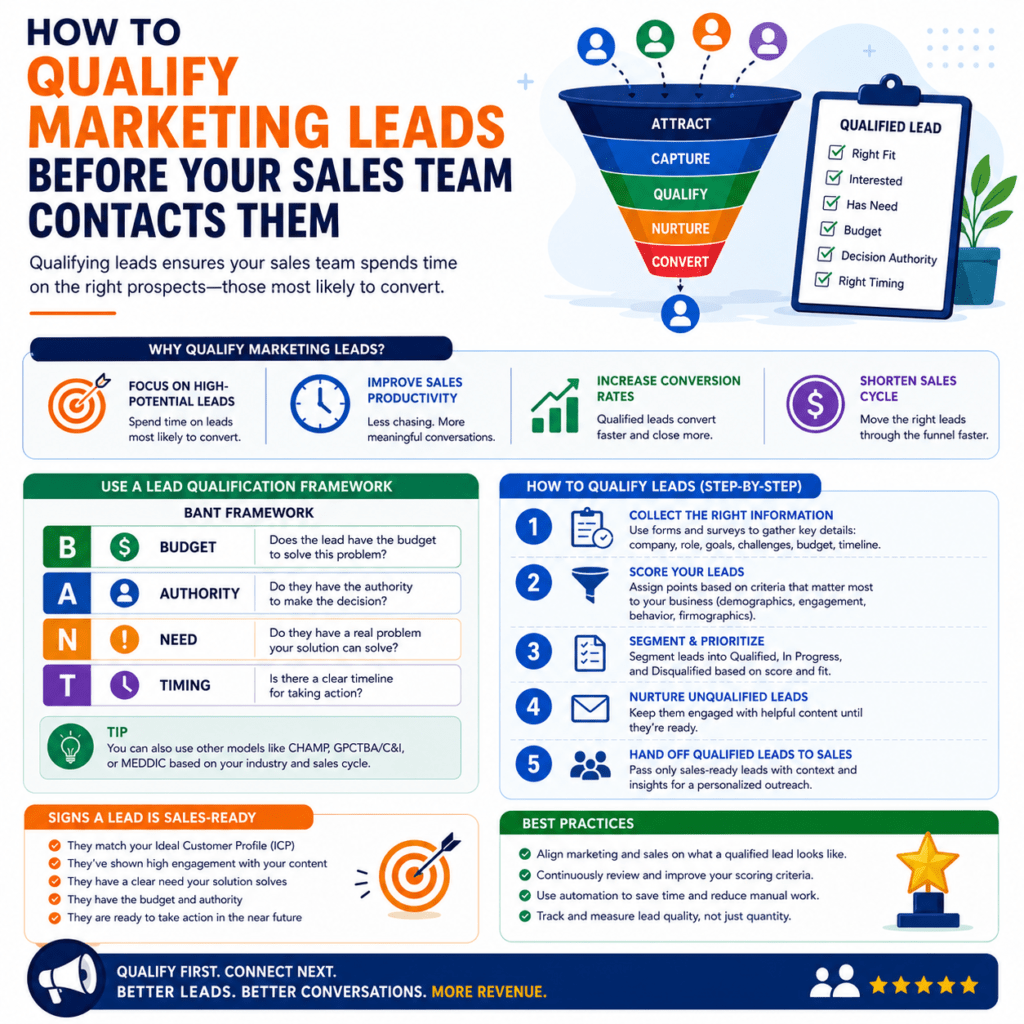
Table of Contents
What Does It Mean to Qualify Marketing Leads?
To qualify marketing leads means evaluating prospects to determine whether they are a suitable potential customer and whether they are ready for further sales attention.
Qualification can consider:
- Need
- Budget
- Authority
- Timing
- Location
- Business fit
- Buying intent
- Service requirements
The exact criteria depend on the business.
For a dental clinic, location and treatment need may be important.
For a digital marketing agency, business size, marketing goals, budget, website condition, and decision making authority may matter.
For a real estate business, property preference, budget, location, financing, and buying timeline may be relevant.
Why Lead Qualification Matters
Sales teams have limited time.
If representatives spend most of their day speaking with people who are unlikely to purchase, productive sales opportunities can be missed.
A qualification system can help:
- Prioritize high quality leads
- Improve sales productivity
- Reduce wasted follow up
- Improve conversion rates
- Align marketing with sales
- Improve customer experience
- Create a cleaner sales pipeline
The broader marketing framework in the source material emphasizes that the audience should be understood first and that marketing activity should connect toward a clear business outcome.
Marketing Qualified Leads vs Sales Qualified Leads
These terms are useful for understanding different stages of qualification.
Marketing Qualified Lead
A marketing qualified lead has shown enough interest or fit to be considered a potentially valuable prospect.
For example, they may:
- Download a relevant guide
- Request information
- Repeatedly visit important pages
- Fill out a form
- Engage with high intent content
Sales Qualified Lead
A sales qualified lead has been evaluated further and appears ready for direct sales attention.
For example:
A business owner requests an SEO consultation, confirms their budget, explains their objectives, and wants to start within the next month.
That prospect may deserve immediate sales attention.
Lead Qualification Criteria
A simple qualification framework is:
Need + Fit + Budget + Authority + Timing
Need
Does the prospect actually have the problem your business solves?
Fit
Does the prospect match your ideal customer profile?
Budget
Can they realistically afford the service or product?
Authority
Are they involved in the purchase decision?
Timing
Are they planning to act soon or only researching for the future?
These criteria do not need to be identical for every business.
How to Build a Lead Scoring System
Lead scoring assigns values to characteristics or actions.
For example:
| Qualification Factor | Example Score |
|---|---|
| Matches target industry | +10 |
| Correct location | +10 |
| Requested consultation | +20 |
| Viewed pricing page | +10 |
| Provided business website | +5 |
| Outside service area | −15 |
| No relevant requirement | −20 |
The scores above are only an example.
The important part is consistency.
You can create categories such as:
Hot Lead: 40 points or more
Warm Lead: 25 to 39 points
Cold Lead: Below 25 points
The thresholds should be based on your own historical data.
Questions to Ask
Your lead form can help collect useful qualification information before sales gets involved.
Questions may include:
What service are you interested in?
This identifies intent.
What is your estimated budget?
This helps determine fit.
When do you want to start?
This gives timing information.
What is your main business challenge?
This provides context.
What is your website?
This can help assess the current situation before a consultation.
Do not make the form unnecessarily long.
Collect information that actually improves the qualification process.
Using a CRM
A CRM can make lead qualification easier to manage.
You can record:
- Lead source
- Lead score
- Contact details
- Requirements
- Qualification status
- Sales activity
- Follow up date
- Opportunity value
- Final outcome
This allows marketing and sales teams to work from the same information.
A simple pipeline might be:
New Lead → Qualified → Sales Contacted → Proposal → Negotiation → Won or Lost
How Marketing and Sales Should Work Together
Lead qualification should not become a battle between marketing and sales.
Marketing should define what a qualified lead looks like with input from sales.
Sales should provide feedback on lead quality.
For example:
Marketing sends 50 leads.
Sales reviews them.
The team discovers that many are outside the target location.
Marketing updates its targeting.
The next campaign produces fewer but better leads.
This creates a feedback loop.
The source material recommends measuring outcomes and using performance data to decide what to improve, stop, test, or scale.
Common Mistakes
Qualifying Based Only on Budget
Someone with a large budget may still be a poor fit.
Ignoring Timing
A prospect may be valuable but not ready.
Asking Too Many Questions
Excessive forms can reduce conversion.
Using the Same Criteria for Every Lead
Different services and customer segments require different qualification standards.
Not Updating Qualification Rules
Customer behavior changes. Review your qualification criteria regularly.
Focusing on Lead Quantity
A smaller number of highly qualified prospects may produce more revenue than a large number of weak leads.
Practical Example
Imagine Native Linkage generates enquiries for digital marketing services.
A basic qualification process could ask:
What service do you need?
What is your monthly marketing budget?
What is your current website?
What result are you trying to achieve?
When do you want to start?
A prospect requesting an SEO strategy, operating a relevant business, having a realistic budget, and wanting to start immediately may be prioritized.
Someone with no clear business need and no intention to invest may receive educational follow up instead.
This saves sales time without automatically rejecting the person.
Frequently Asked Questions
What does it mean to qualify marketing leads?
To qualify marketing leads means evaluating prospects based on factors such as need, fit, budget, authority, timing, and buying intent to determine whether they should move to the next sales stage.
What is an MQL?
A Marketing Qualified Lead is a prospect that has demonstrated enough interest or fit to be considered potentially valuable by the marketing process.
What is an SQL?
A Sales Qualified Lead is a prospect that has been evaluated further and is considered ready for direct sales attention.
How can I qualify marketing leads automatically?
You can use lead forms, CRM rules, lead scoring, automation, website behavior, and marketing platform data to assign qualification criteria.
What is the most important qualification factor?
There is no single universal factor. Need, fit, timing, budget, and authority can all matter depending on the business.
Should every lead be contacted by sales?
Not necessarily. Low intent or poor fit leads may be better suited to nurturing before receiving direct sales attention.
Conclusion
Learning how to qualify marketing leads helps businesses focus their sales resources on prospects who are more likely to become valuable customers.
The process starts with understanding your ideal customer.
Then define qualification criteria around need, fit, budget, authority, timing, and buying intent.
Use forms, lead scoring, CRM data, and marketing behavior to create a consistent system. Most importantly, keep communication between marketing and sales open so that the definition of a quality lead improves over time.
The objective is not to create the fewest leads.
It is to create a healthier pipeline filled with prospects who have a genuine need, appropriate fit, and realistic potential to become customers.