
Top 10 Social Media Growth Strategies for Brands
Practical ways to build an audience, improve engagement, and turn social media into a useful business channel
Introduction
Social media can help a brand reach thousands of people, but getting noticed is only one part of the job. The real challenge is getting people to remember your brand, engage with your content, and eventually become customers.
That is why having the right social media growth strategies matters.
Many brands post regularly but still struggle to grow. Usually, the problem is not a lack of content. It is a lack of direction. Posting without understanding your audience, changing your content style every week, or focusing only on followers can make social media feel like a lot of work with very little return.
A better approach is to have a clear strategy, create content people actually care about, and use your results to improve over time.
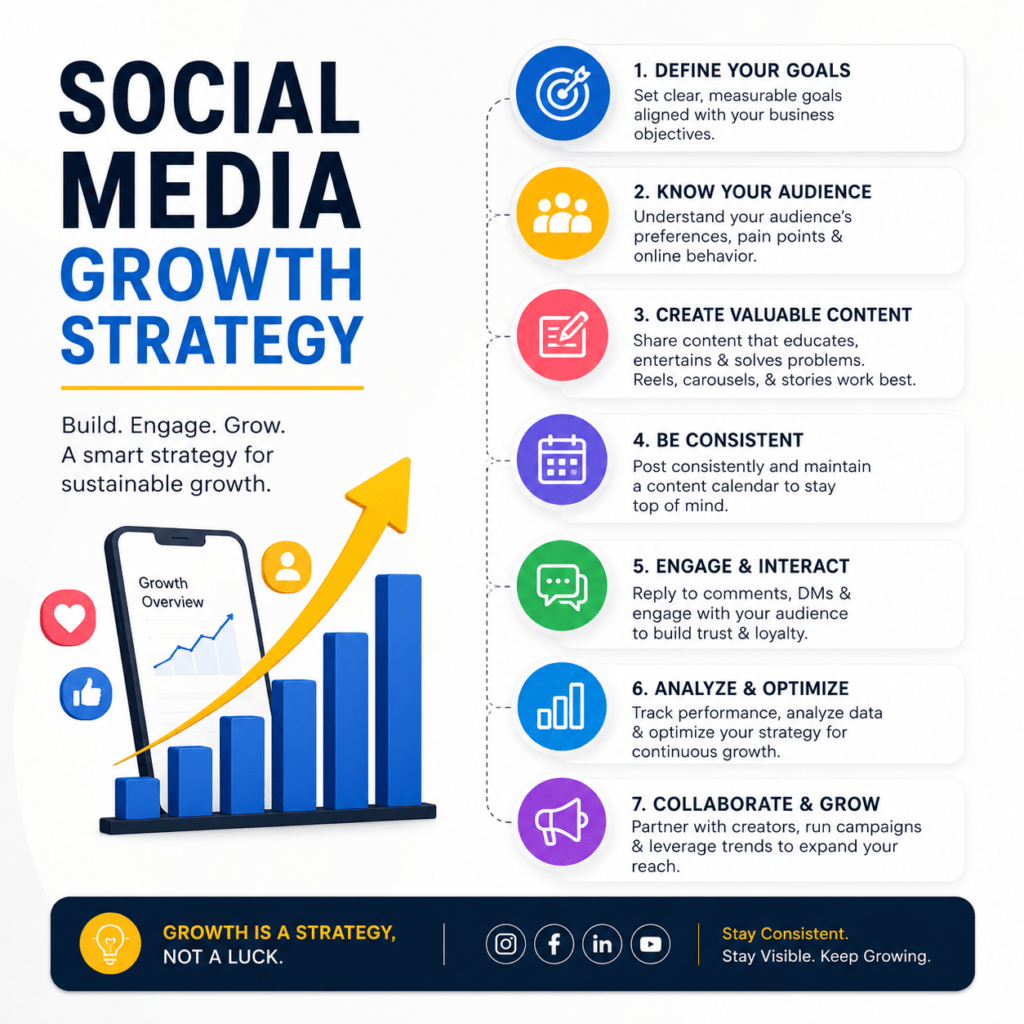
Here are 10 practical social media growth strategies that brands can start using.
1. Know Your Target Audience
Before trying to grow, know who you are trying to reach.
A fashion brand, dental clinic, real estate company, and software business cannot use the same content strategy. Their customers have different problems, interests, buying habits, and reasons for following a brand.
Start by understanding:
| What to Understand | Example |
|---|---|
| Age group | 18 to 30 |
| Location | Mumbai |
| Main problem | Finding affordable skincare |
| Interests | Beauty, fashion, self care |
| Buying concern | Price and trust |
| Preferred content | Reels and reviews |
Once you understand your audience, creating content becomes much easier.
Instead of asking, “What should I post today?” you can ask, “What would my audience actually find useful today?”
That small change can improve your entire social media strategy.
2. Create Content With a Clear Purpose
Every post does not need to sell something.
In fact, constantly selling can make people stop paying attention.
A strong content strategy usually includes different types of content.
| Content Type | Purpose |
|---|---|
| Educational | Teach something useful |
| Entertaining | Get attention |
| Inspirational | Create an emotional connection |
| Social proof | Build trust |
| Promotional | Drive sales |
| Behind the scenes | Show the human side of the brand |
For example, a dental clinic can post a simple explanation of why sensitivity happens, a patient review, a dentist introduction, a common dental mistake, and then a service related post.
The goal is to create a healthy mix instead of turning every post into an advertisement.
3. Focus on Short Form Video
Short form video has become one of the most useful content formats for brands.
Platforms such as Instagram, YouTube, and TikTok are built around quick video consumption. A simple 20 second video can sometimes communicate more than a long caption.
But creating videos does not mean every Reel needs a huge production setup.
A useful video can be:
“3 mistakes people make before buying a car.”
“Why your website gets visitors but no enquiries.”
“Things I wish I knew before starting my business.”
The important part is the idea.
Start with a strong first few seconds, deliver one clear message, and avoid unnecessary information.
4. Build a Consistent Content Style
People should be able to recognize your content without checking the username.
This does not mean every post needs to look exactly the same. It means your brand should have some consistency in its visual and communication style.
Think about:
Typography
Photography style
Colors
Tone of voice
Editing style
Types of topics
Posting format
For example, a premium clothing brand may use clean visuals and minimal captions, while a local food brand may use more casual videos and conversational content.
Consistency helps people understand what your brand represents.
5. Make Your Content Easy to Share
Likes are useful, but shares can be even more valuable for growth.
Think about the content you personally send to friends. It is usually something useful, funny, relatable, surprising, or highly relevant.
Create content that makes people think:
“I should send this to someone.”
Examples include:
“Send this to someone starting a business.”
“Save this before your next interview.”
“Tag someone who needs to see this.”
But do not force these lines into every post. The content itself should be worth sharing.
A useful rule is simple:
Create something people would want to keep or send.
6. Talk With Your Audience
Social media is not just a publishing platform.
It is a place where people can talk to your brand.
Reply to comments. Answer questions. Respond to messages. Ask for opinions. Use polls and question stickers. Notice what people repeatedly ask.
These conversations can also become content ideas.
Suppose ten customers keep asking the same question.
That is probably not just a customer service issue. It may be a content opportunity.
Turn that question into a Reel, carousel, story, FAQ, or blog post.
Your audience can tell you what they want to learn. You just need to pay attention.
7. Use Trends Carefully
Trends can help your content reach more people, but blindly following every trend is not a strategy.
A trending audio may be popular today and forgotten next week.
The better approach is to ask:
Can this trend fit my brand?
A serious B2B company may not need to copy a random dance trend. A fashion brand, however, may be able to use the same trend creatively to showcase a product.
Use trends as a format or opportunity, not as your entire content strategy.
Your brand should still have its own voice.
8. Work With the Right Creators
Influencer and creator collaborations can help brands reach existing communities.
But follower count should not be the only thing you look at.
A creator with 20,000 highly relevant followers may be more useful than someone with 500,000 followers who has no connection with your target audience.
Before working with a creator, look at:
Audience relevance
Engagement quality
Content style
Previous brand collaborations
Audience location
Comments and community interaction
The right creator should feel natural for your brand.
The goal is not simply to get exposure. It is to reach people who may genuinely care about what you offer.
9. Track the Metrics That Matter
Growing on social media is not only about gaining followers.
You need to understand what those followers are doing.
Some useful metrics include:
| Metric | What It Tells You |
|---|---|
| Reach | How many people saw your content |
| Saves | Whether people found it useful |
| Shares | Whether people found it worth passing on |
| Engagement | How people interacted with it |
| Profile visits | Whether content created interest |
| Website clicks | Whether people took the next step |
| Leads | Whether social activity created business opportunities |
| Sales | Whether social media influenced revenue |
For example, a post with 5,000 views and 150 saves may be more valuable for your brand than a post with 30,000 views and almost no meaningful interaction.
Do not look at numbers separately from your business goal.
10. Test, Learn, and Improve
Your first strategy probably will not be perfect.
That is normal.
The brands that grow consistently are usually the ones that keep learning from their content.
Test different:
Hooks
Topics
Video lengths
Posting formats
Captions
Calls to action
Creative styles
Then compare the results.
Suppose educational Reels consistently perform better than promotional posts. That gives you useful information.
Create more educational content.
The goal is not to guess what works forever. The goal is to find patterns and improve your strategy based on actual results.
A Simple Social Media Growth Framework
You can make the process easier by following this basic framework:
Understand → Create → Publish → Engage → Measure → Improve
First, understand your audience.
Then create useful content for them.
Publish consistently.
Engage with the people who respond.
Measure the results.
Then improve what you are doing.
This creates a much stronger system than simply posting whenever you have an idea.
Common Social Media Growth Mistakes
Even a good strategy can fail when basic mistakes are repeated.
Posting only promotional content
People do not follow brands just to see advertisements.
Chasing followers
A large audience is not useful when nobody is interested in your product or service.
Copying competitors
Your competitor’s strategy may work because of their audience, positioning, or brand. Copying their posts does not mean you will get the same results.
Changing strategy too quickly
One bad post does not mean your entire strategy is wrong.
Ignoring comments
Comments can contain questions, objections, ideas, and even potential leads.
Focusing only on views
Views show reach, but they do not always show business value.
Best Practices for Better Social Media Growth
Keep your strategy simple.
Choose a clear target audience.
Have a few strong content pillars instead of trying to talk about everything.
Create content that teaches, entertains, or helps people make better decisions.
Use consistent branding.
Reply to your community.
Review your analytics regularly.
Most importantly, give your strategy enough time to produce useful patterns.
Frequently Asked Questions
The most useful strategies include defining a clear audience, creating helpful content, maintaining consistency, using short form video, engaging with customers, analyzing performance, and connecting social media activity with business goals.
There is no universal number. A brand should choose a posting schedule it can maintain without reducing content quality. Consistency is generally more useful than posting heavily for a short period.
Small businesses can focus on local content, customer stories, educational posts, short videos, community engagement, and strong profile optimization. Their local connection can become a major advantage.
Neither metric should be viewed alone. Businesses should connect social media performance with meaningful outcomes such as enquiries, website visits, bookings, store visits, and sales.
Yes, when used with a clear objective. Paid campaigns can help brands reach specific audiences, while organic content helps build credibility and ongoing engagement.
Conclusion
Effective social media growth strategies for brands are not about finding one perfect posting trick. Sustainable growth comes from understanding your audience, producing useful content, staying consistent, building relationships, and measuring what actually contributes to business results.
For a restaurant, that may mean more reservations. For a coaching institute, it may mean more enquiries. For a local business, it may simply mean becoming the first name people remember when they need a particular product or service.
Start with one clear audience, one measurable goal, and a content system you can maintain. Then improve based on what your audience tells you through its behavior.