
Performance Marketing vs Organic Marketing: Which Is Better for Your Business?
Introduction
If you run a restaurant, cafe, coaching institute, hotel, or small local business, one question comes up often: should you spend money on advertising or focus on organic growth?
Understanding performance marketing vs organic marketing makes this decision much easier. Performance marketing focuses on measurable actions such as clicks, leads, bookings, and sales. Organic marketing builds visibility through content, SEO, social media, referrals, and other unpaid channels.
Both can work well. The better choice depends on your budget, business goals, competition, and how quickly you need results.
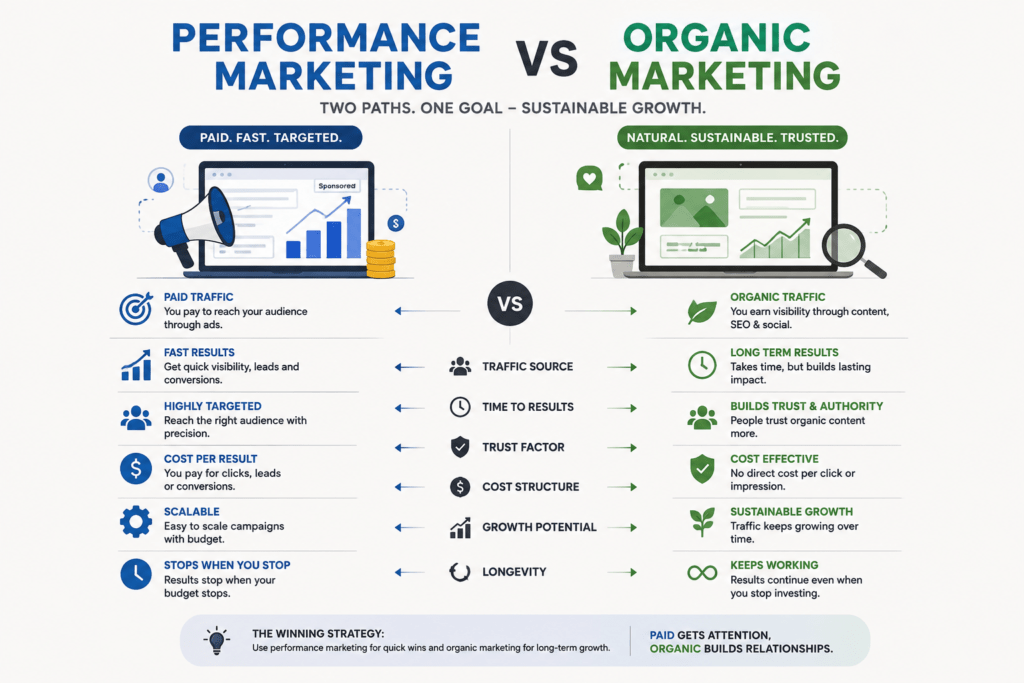
Table of Contents
- What Is Performance Marketing?
- What Is Organic Marketing?
- Performance Marketing vs Organic Marketing
- Which Strategy Should Your Business Choose?
- Common Mistakes to Avoid
- FAQs
- Conclusion
What Is Performance Marketing?
Performance marketing is a paid marketing approach where campaigns are measured against specific business outcomes.
For example, a restaurant may run Meta ads promoting weekend offers and track how many people visit its website, call the restaurant, or place an order.
Common performance marketing channels include:
| Channel | Common Goal |
|---|---|
| Meta Ads | Leads, sales, bookings |
| Google Ads | Search traffic and conversions |
| Display Ads | Awareness and remarketing |
| YouTube Ads | Reach and consideration |
The major advantage is measurability. You can see how much was spent and compare it with the results generated.
For a coaching institute, for instance, spending ₹10,000 on Google Ads and receiving 40 enquiries gives the business a starting point for calculating its cost per lead.
2. What Is Organic Marketing?
Organic marketing attracts people without directly paying for every click or impression.
SEO, useful blog content, Instagram content, Google Business Profile activity, referrals, email content, and educational videos can all contribute to organic growth.
Consider a cafe that regularly publishes useful content about its menu, location, customer experience, and special events. Over time, this content can help people discover the business without the cafe paying for every visit.
Organic growth usually takes longer, but its benefits can continue after the original content has been published.
3. Performance Marketing vs Organic Marketing
The biggest difference is how traffic and results are generated.
| Factor | Performance Marketing | Organic Marketing |
| Investment | Requires advertising budget | Mainly requires time and content effort |
| Speed | Usually faster | Usually slower |
| Measurement | Highly measurable | Measurable, but attribution can be harder |
| Long term value | Depends on continued campaigns | Can build lasting visibility |
| Best for | Leads, sales, bookings | Trust, visibility, authority |
This is where Paid Marketing Vs Unpaid Marketing becomes an important business decision.
A hotel launching a new property may use paid ads to generate bookings quickly while simultaneously building SEO content around destinations, rooms, amenities, and travel questions.
That combination is often more practical than choosing only one approach.
4. Which Strategy Should Your Business Choose?
There is no universal answer.
Choose Performance Marketing When
You need results quickly, have a clear offer, and can measure conversions properly.
A local restaurant running a limited weekend promotion is a good example. Paid ads can put that offer in front of nearby customers immediately.
Choose Organic Marketing When
You want to build long term visibility and authority.
A digital marketing agency, for example, can publish detailed SEO guides and case studies. These may bring relevant visitors months after publication.
Use Both When Possible
For most growing businesses, a combination is sensible.
Paid campaigns can generate immediate traffic while organic marketing builds an audience and search visibility over time. The two approaches can also provide useful data for each other.
5. Common Mistakes to Avoid
One common mistake is running advertisements without tracking conversions. Getting clicks does not automatically mean getting customers.
Another mistake is expecting SEO or social media content to produce major results within a few weeks. Organic growth generally needs consistency.
Businesses should also avoid judging marketing only by likes or impressions. Leads, bookings, revenue, customer quality, and return on investment are much more useful measures.
6. Frequently Asked Questions
Not necessarily. Performance marketing is useful when quick, measurable results are important. Organic marketing is valuable for building long term visibility and trust.
Not completely. You may not pay for every click, but organic marketing requires time, skilled work, content creation, SEO, and regular management.
A small business should choose based on its goal. Paid campaigns can help generate immediate enquiries, while organic marketing can gradually build sustainable visibility.
Yes. Paid search can provide immediate visibility while SEO works toward stronger organic rankings. Data from paid campaigns can also help identify valuable keywords and customer interests.
There is no fixed timeline. Results depend on competition, website quality, content quality, authority, consistency, and the market. SEO often requires patience before meaningful growth appears.
7. Conclusion
The performance marketing vs organic marketing decision is not really about choosing one forever. Performance marketing can help businesses generate measurable results quickly, while organic marketing can build lasting visibility, credibility, and customer relationships.
For many restaurants, cafes, local businesses, coaching institutes, hotels, and entrepreneurs, the strongest approach is to use paid campaigns for immediate opportunities and organic channels for long term growth.
The important part is not simply spending more. It is understanding what you want to achieve, measuring the right outcomes, and improving your strategy based on actual results.