
AI in Digital Marketing Industry: Boon or Bane?
How artificial intelligence is changing marketing, and where businesses still need human judgment.
Introduction
AI in digital marketing has changed how businesses research customers, create content, analyze campaigns, and communicate with audiences. A small business can now complete tasks that once required several hours of manual work.
But there is another side to the story. When businesses depend too heavily on AI, content can become repetitive, inaccurate, or disconnected from real customer needs.
So, is AI a boon or a bane for the digital marketing industry? The honest answer is that it depends on how it is used. AI can improve speed and decision making, but human experience, creativity, judgement, and trust still matter.
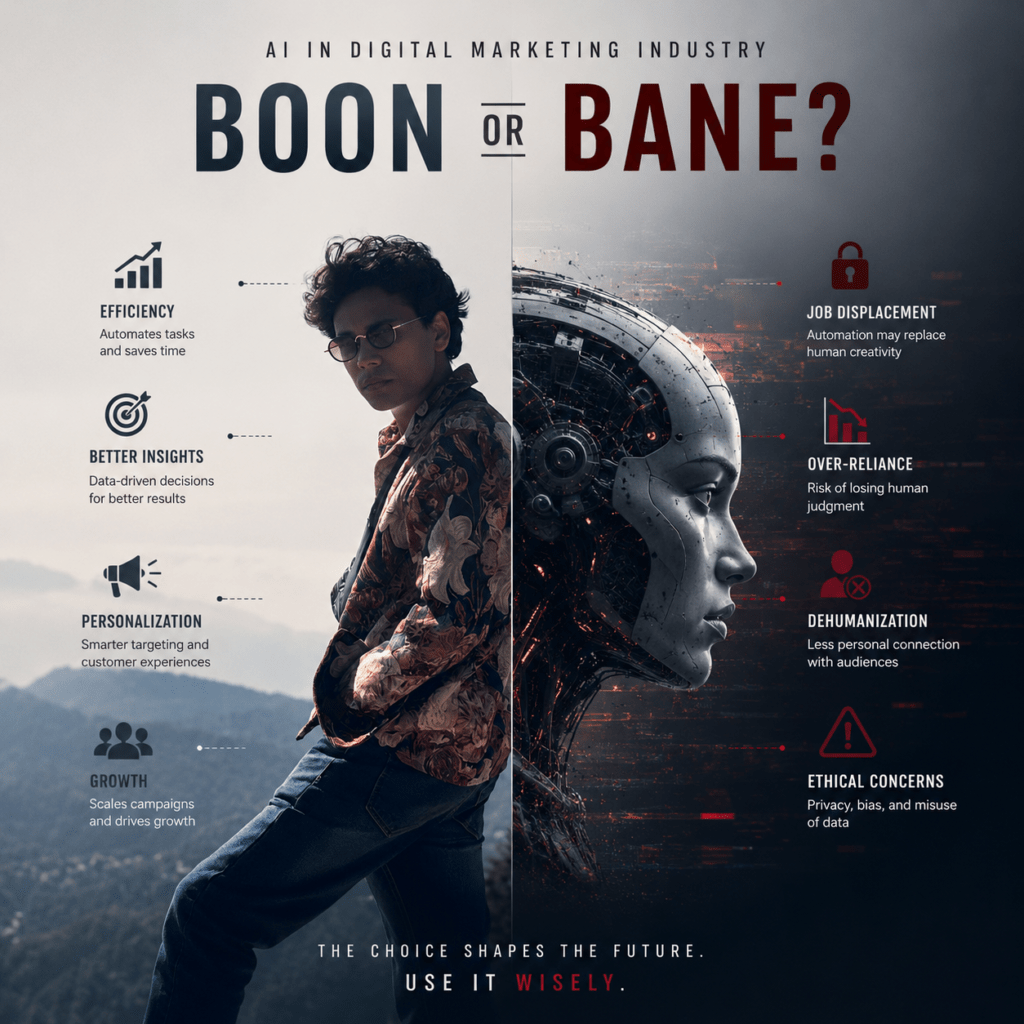
Table of Contents
- What is AI in digital marketing?
- How AI is helping businesses
- Where AI can become a problem
- AI in internet marketing with practical examples
- Best practices for using AI
- Common mistakes businesses should avoid
- Frequently asked questions
- Conclusion
1. What Is AI in Digital Marketing?
AI in digital marketing means using artificial intelligence to assist with tasks such as customer research, content creation, search engine optimization, advertising, analytics, personalization, and automation.
For example, a restaurant can study customer behavior and identify which type of promotion receives more responses. A real estate business can use AI to organize leads and create initial responses for common enquiries.
AI does not necessarily replace the marketer. In most practical situations, it works better as an assistant that helps the marketer make faster and better decisions.
2. How AI Is Helping Businesses
The biggest advantage of AI in Digital Marketing is efficiency.
Faster Content Research and Planning
AI can help marketers generate topic ideas, identify common customer questions, organize content calendars, and create initial drafts.
However, the final content should be reviewed by someone who understands the business. A coaching institute, for example, should add its own teaching experience, student questions, results, and practical examples instead of publishing generic AI generated articles.
Better Data Analysis
Digital marketing produces large amounts of information. AI can help identify patterns in website traffic, advertisements, customer behaviour, and conversions.
This is particularly useful for small businesses that may not have a dedicated analytics team.
Improved Customer Communication
Chatbots and automated responses can handle simple questions about opening hours, pricing, appointments, room availability, or services.
A hotel can answer routine booking questions quickly, while staff can focus on more complicated customer requests.
3. Where AI Can Become a Problem
The biggest risk is not AI itself. The problem starts when businesses stop checking what AI produces.
AI can sometimes provide incorrect information, misunderstand context, or produce content that sounds polished but says very little.
Another concern is originality. If hundreds of businesses use similar prompts and publish similar articles, their websites may struggle to offer anything genuinely useful.
Trust can also suffer when customers realize that every interaction feels automated.
For local businesses, this matters even more. Customers often choose a restaurant, property agent, hotel, or service provider because of personal experience and reputation.
4. Some Practical Examples of AI in Digital Marketing Industry
Consider a local real estate company. AI can help organize leads, summarize enquiries, prepare follow up messages, and analyse which advertising campaigns generate enquiries.
The agent still needs to verify property details, understand the buyer’s requirements, and build the relationship.
The same principle applies to a cafe. AI can suggest content ideas based on seasonal products, but photographs of the actual cafe, customer experiences, staff stories, and genuine reviews provide something automation cannot easily reproduce.
This is where human input becomes the differentiating factor.
5. Best Practices for Using AI
| Business Area | Useful AI Application | Human Responsibility |
|---|---|---|
| SEO | Topic research and content planning | Verify information and search intent |
| Social Media | Content ideas and captions | Maintain authentic brand voice |
| Advertising | Audience and campaign analysis | Make strategic decisions |
| Customer Support | Routine questions | Handle complex conversations |
| Email Marketing | Drafting and personalization | Review tone and accuracy |
| Analytics | Pattern identification | Interpret business meaning |
A simple rule works well: use AI for assistance, not blind decision making.
Always fact check important claims. Add first hand knowledge where possible. Review generated content before publishing. Most importantly, ask whether the content actually helps the customer.
6. Common Mistakes Businesses Should Avoid
One common mistake is publishing AI generated articles without editing them.
Another is using AI to create every social media post without adding real experiences. Businesses should also avoid trusting AI with sensitive customer information without understanding privacy and security implications.
Finally, do not measure AI success by the amount of content produced. Measure outcomes such as qualified leads, useful website visits, enquiries, conversions, customer satisfaction, and revenue.
7. Frequently Asked Questions
Yes. AI can reduce repetitive work and help small teams with research, content planning, analytics, and customer communication.
AI may automate some repetitive marketing tasks, but strategy, creativity, communication, judgement, and understanding customers still require human involvement.
AI generated content can appear in search results when it is useful, accurate, original, and created for people. Simply using AI does not guarantee rankings.
Restaurants can use AI for content ideas, customer analysis, advertising insights, review analysis, and routine customer communication.
No. AI should support business decisions rather than make every decision independently. Human review remains important for accuracy, brand reputation, and customer trust.
8. Conclusion
AI in digital marketing is neither completely a boon nor completely a bane. It is a tool whose value depends on the person using it.
Used thoughtfully, AI can save time, analyze information, support creativity, and help businesses work more efficiently. Used carelessly, it can produce inaccurate information, generic content, weak customer experiences, and a loss of trust.
The strongest approach is simple: let AI handle repetitive work, while people handle judgement, relationships, creativity, and responsibility.
For businesses such as real estate companies, restaurants, cafes, coaching institutes, hotels, and local service providers, that balance can make digital marketing more efficient without making it feel less human.