
Which Is the Best Way to Research About Your Audience?
A practical guide to understanding customer needs, behavior, preferences, and buying decisions before creating your marketing strategy.
Introduction
Good marketing starts with understanding people. Before creating an advertisement, social media campaign, website, or content plan, you need to know who you are trying to reach.
The Best Way to Research About Your Audience is not simply checking their age or location. Effective audience research helps you understand their problems, interests, expectations, buying habits, and reasons for choosing one business over another.
For example, a restaurant may discover that customers care more about affordable combos and quick service than elaborate promotions. A dental clinic may learn that potential patients are mainly concerned about treatment costs and safety.
The Best Way to Research About Your Audience is therefore to collect real information before making marketing decisions.
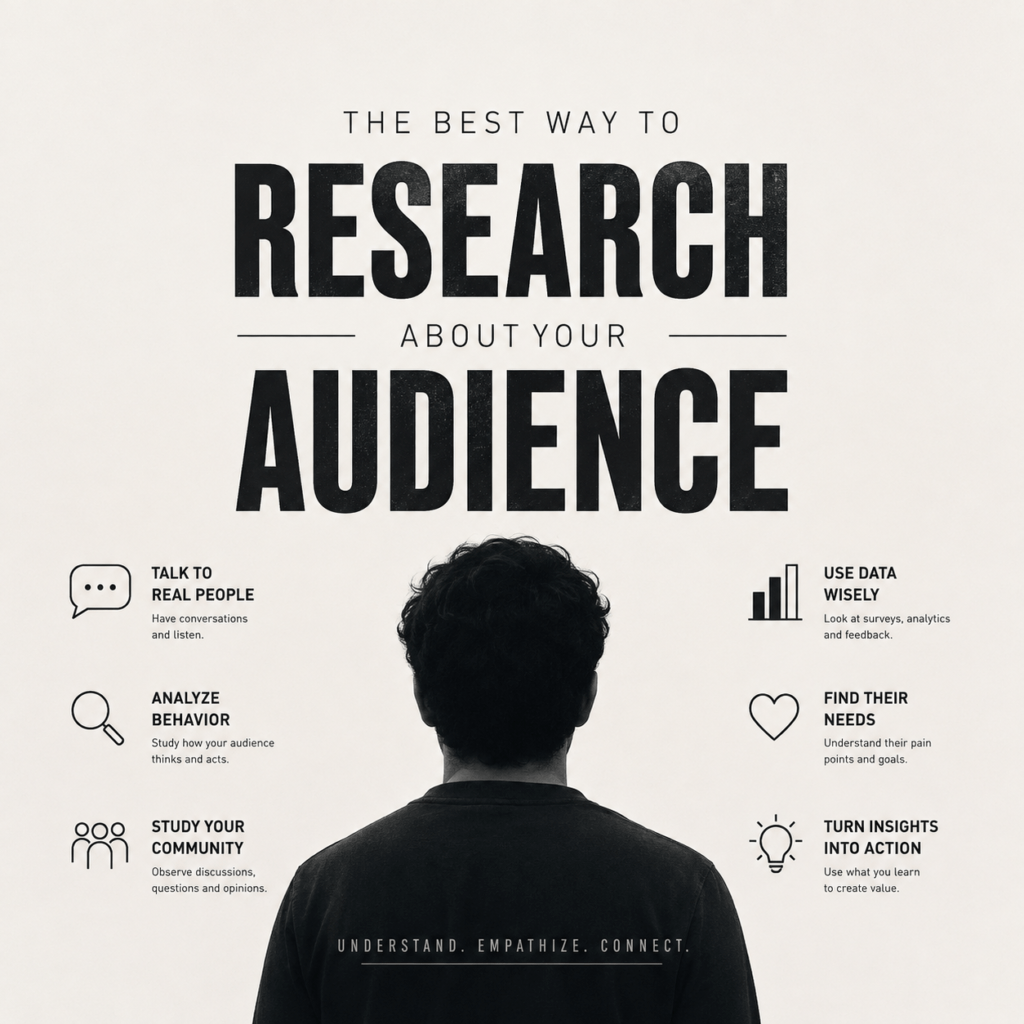
Table of Contents
- What is Audience Research
- Why audience research matters
- The best ways to research your audience
- How to turn research into marketing decisions
- Common audience research mistakes
- Practical audience research framework
- FAQs
1. What Is Audience Research?
Audience research means collecting information about people who are likely to buy your product or use your service.
The Best Way to Research About Your Audience involves understanding:
- Customer needs
- Problems and pain points
- Interests
- Buying behavior
- Budget expectations
- Online habits
- Decision making factors
- Common concerns
The purpose is not to collect unnecessary data. The purpose is to find useful insights that can improve your marketing strategy.
2. Why Audience Research Matters
Audience research helps you answer an important question:
“What does my customer actually care about?”
Without research, businesses often create content based on assumptions. A café may believe customers care mainly about discounts, while customers may actually care about ambience, location, parking, or quiet seating.
| Business | What to Research |
|---|---|
| Real estate | Budget, location, property type, concerns |
| Restaurant | Food preferences, pricing, reviews |
| Café | Ambience, menu, work friendly facilities |
| Coaching institute | Course goals, fees, career expectations |
| Hotel | Travel purpose, facilities, location |
| Local business | Local demand, preferences, buying habits |
3. The Best Ways to Research Your Audience
1. Talk to Existing Customers
Direct conversations are one of the most useful research methods because customers can explain their decisions in their own words.
Ask questions such as:
- What made you choose us?
- What problem were you trying to solve?
- What almost stopped you from buying?
- What did you compare before choosing us?
For example, a real estate company may discover that buyers are not primarily worried about price. They may be more concerned about legal documentation, connectivity, or loan approval.
2. Study Reviews
Reviews reveal what customers genuinely notice after purchasing.
Look at your own reviews and those of competitors. Identify repeated words and complaints.
If several restaurant customers mention portion size, waiting time, or cleanliness, those topics deserve attention in your marketing and operations.
3. Use Search Behaviour
Search engines provide valuable clues about customer intent.
Look for questions people ask about your product or service. A coaching institute might find searches such as “best course after graduation” or “digital marketing course fees.”
These searches tell you what people want to know before making a decision.
4. Observe Social Media
Social media can show what your audience discusses, shares, comments on, and responds to.
Pay attention to comments rather than only follower numbers. A post with fewer views but meaningful questions can reveal more about customer intent than a highly viewed post.
5. Research Competitors
Competitor research is not about copying their content. It is about identifying gaps.
Study their reviews, services, FAQs, content topics, offers, and customer complaints. If competitors repeatedly receive complaints about slow communication, providing faster and clearer communication can become part of your positioning.
4. How to Turn Research Into Marketing Decisions(Click Here)
Research becomes useful when you convert observations into actions.
| Research Finding | Marketing Decision |
| Customers worry about price | Explain value and pricing clearly |
| Customers ask the same question | Create educational content |
| Customers compare alternatives | Create comparison content |
| Customers trust reviews | Showcase genuine customer experiences |
| Customers struggle to understand a service | Simplify your website copy |
A useful approach is to create a simple audience profile containing their needs, problems, motivations, objections, preferred channels, and buying triggers.
For instance, a local café may identify its audience as students and professionals looking for affordable food, comfortable seating, reliable WiFi, and a convenient location. That information can influence its content, offers, website, and social media strategy.
5. Common Audience Research Mistakes
The biggest mistake is assuming that you are the customer.
Another common problem is focusing only on demographics such as age, gender, or location. These details are useful, but they rarely explain the complete buying decision.
Businesses should also avoid relying only on competitor research. Your competitors may target a different customer segment or have completely different business strengths.
Most importantly, audience research should be updated regularly. Customer expectations change, and the information that was useful six months ago may not tell the complete story today.
6. A Practical Audience Research Framework
Use this simple process:
Step 1: Identify your existing customers.
Step 2: Talk to real customers and collect their language.
Step 3: Study reviews and complaints.
Step 4: Analyse search queries and frequently asked questions.
Step 5: Observe social media discussions.
Step 6: Research competitors and identify gaps.
Step 7: Group customers according to common needs.
Step 8: Use these findings to improve your content, offers, website, and advertising.
The goal is not to collect endless information. The goal is to understand enough to make better marketing decisions.
7. Frequently Asked Questions
What is the best way to research about your audience?
The best approach is to combine customer conversations, reviews, search behaviour, social media insights, competitor research, and your own business data.
Why is audience research important in marketing?
It helps businesses understand customer needs and create more relevant content, offers, advertisements, and services.
How can small businesses research their target audience?
Small businesses can start with customer interviews, Google search queries, online reviews, social media comments, competitor research, and sales conversations.
What should I learn about my target audience?
Research their problems, needs, motivations, objections, budget, buying behaviour, preferred communication channels, and reasons for choosing a particular business.
How often should audience research be conducted?
There is no fixed rule, but businesses should review audience insights regularly and whenever they introduce a new product, enter a new market, or notice a change in customer behaviour.
Conclusion
The Best Way to Research About Your Audience is not one particular tool. It is a process that combines real conversations, customer feedback, search behavior, social media insights, and business data.
Start with the people who already interact with your business. Ask better questions, study their behavior, and look for patterns across different sources.
The Best Way to Research About Your Audience is ultimately about replacing assumptions with evidence. Once you understand what your customers genuinely need, your content, advertising, website, and overall marketing strategy can become much more relevant.