
Ahrefs for Beginners: How to Use Keywords Explorer for Smarter SEO Research
Understand keyword difficulty, search volume, traffic potential, SERP analysis, and competitor research with Ahrefs.
Introduction
Keyword research becomes much more powerful when you understand not only what people search for, but also how difficult a topic may be to rank for and what kind of pages currently dominate the results.
That is where Ahrefs becomes useful.
Ahrefs Keywords Explorer provides keyword ideas, search volume, Keyword Difficulty, Traffic Potential, Parent Topic information, SERP analysis, search intent features, and keyword clustering.
For beginners, the platform can seem complicated at first. But once you understand a few core metrics, it becomes much easier to use.
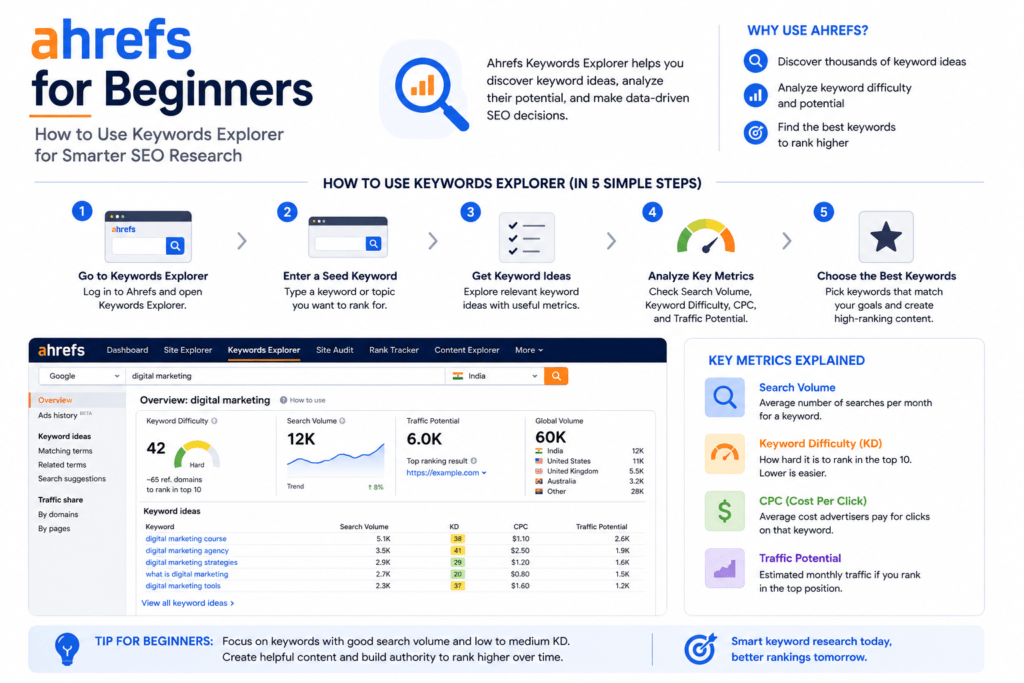
Table of Contents
What Is Ahrefs?
Ahrefs is a broader SEO platform that includes tools for keyword research, competitor analysis, backlink research, technical auditing, rank tracking, and content research.
Its Keywords Explorer focuses specifically on understanding search queries and the competitive landscape around them.
What Is Keywords Explorer?
Keywords Explorer allows you to enter a keyword and investigate the opportunity around it.
For a seed keyword such as:
Digital marketing
you can examine related keyword ideas, search demand, difficulty, traffic potential, SERP results, intent, and related topics.
The platform can also generate thousands of keyword ideas and organize them into related groups.
Understanding Keyword Difficulty
One of the most discussed metrics is Keyword Difficulty.
This tool measures KD from 0 to 100, with higher values representing greater difficulty. Its calculation is primarily based on the referring domains linking to the top ranking pages.
That is useful, but there is an important limitation.
A KD score does not tell you everything about ranking difficulty.
It does not fully capture content quality, search intent, brand strength, technical SEO, or user experience.
This is why you should treat KD as one input rather than the final answer.
Understanding Search Volume
Search volume estimates how often people search for a term in a particular location.
Ahrefs uses a twelve month average for its volume metric and updates volume data periodically.
For a local business, country specific or location specific data is often more useful than global data.
Imagine a dental clinic serving one city. Global search volume for “dentist” may be interesting, but local demand is much more relevant to the business.
Understanding Traffic Potential
A keyword can have search volume without producing as much traffic as expected.
Ahrefs therefore includes a Traffic Potential metric that estimates the traffic the top ranking page receives for a keyword.
This gives you another way to evaluate opportunities.
Suppose one keyword has high volume but the current ranking page receives significant traffic from many related searches. Another keyword may have similar volume but much lower broader traffic potential.
That difference can influence which topic you choose.
SERP Analysis
One of the most useful parts of Ahrefs is looking beyond the keyword metrics and examining the actual search results.
Ask:
- What type of content ranks?
- Are the results mainly guides or service pages?
- Are strong brands dominating?
- How many referring domains do top pages have?
- Does the search intent appear informational or commercial?
Ahrefs provides SERP information that helps users study the pages currently ranking.
This is important because SEO is ultimately about competing with actual pages, not only with a numerical difficulty score.
Competitor Research
Ahrefs can also help you investigate competitors.
You can examine which keywords bring organic traffic to competing websites, identify pages that perform strongly, and discover content gaps.
For example, a real estate company could study another property website and discover that it receives organic traffic for searches about home buying, property investment, and local neighborhoods.
The smart move is not to reproduce the competitor’s pages.
Instead, identify unanswered questions and create something more useful.
Common Mistakes
Treating KD as a Guarantee
A low KD does not guarantee ranking.
Ignoring Search Intent
Always examine the pages that already rank.
Targeting High Volume Keywords Automatically
Business value matters just as much as traffic.
Looking Only at One Keyword
A strong page can rank for many related queries. Ahrefs itself provides topic grouping and Parent Topic information to help with broader content targeting.
Frequently Asked Questions
Ahrefs is used for SEO research including keywords, backlinks, competitors, technical issues, content opportunities, and rankings.
It is Ahrefs’ estimate of how difficult it may be to rank among the top ten Google results for a keyword. Its score ranges from 0 to 100.
Yes, but the platform has many advanced features. Beginners may need some time to understand the metrics and reports.
Traffic Potential estimates the traffic that the top ranking page receives for a target keyword, helping users evaluate opportunities beyond search volume alone.
Yes. Ahrefs can help identify competitors’ organic keywords, pages, backlinks, and other SEO opportunities.
Conclusion
Ahrefs is powerful because it goes beyond basic keyword suggestions.
It helps you understand how competitive a topic is, how much search demand exists, how much traffic a ranking page may receive, and what the current SERP looks like.
The most useful way to approach Ahrefs is not to chase the lowest KD number or the highest search volume.
Look at the whole picture.
When keyword metrics, search intent, SERP analysis, competitor research, and business relevance point in the same direction, you have a much stronger basis for choosing a topic.