
Semrush Keyword Magic Tool: A Beginner's Guide to Smarter Keyword Research
Learn how to discover related keywords, analyze intent, identify long tail opportunities, and build a stronger SEO content strategy.
Introduction
Keyword research becomes difficult when one topic produces hundreds or thousands of possible search terms.
You need a way to organize those ideas, understand what people are searching for, and identify the phrases that match your business.
The Semrush Keyword Magic Tool is designed for exactly this type of research. Semrush says the tool has a database of more than 27 billion keywords and provides keyword ideas, topic groups, search volume, keyword difficulty, search intent, SERP feature information, and filtering options.
For beginners, the key is learning how to use the data without becoming obsessed with every metric.
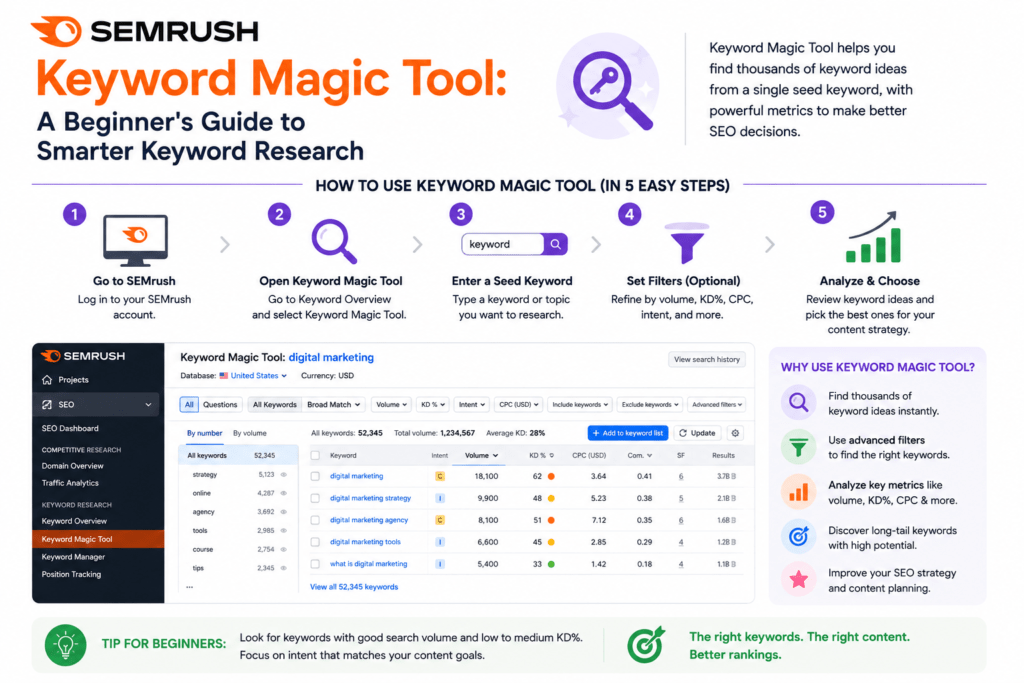
Table of Contents
What Is Semrush Keyword Magic Tool?
The Semrush Keyword Magic Tool is a keyword research feature within Semrush.
You enter a seed keyword, choose a target database, and receive related search terms that can be filtered and organized by different criteria.
For example, if you enter:
Digital marketing
you may uncover keywords about courses, strategies, agencies, tools, jobs, services, social media, SEO, and many other subtopics.
How It Works
A simple workflow is:
Seed keyword → Related keywords → Filters → Intent → SERP review → Keyword selection
The strength of the tool is not merely the number of suggestions.
It is the ability to turn a large group of ideas into a smaller set of meaningful opportunities.
Finding Keyword Ideas
Start with a broad topic connected to your business.
A real estate business could enter:
Real estate
A dental clinic could enter:
Dental clinic
A digital marketing agency could enter:
Digital marketing
The tool can then provide related terms and automatically organize keywords into thematic subgroups.
This can help you discover topics that might otherwise be missed.
Understanding Search Intent
One of the most important filters in the Semrush Keyword Magic Tool is search intent.
A keyword can be informational, navigational, commercial, or transactional.
For example:
What is dental implant treatment
is informational.
Best dental clinic in Delhi
has commercial investigation intent.
Book dental implant consultation
is closer to transactional intent.
The content you create should match that intent.
A user looking for an explanation does not necessarily want to land on a sales page.
Finding Long Tail Keywords
Long tail keywords are specific search phrases that often reveal a clearer need.
For example:
Real estate
is broad.
Best 2 BHK flats for investment in Pune
is more specific.
The Keyword Magic Tool can help discover related long tail terms, which can then be filtered according to volume, difficulty, intent, and other criteria.
For newer websites, these specific searches can sometimes provide more realistic starting points than extremely competitive broad terms.
Using Keyword Groups
The Semrush Keyword Magic Tool automatically organizes related keywords into groups.
This can be extremely helpful when building a content strategy.
Instead of creating a separate page for every tiny keyword variation, you can look for groups of closely related searches that can be answered by one comprehensive page.
That prevents unnecessary content duplication.
Building a Content Strategy
Suppose your main topic is:
Dental implants
Your research may reveal several subtopics:
- Dental implant cost
- Dental implant procedure
- Dental implant recovery
- Dental implant benefits
- Dental implant preparation
- Dental implant alternatives
These can form the foundation of a complete content cluster.
The goal is not to publish because a keyword exists.
The goal is to answer the questions your audience actually has.
7. Measure What Actually Matters
Likes and followers can provide useful signals, but they should not be your only measures of success.
Track metrics that connect to your business goals.
These may include:
- Website visitors
- Search impressions
- Enquiries
- Leads
- Conversion rate
- Cost per lead
- Sales
- Customer retention
Suppose an advertisement receives 100,000 impressions but produces only two enquiries. It may look impressive on a report, but the business result is weak.
Always connect marketing activity to an outcome.
Frequently Asked Questions
What is the Semrush Keyword Magic Tool?
It is a Semrush keyword research tool that helps users discover and analyze related search terms, search volume, difficulty, intent, and SERP features.
Is the Semrush Keyword Magic Tool good for beginners?
Yes, although the large number of features can take time to understand.
Can it find long tail keywords?
Yes. The tool is designed to help users discover related and more specific search queries.
Can I use it for content planning?
Yes. Its keyword groups and topic relationships can help build content clusters and topic plans.
Does Semrush show search intent?
Yes. Search intent is one of the metrics available in the Keyword Magic Tool.
Conclusion
The Semrush Keyword Magic Tool is most useful when you treat keyword research as a decision making process rather than a keyword collection exercise.
Start with a broad topic. Discover related terms. Organize them into groups. Study search intent. Review the actual SERPs. Then select topics that fit your audience and business.
The result should be a focused content strategy rather than a spreadsheet full of keywords.