
What Is Affiliate Marketing? A Complete Beginner’s Guide to How It Works
Understand how affiliate marketing works, how affiliates earn commissions, how businesses benefit, and how to build a trustworthy affiliate strategy.
Introduction
What is affiliate marketing? It is a performance based marketing method where a person or business promotes another company’s product or service and earns a commission when the promotion generates a qualifying action, such as a sale or lead.
The concept sounds simple, but there is much more happening behind an affiliate link. Businesses need to choose suitable partners, create attractive offers, track conversions, manage commissions, and protect customer trust. Affiliates, meanwhile, need to choose relevant products and create content that genuinely helps their audience.
For bloggers, influencers, content creators, website owners, entrepreneurs, and businesses, understanding what is affiliate marketing can open the door to a flexible marketing model that connects recommendations with measurable results.
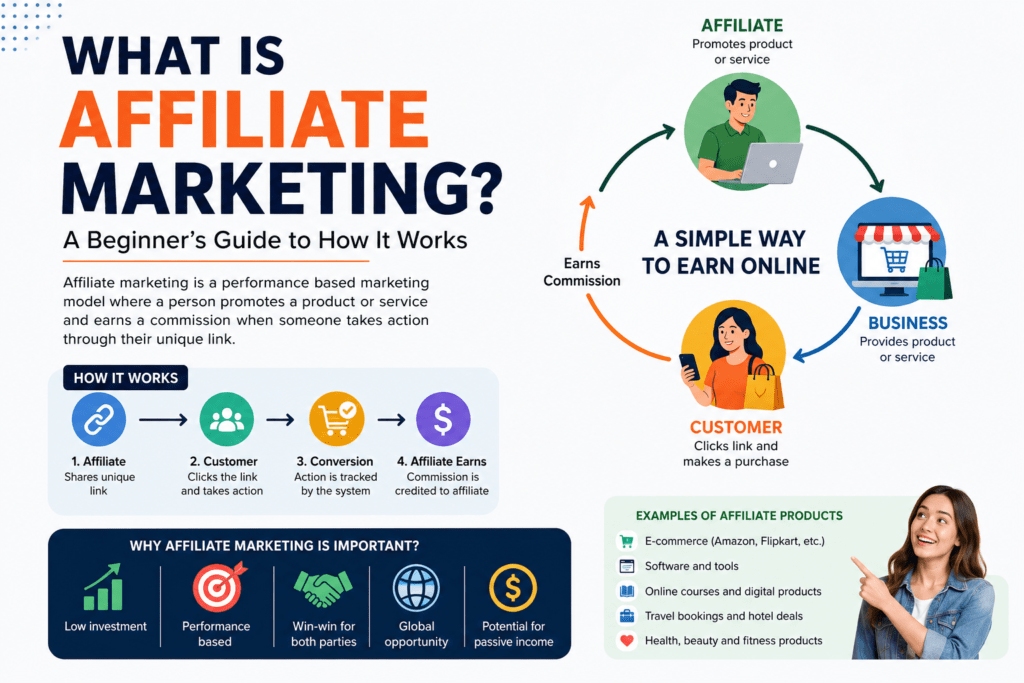
Table of Contents
What Is Affiliate Marketing?
So, what is affiliate marketing in practical terms?
Affiliate marketing is a relationship between a business and an independent promoter. The business provides a product or service, while the affiliate introduces that offer to an audience through content, recommendations, reviews, social media, email, websites, videos, or other channels.
The affiliate normally receives a unique link or tracking code. When a customer completes the required action through that link or code, the affiliate may receive a commission according to the program’s terms.
The action does not always have to be a purchase. Depending on the program, it could be a lead, registration, subscription, application, or another defined conversion.
How Does Affiliate Marketing Work?
Understanding what is affiliate marketing becomes much easier when you see the process.
Brand creates an affiliate program → Affiliate joins → Unique link is provided → Affiliate promotes the offer → Customer clicks → Customer completes an action → Conversion is tracked → Commission is paid
Here is a simple example.
Imagine a software company launches an affiliate program. A digital marketing creator writes an article reviewing the software and includes a unique affiliate link.
A reader finds the article through Google, reads the review, clicks the link, and purchases the software.
The tracking system connects that purchase to the affiliate, and the affiliate receives the agreed commission.
The exact payment structure varies between programs.
How Do Affiliates Earn Money?
A major part of understanding what is affiliate marketing is knowing how commissions work.
An affiliate can earn through several types of arrangements.
Commission Per Sale
The affiliate receives a percentage or fixed amount after a customer purchases something.
Commission Per Lead
The affiliate is paid when a person completes a qualified action, such as submitting an enquiry or registration form.
Recurring Commission
Some subscription businesses offer recurring commissions for customers who remain subscribed, depending on their program terms.
Fixed Referral Payment
Certain businesses may pay a fixed amount for a successful referral instead of using a percentage.
The commission structure should always be understood before an affiliate promotes an offer.
Why Do Businesses Use Affiliate Marketing?
Businesses use affiliate marketing because it can provide access to audiences that they may not reach efficiently through their own channels.
A relevant affiliate may already have:
- A loyal audience
- Industry expertise
- Search visibility
- Social media reach
- An email audience
- A trusted personal brand
For example, a fitness company could work with fitness creators who regularly review workout products. A software company could partner with technology educators. A travel business could work with travel content creators.
The common factor is relevance.
A large audience is not automatically valuable. The audience needs to have a genuine interest in the product.
Affiliate Marketing vs Influencer Marketing
These concepts are related, but they are not identical.
| Affiliate Marketing | Influencer Marketing |
| Compensation is often connected to tracked results | Payment may be fixed for promotional content |
| Uses unique links or codes | May use posts, videos, stories, or other content |
| Strong focus on conversions | Can focus on awareness, engagement, or sales |
| Often performance focused | Often campaign focused |
| Can be long term | Can be short term or campaign based |
A campaign can also combine both.
For example, an influencer may receive an upfront payment for creating a video and also receive commission from sales generated through an affiliate link.
How to Start Affiliate Marketing
If you are a beginner, start with a topic you genuinely understand.
Choose a Specific Niche
Instead of trying to promote everything, focus on a subject where your audience has clear interests.
Build Useful Content
Create reviews, comparisons, tutorials, buying guides, explanations, and practical resources.
Select Relevant Affiliate Programs
Choose products that genuinely fit your audience.
Explain Your Experience Honestly
Do not make claims about products you cannot support.
Track Performance
Monitor clicks, conversions, commission, and revenue so you can understand which content is working.
The strongest affiliate businesses tend to focus on usefulness first and monetization second.
Important Disclosure and Trust Considerations
Transparency is an important part of affiliate marketing.
When an affiliate receives a commission from purchases made through their links, that relationship should be clearly disclosed to readers or viewers. The United States Federal Trade Commission says affiliate relationships should be disclosed clearly and conspicuously, with the disclosure placed close enough to the recommendation or link that consumers can understand the connection.
The FTC also emphasizes that endorsements should reflect honest opinions and should not make misleading claims.
A simple explanation such as “I may earn a commission from purchases made through links in this article” can make the financial relationship clear. Requirements can vary by country and situation, so businesses and creators should follow the rules that apply to them.
Transparency is not just a compliance issue. It also helps protect the relationship between a creator and their audience.
Frequently Asked Questions
It is used by businesses to reach new audiences and by affiliates to monetize relevant content, recommendations, and online traffic.
Yes. Beginners can start by choosing a specific topic, building useful content, finding relevant affiliate programs, and learning how tracking and commissions work.
They are closely related, but the exact structure can differ. Affiliate programs commonly use tracked links and commissions, while referral programs may use customer focused incentives or other reward structures.
Yes. Influencers can use affiliate links, discount codes, or other tracking methods to earn commissions from products they recommend.
Conclusion
So, what is affiliate marketing at its core?
It is a performance based relationship that connects a business, an affiliate, and a customer through a measurable recommendation.
For businesses, it can provide access to new audiences and create another customer acquisition channel. For creators, bloggers, influencers, and niche publishers, it can create a way to monetize useful content without developing their own products.
But the strongest affiliate strategies are not built around links alone. They are built around relevance, honest recommendations, useful information, proper tracking, and audience trust.
When creators recommend products they genuinely believe are useful and businesses work with the right partners, affiliate marketing can become a valuable part of a broader digital marketing strategy.