
Why Is My Website Getting Traffic but No Leads? 10 Reasons and How to Fix Them
A practical guide to finding out why visitors are not converting and how to turn website traffic into qualified leads, enquiries, and business opportunities.
Introduction
Getting visitors to your website is a good sign. But what happens when people are arriving, reading your content, and leaving without filling out a form, calling your business, booking an appointment, or making a purchase?
This is a common problem behind the question, why is my website getting traffic but no leads?
The issue is often not traffic itself. Your website may be attracting the wrong audience, failing to communicate its value, creating too much friction, or making the next step unclear.
A real estate website, dental clinic, digital marketing agency, freelancer, or local business can all face this problem.
The solution is to look beyond traffic and examine the complete journey from the first visit to the desired action.
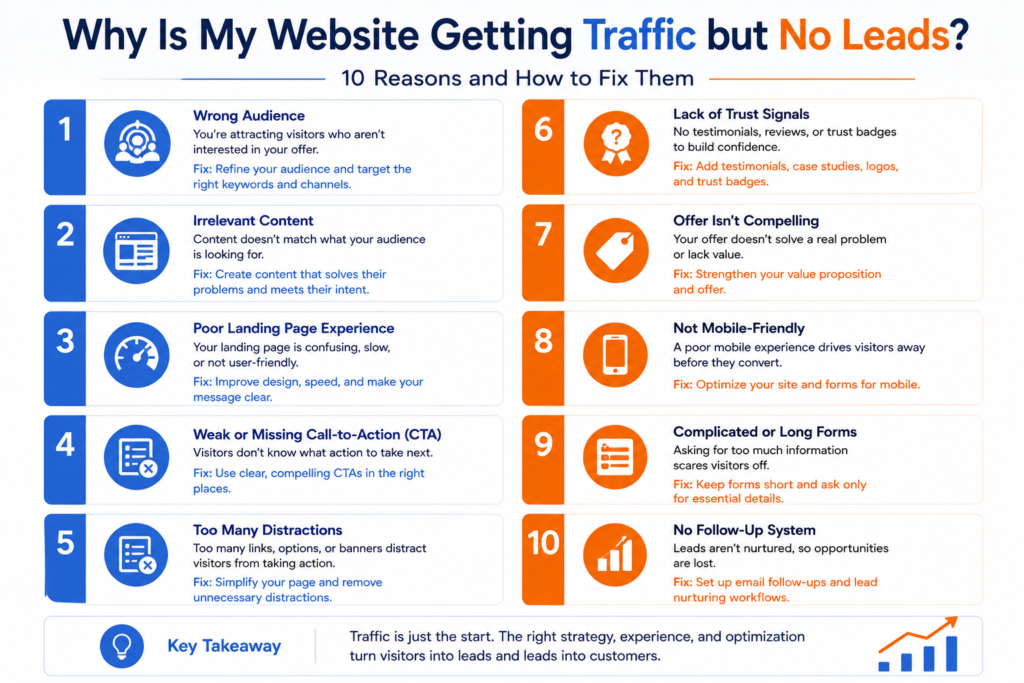
Table of Contents
1. Why Website Traffic Does Not Always Produce Leads
Traffic and leads are two different outcomes.
Traffic tells you that people are visiting your website.
A lead means that someone has taken a meaningful action, such as submitting an enquiry, requesting a quote, booking an appointment, calling your business, or starting a sales conversation.
This means a website can receive substantial traffic while generating very few leads.
| Situation | What It May Indicate |
|---|---|
| High traffic, low leads | Conversion problem |
| Low traffic, high conversion rate | Audience may be relevant |
| High traffic, low engagement | Poor relevance or content |
| High landing page visits, low form submissions | Friction or weak offer |
| High enquiries, low sales | Lead quality or sales problem |
The first step is identifying where the problem actually exists.
2. Your Website May Be Attracting the Wrong Audience
One of the most overlooked reasons for website getting traffic but no leads is poor audience targeting.
Imagine a dental clinic receives visitors from searches such as “how to brush your teeth properly.”
The article may generate significant traffic, but most visitors are looking for general information rather than trying to book a dental appointment.
The traffic is real.
The problem is that the commercial intent is weak.
Review:
- Search queries
- Traffic sources
- Location
- Landing pages
- Audience demographics
- Search intent
You may discover that your website is attracting people who are interested in your topic but are not suitable potential customers.
3. Your Offer Is Not Clear
Visitors should understand what you offer quickly.
If someone reaches your website and still cannot answer:
What does this business do?
Who is it for?
Why should I choose it?
then the page needs clearer communication.
Avoid vague statements such as:
“We help businesses grow online.”
A clearer message could explain the service, audience, and benefit.
For example:
“SEO and digital marketing services for small businesses looking to generate more qualified enquiries.”
Specificity makes the offer easier to understand.
4. Your Call to Action Is Weak
A visitor may be interested but still do nothing because the next step is unclear.
A website should make the desired action obvious.
Instead of relying only on:
Learn More
consider actions such as:
- Book a Consultation
- Request a Free Audit
- Get a Quote
- Schedule an Appointment
- Talk to Our Team
- Request a Callback
The CTA should match the visitor’s stage in the customer journey.
Someone researching a service may not be ready to buy immediately, but they may be willing to download a useful guide or request more information.
5. Your Landing Page Has Too Much Friction
A landing page should make it easy for visitors to take the intended action.
Common problems include:
- Too many form fields
- Confusing navigation
- Weak headlines
- Long blocks of text
- Unclear pricing
- Slow loading
- Too many competing CTAs
- Missing trust information
For example, a business asking for 12 pieces of information before allowing someone to request a consultation may be creating unnecessary friction.
Ask for the information you genuinely need.
6. Your Website Is Not Building Enough Trust
People may hesitate to submit their information because they are uncertain about your business.
Trust can come from:
- Testimonials
- Reviews
- Case studies
- Client results
- Professional credentials
- Clear contact information
- Transparent service details
- Relevant experience
- Useful educational content
A dental clinic can show qualifications, patient reviews, treatment information, and location details.
A real estate company can provide market knowledge, property expertise, customer testimonials, and transparent processes.
A digital marketing agency can demonstrate previous work and measurable outcomes.
Trust is especially important when the visitor is considering a service that involves money, time, or personal information.
7. Your Content Does Not Match Search Intent
A visitor may land on the correct website but still find the wrong type of content.
Suppose someone searches:
“What is SEO?”
They probably want an explanation.
Now compare that with:
“SEO agency for small business”
That person is much closer to evaluating a service.
If you send both visitors to the same aggressive sales page, one group may leave because the page does not match what they wanted.
Create content for different stages of the customer journey.
| Search Intent | Suitable Content |
|---|---|
| Informational | Guides and educational blogs |
| Commercial | Comparisons and service information |
| Transactional | Service and product pages |
| Local | Location pages and local service content |
8. Your Website Experience Is Poor
Sometimes the problem is not the offer at all.
It may be the website experience.
Check:
- Mobile usability
- Page speed
- Navigation
- Readability
- Button visibility
- Broken links
- Form usability
- Visual hierarchy
Imagine someone searching for a dentist on their phone.
They find your website, but the appointment button is difficult to locate and the page loads slowly.
That visitor may leave before contacting you.
A website needs to make the path to the next action simple.
9. Your Lead Form Is Too Complicated
Forms are often treated as a minor website element, but they can have a major effect on lead generation.
Consider the difference between:
Name + Phone + Email
and:
Name + Phone + Email + Address + Company Size + Budget + Job Title + Industry + Detailed Message + Multiple Dropdowns
The second form may collect more information, but it also requires more effort.
Ask only for what is necessary at that stage.
You can collect additional information later during a sales conversation.
10. You Are Measuring the Wrong Things
A common mistake is assuming more traffic automatically means better marketing.
It does not.
You should also monitor:
- Conversion rate
- Qualified leads
- Cost per lead
- Landing page performance
- Form completion
- Phone calls
- Appointment bookings
- Sales generated
- Lead quality
The goal is not simply to bring more visitors.
The goal is to bring the right visitors and give them a clear reason to take action.
How to Fix a Website Getting Traffic but No Leads
Start with a simple diagnostic process.
Step 1: Identify Your Best Traffic Sources
Find out which channels and search queries produce your visitors.
Step 2: Identify Your Highest Traffic Pages
Determine which pages attract the most people.
Step 3: Check Conversion Performance
Compare visitors with enquiries and conversions.
Step 4: Review Search Intent
Ask whether the people reaching each page actually need the service you offer.
Step 5: Improve the Offer
Make your value proposition clear and specific.
Step 6: Strengthen CTAs
Tell visitors exactly what they should do next.
Step 7: Reduce Friction
Simplify forms, navigation, and the overall conversion process.
Step 8: Add Trust
Use genuine reviews, case studies, credentials, examples, and useful information.
Step 9: Test Changes
Use A/B testing where enough traffic and conversions exist to produce meaningful comparisons.
Step 10: Measure Business Results
Track qualified leads, conversions, cost per acquisition, and revenue rather than focusing only on traffic.
Practical Example
Imagine a local dental clinic receives 10,000 monthly website visitors but only 15 enquiries.
The clinic analyzes its traffic and discovers that most visitors arrive through informational blog posts.
The service pages, however, receive relatively little traffic.
The business could improve its strategy by:
- Adding relevant internal links from blogs to service pages
- Creating stronger appointment CTAs
- Adding local service information
- Improving treatment pages
- Adding genuine patient reviews
- Making appointment forms simpler
- Creating content for commercial search intent
The goal is not simply to increase the 10,000 visitors.
It is to improve the journey from information to enquiry.
Conclusion
When you ask, why is my website getting traffic but no leads, the answer is rarely as simple as “you need more traffic.”
The real issue may be audience quality, search intent, unclear messaging, weak CTAs, poor trust signals, complicated forms, or a difficult customer journey.
Start by identifying where visitors come from and what they are trying to accomplish. Then look at what happens after they arrive.
A successful website does more than attract visitors.
It helps the right visitors understand the offer, trust the business, and take a clear next step.
That is the difference between a website that simply receives traffic and one that contributes to business growth.