
How to Perform a Complete SEO Content Audit: A Practical Step by Step Guide
Learn how to review your website content, identify outdated or underperforming pages, fix content gaps, improve search intent alignment, and build a stronger SEO strategy.
Introduction
Publishing content consistently is only one part of SEO. Over time, a website can accumulate outdated articles, pages with little traffic, duplicate topics, weak internal links, and content that no longer matches what users are searching for.
This is where an SEO Content Audit becomes valuable.
An SEO Content Audit is a systematic review of your website content to understand what is performing well, what needs improvement, what should be updated, and what may no longer deserve to remain published.
For a small business, real estate company, dental clinic, doctor, influencer, or digital marketing agency, a content audit can uncover opportunities that are easy to miss when you only focus on publishing new articles.
The goal is not to change every page.
The goal is to understand what your existing content is doing and make better decisions based on evidence.
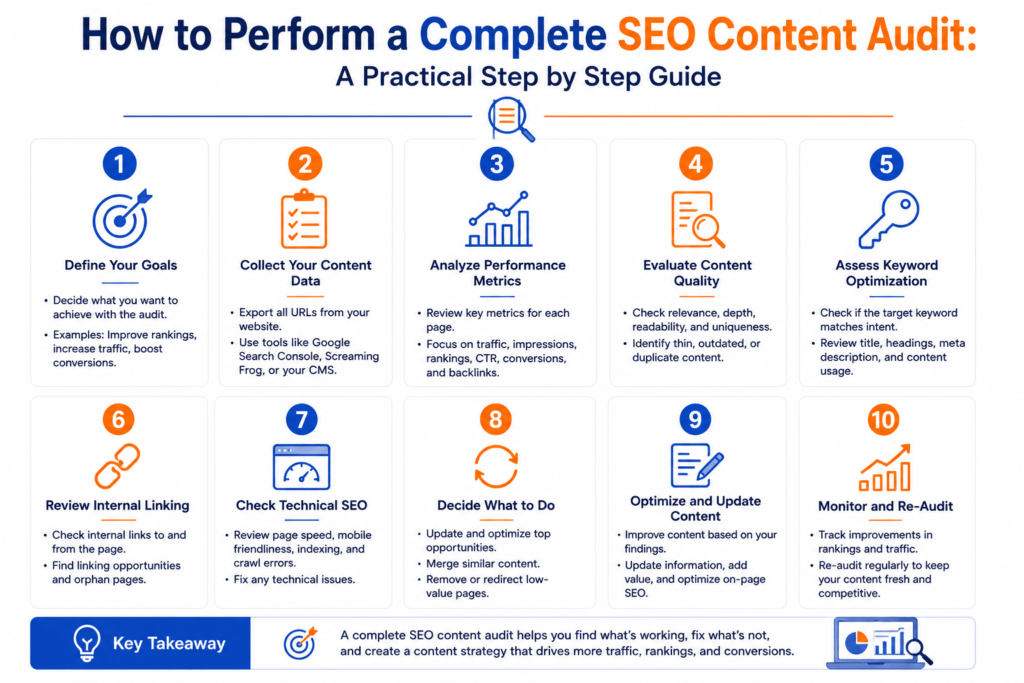
What Is an SEO Content Audit?
An SEO Content Audit is the process of evaluating website content based on factors such as relevance, quality, search visibility, user intent, traffic, conversions, and overall business value.
During an audit, you may review:
- Blog posts
- Service pages
- Product pages
- Landing pages
- Location pages
- Guides
- Resource pages
- Older content
The purpose is to answer practical questions.
Which pages are performing well?
Which pages are losing visibility?
Which pages are outdated?
Which topics are missing?
Which pages compete with each other?
Which pages contribute to leads or sales?
This creates a clearer picture of your website’s content ecosystem.
Why Is an SEO Content Audit Important?
A website can slowly accumulate content that no longer performs well.
An old article may contain outdated information.
Two articles may target almost the same topic.
A page may receive traffic but generate no meaningful action.
Another page may have valuable information but very little search visibility.
A properly performed SEO Content Audit helps identify these situations.
| Audit Finding | Possible Action |
|---|---|
| Strong traffic and conversions | Maintain and improve |
| Strong traffic but outdated | Update |
| Similar pages | Consolidate |
| Low value page | Improve or remove |
| Important missing topic | Create new content |
| Weak internal links | Add relevant links |
The source material emphasizes that useful marketing begins with understanding the audience, creating relevant assets, measuring outcomes, and deciding what to improve, stop, test, or scale.
What Should You Check During a Content Audit?
A complete SEO Content Audit should examine more than keyword rankings.
Consider:
Content Quality
Is the information accurate, useful, original, and easy to understand?
Search Intent
Does the page answer what people actually want when they perform the search?
Performance
Does the page receive impressions, clicks, traffic, engagement, or conversions?
Relevance
Is the content still relevant to your audience and business?
Internal Links
Does the page connect naturally with other important pages?
Business Value
Does the content contribute to leads, sales, enquiries, trust, or another meaningful objective?
The source material specifically recommends reviewing content by asking whether it is useful, accurate, original, and clear about the next step.
Step 1: Create a Complete Content Inventory
Before evaluating your content, create a list of your important URLs.
Your spreadsheet can include:
| URL | Page Type | Topic | Traffic | Leads | Action |
|---|---|---|---|---|---|
| Example URL | Blog | SEO | 1,500 | 12 | Update |
| Example URL | Service | SEO Services | 800 | 35 | Maintain |
| Example URL | Blog | Old Topic | 40 | 0 | Review |
You can collect URLs from your sitemap, content management system, analytics platform, and Search Console.
Do not try to evaluate everything from memory.
A complete inventory gives you a much clearer starting point.
Step 2: Analyze Content Performance
Now look at how each page performs.
Useful metrics can include:
- Organic clicks
- Impressions
- Organic traffic
- Engagement
- Conversion rate
- Leads
- Revenue
- Returning visitors
- Keyword visibility
Do not judge a page using only traffic.
A page receiving 500 visits and producing 20 qualified leads may be more valuable than a page receiving 5,000 visits and producing nothing.
The source material similarly points out that traffic demonstrates reach but does not necessarily show whether the audience is valuable.
Step 3: Check Search Intent
Search intent should be a major part of your audit.
Ask:
What does the user actually want?
For example:
What is SEO?
This suggests informational intent.
Best SEO agency for small businesses
This suggests commercial research.
Hire SEO agency
This suggests stronger transactional intent.
If your page does not match the intent behind the target search, even well written content may struggle to perform.
Look at the current search results and compare your page with the type of content users are being shown.
Step 4: Review Content Quality
Now read the page as a human rather than as an SEO checklist.
Ask:
- Is the introduction useful?
- Does the page answer the main question?
- Is the information accurate?
- Is it unnecessarily repetitive?
- Are examples included?
- Are important questions unanswered?
- Is the language easy to understand?
- Does the content demonstrate real expertise?
The source material stresses that quality is not simply about polished design or longer writing. The information needs to answer the actual question and help the reader make a better decision.
Identify Outdated Content
Look for:
- Old statistics
- Outdated screenshots
- Broken links
- Old product information
- Old industry practices
- Incorrect business details
- Previous year references
If the topic remains valuable, update it instead of automatically creating a new page.
Step 5: Identify Content Gaps
A content gap exists when your audience needs information that your website does not adequately cover.
For example, a dental clinic may have a page about dental implants but no useful content explaining preparation, recovery, common questions, or treatment considerations.
A real estate website may have property listings but no guides for first time buyers.
A digital marketing agency may discuss SEO but not explain keyword research, technical SEO, or local SEO in enough depth.
Use:
- Keyword research
- Competitor research
- Customer questions
- Search Console data
- Sales conversations
- Reviews
- Social media comments
The source material recommends studying customer questions, reviews, search queries, comments, and sales questions to identify patterns in audience needs.
Step 6: Check Internal Linking
Content should not exist in isolation.
Review whether important pages are connected through relevant internal links.
For example, an article about keyword research can naturally link to:
- Keyword research tools
- Keyword clustering
- Search intent
- SEO content strategy
A service page can also be linked from relevant educational articles when the connection is genuinely useful.
Internal linking can make your website easier to navigate and create stronger relationships between related topics.
Step 7: Decide What to Update, Merge, or Remove
After completing your SEO Content Audit, classify each page.
Keep
The content is useful, relevant, and performing well.
Update
The topic is valuable but the content needs improvement.
Merge
Two or more pages cover very similar intent and would be stronger as one comprehensive resource.
Improve
The page has potential but needs better targeting, structure, content, or conversion elements.
Remove
The page provides little value and has no clear purpose.
Do not delete content simply because it receives low traffic.
First determine whether the page has strategic value or could become useful after improvement.
Practical Example
Imagine a real estate website has 100 blog posts.
After an SEO Content Audit, the business discovers:
- 20 strong articles generating consistent organic traffic
- 25 outdated articles
- 15 articles targeting similar topics
- 20 pages with very little value
- 20 missing topics based on customer questions
The business could:
Update 25
Merge 15
Review 20
Create 20 new resources
This is much more strategic than simply writing another 20 new articles.
Common SEO Content Audit Mistakes
Looking Only at Rankings
Rankings matter, but they are not the same as business value.
Updating Everything
Some pages do not deserve significant investment.
Prioritize based on relevance and opportunity.
Ignoring Search Intent
A page can be well optimized and still fail if it answers the wrong question.
Focusing Only on Keywords
Content quality, usefulness, authority, user experience, and business relevance also matter.
Forgetting Existing Content
A content strategy should include improvement as well as publication.
Making Decisions Without Data
Use analytics, Search Console, customer feedback, and business outcomes wherever possible.
The source material recommends connecting marketing measurement to meaningful goals and using results to determine what should be improved, stopped, tested, or scaled.
Frequently Asked Questions
An SEO Content Audit is a systematic review of website content to evaluate quality, relevance, search performance, user intent, internal links, and business value.
Many businesses can conduct a detailed audit once or twice a year while monitoring content performance continuously.
Fast changing industries may need more frequent reviews.
Common tools include Google Search Console, Google Analytics, crawling tools, keyword research platforms, content management systems, and spreadsheets.
Not automatically. First determine whether the content is useful, strategically important, outdated, duplicated, or simply poorly optimized.
If the topic remains valuable, update the information, improve the structure, refresh examples, fix links, and ensure that the page matches current search intent.
Conclusion
A complete SEO Content Audit gives you something that constant publishing cannot: a clear understanding of what your existing content is actually doing.
Instead of automatically creating more pages, you can identify what is working, improve what has potential, consolidate unnecessary duplication, remove content that has no useful role, and find important topics your audience still needs.
Start with a complete content inventory.
Then analyze performance, search intent, content quality, internal links, business value, and content gaps.
The goal is not to have the largest content library.
The goal is to have a website where every important page has a clear purpose and provides genuine value.
A well maintained content library can become a stronger SEO asset when it is regularly reviewed, improved, and connected to the next step in the customer journey.