
How to Build a Customer Acquisition Funnel From Scratch
A practical step by step guide to attracting the right audience, turning visitors into leads, and moving prospects toward becoming customers.
Introduction
Getting people to visit your website is only the beginning. A business needs a clear process for turning those visitors into leads and eventually into paying customers.
This is where a customer acquisition funnel becomes useful.
A customer acquisition funnel is a structured journey that moves potential customers from their first interaction with your business toward a meaningful action such as an enquiry, appointment, registration, or purchase.
For a small business, dental clinic, real estate company, freelancer, influencer, or digital marketing agency, the funnel may look different. However, the basic principle remains the same:
Attract the right people, build interest, create trust, encourage action, and continue the relationship.
The source material emphasizes connecting marketing activity from discovery through education, trust, action, and follow up instead of treating individual tactics as isolated activities.
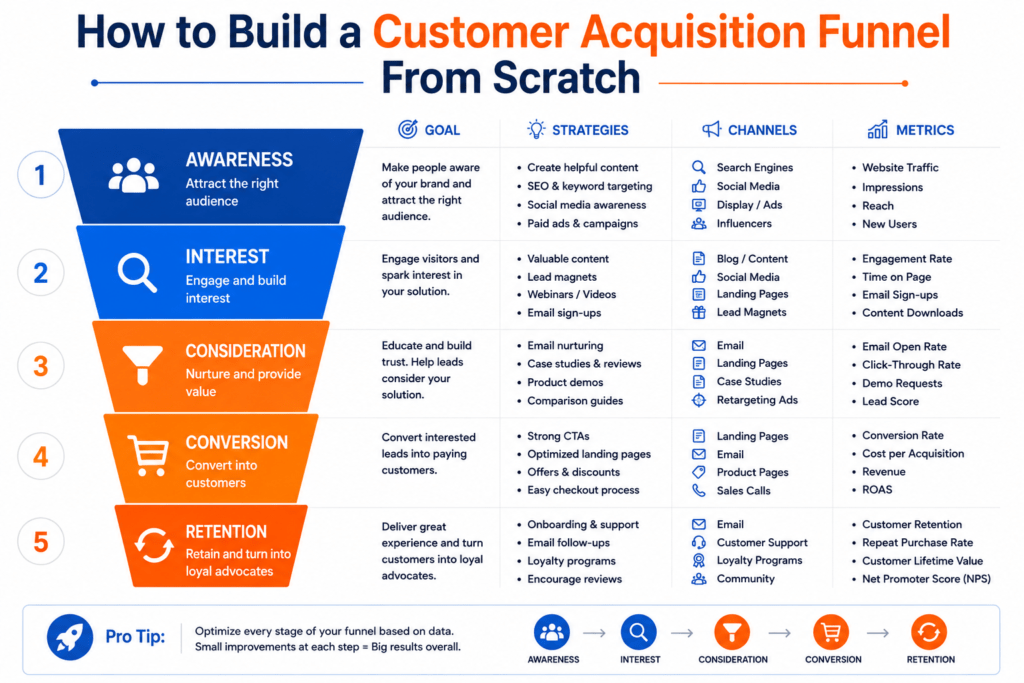
What Is a Customer Acquisition Funnel?
A customer acquisition funnel represents the stages a person moves through before becoming a customer.
A basic funnel can be divided into:
Awareness → Interest → Consideration → Conversion → Retention
Not everyone enters at the same stage.
Someone may discover your brand through Google.
Another person may already know your business because a friend recommended it.
The funnel gives you a framework for understanding what people need at different points in the decision making process.
Why Is a Customer Acquisition Funnel Important?
Without a funnel, businesses often make one of two mistakes.
They either focus heavily on getting traffic without considering what happens afterward, or they push sales messages before people are ready to buy.
A customer acquisition funnel creates a clearer path.
| Funnel Stage | Customer Need | Suitable Activity |
|---|---|---|
| Awareness | Discover a solution | SEO, social media, content |
| Interest | Learn more | Guides, videos, educational content |
| Consideration | Compare options | Case studies, reviews, comparisons |
| Conversion | Take action | Landing pages, consultations |
| Retention | Continue relationship | Follow up, email, customer service |
How to Build a Customer Acquisition Funnel
Step 1: Define Your Ideal Customer
Start with the audience.
Understand:
- Problems
- Goals
- Buying motivations
- Objections
- Budget
- Search behavior
- Preferred platforms
The source material recommends studying customer conversations, search queries, comments, reviews, and sales questions to identify audience patterns.
Step 2: Define the Desired Action
What do you want the customer to do?
It might be:
- Request a quote
- Book a consultation
- Schedule an appointment
- Buy a product
- Register
- Call your business
This gives your funnel a measurable destination.
Step 3: Create Awareness
At the top of the customer acquisition funnel, your audience may not know your business.
Useful channels include:
- SEO
- Social media
- Educational blogs
- YouTube
- Paid advertising
- Referrals
The content should focus on helping the audience understand a problem rather than immediately demanding a purchase.
Step 4: Build Interest
Once people discover you, provide more information.
Examples:
- Guides
- Videos
- FAQs
- Webinars
- Case studies
- Comparison articles
For example, a real estate company could publish a guide for first time home buyers.
Step 5: Build Trust
Trust can come from:
- Reviews
- Testimonials
- Case studies
- Credentials
- Demonstrations
- Transparent pricing
- Expert content
A customer needs enough confidence to take the next step.
Step 6: Create a Strong Conversion Point
The conversion stage should have a clear next action.
For a dental clinic:
Book an Appointment
For a digital marketing agency:
Book a Free Consultation
For a real estate business:
Request Property Details
Make the action obvious.
Step 7: Nurture Leads
Not every lead will purchase immediately.
Follow up with:
- Helpful content
- Retargeting
- Sales calls
- Relevant offers
The customer journey may require several interactions before a decision is made.
Measuring Funnel Performance
A customer acquisition funnel should be measurable.
Track:
| Stage | Metric |
|---|---|
| Awareness | Reach, impressions, traffic |
| Interest | Engagement, time on page |
| Consideration | Returning visitors, enquiries |
| Conversion | Leads, sales, bookings |
| Acquisition | Cost per customer |
| Retention | Repeat purchases, referrals |
Traffic alone does not tell you whether your audience is valuable. The source material recommends connecting measurement to the original goal and focusing on metrics such as qualified leads, conversion rate, cost per acquisition, engagement quality, and revenue.
Common Mistakes
Targeting Everyone
A broad audience can make your messaging weak.
Asking for a Sale Too Early
Not everyone is ready to buy immediately.
Having No Follow Up
A lead can become valuable later.
Using Too Many Channels
Choose channels based on audience behavior and business goals.
Measuring Only Traffic
A large audience does not necessarily mean strong customer acquisition.
Practical Example
Imagine a dental clinic wants more implant enquiries.
Its funnel could look like:
Google Search → Dental Implant Guide → Treatment Page → Patient Reviews → Consultation Form → Appointment
Each stage answers a different customer need.
The educational article attracts people researching treatment.
The service page explains the offer.
Reviews build confidence.
The consultation page provides the conversion opportunity.
That is a functioning customer acquisition funnel.
Frequently Asked Questions
What is a customer acquisition funnel?
A customer acquisition funnel is a structured journey that moves potential customers from discovering a business to becoming leads and customers.
What are the main stages of a customer acquisition funnel?
Common stages include awareness, interest, consideration, conversion, and retention.
How do I build a customer acquisition funnel for a small business?
Define your audience, choose a clear business goal, attract relevant visitors, create useful content, build trust, provide a clear conversion point, and follow up with leads.
What channels can be used in a customer acquisition funnel?
SEO, social media, email, paid advertising, content marketing, referrals, and direct outreach can all contribute depending on the audience.
Conclusion
A customer acquisition funnel gives your marketing a clear structure.
Instead of asking only how to get more visitors, you begin asking what those visitors need next.
Attract the right people. Educate them. Build trust. Make the next action obvious. Follow up consistently. Then measure the results.
A strong funnel does not need to be complicated. It needs to match the customer journey and connect each marketing activity to a meaningful business objective.