
Customer Acquisition Cost: How to Calculate and Reduce It
Learn what Customer Acquisition Cost means, how to calculate it, why it matters, and practical ways businesses can reduce acquisition costs without sacrificing lead quality.
Introduction
Getting a new customer costs money.
You may spend on Google Ads, social media, SEO, content, sales staff, software, creative production, or other marketing activities before someone finally makes a purchase.
But do you know how much it actually costs to acquire one customer?
That is where Customer Acquisition Cost becomes useful.
Customer Acquisition Cost, often called CAC, measures the average amount a business spends to acquire a new customer during a specific period.
It gives business owners a clearer view of marketing efficiency.
For example, a campaign may generate 100 leads and look successful at first. But if only two become customers and the acquisition cost is extremely high, the campaign may not be financially sustainable.
The source material emphasizes measuring marketing through outcomes such as qualified leads, conversion rate, cost per acquisition, engagement quality, and revenue rather than relying only on traffic or surface level engagement.
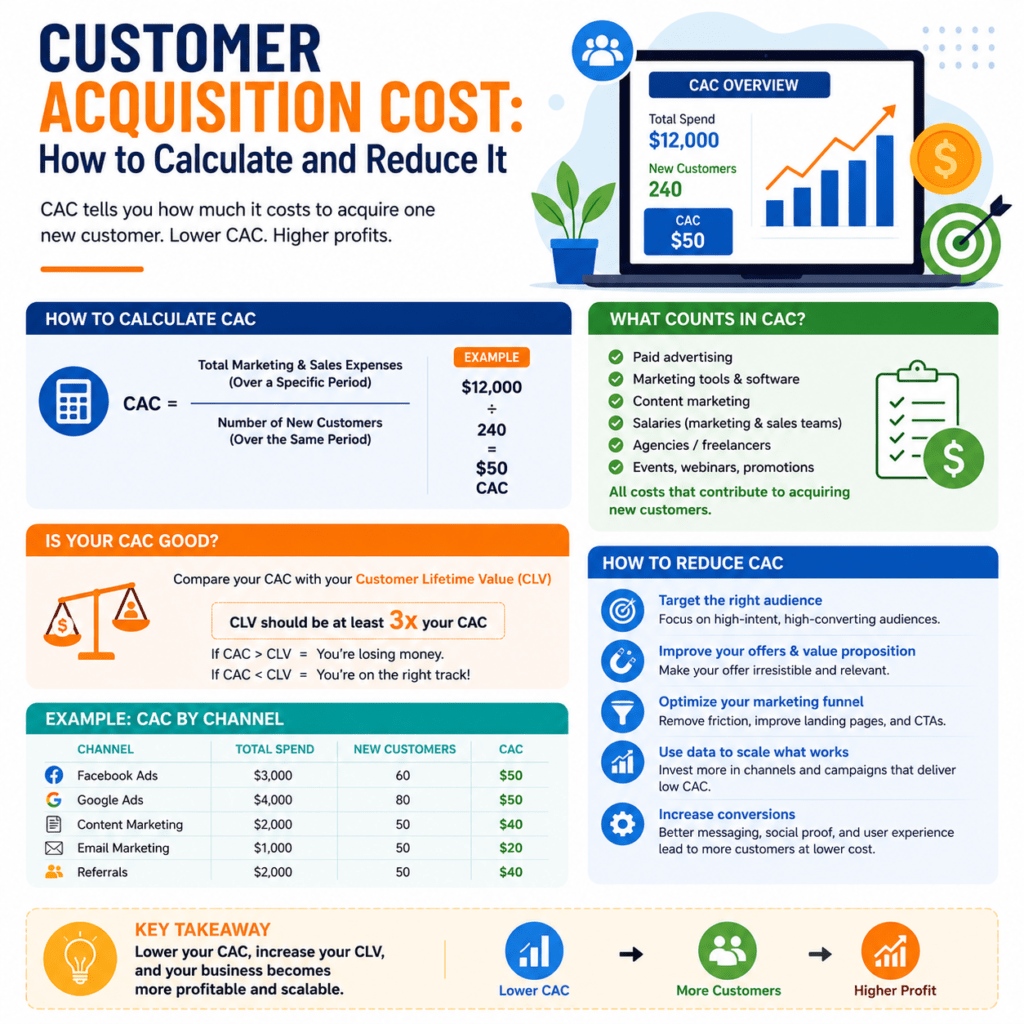
Table of Contents
What Is Customer Acquisition Cost?
Customer Acquisition Cost is the average amount a business spends to acquire one new customer.
It can include both marketing and sales related costs, depending on how your business defines and measures acquisition.
Possible costs include:
- Advertising
- Marketing software
- Content creation
- Sales salaries
- Sales commissions
- Creative production
- Agency fees
- Promotional campaigns
The important thing is to use a consistent definition when comparing periods or channels.
Why Customer Acquisition Cost Matters
CAC helps you understand whether your customer acquisition strategy is financially sustainable.
Suppose your average customer generates ₹20,000 in gross profit.
A CAC of ₹2,000 may be manageable.
A CAC of ₹18,000 may create a completely different financial situation.
This is why acquisition cost should be evaluated alongside customer value.
CAC can also help you compare channels.
| Channel | Customers | Cost | CAC |
|---|---|---|---|
| Google Ads | 20 | ₹40,000 | ₹2,000 |
| Social Ads | 10 | ₹30,000 | ₹3,000 |
| Referral | 15 | ₹15,000 | ₹1,000 |
In this example, referrals have the lowest acquisition cost.
However, CAC alone should not determine the final decision. Customer quality and long term value also matter.
Customer Acquisition Cost Formula
The basic formula is:
Customer Acquisition Cost = Total Acquisition Costs ÷ Number of New Customers
For example:
Marketing and sales costs = ₹1,00,000
New customers = 50
Therefore:
CAC = ₹1,00,000 ÷ 50 = ₹2,000
The business spent an average of ₹2,000 to acquire each new customer.
Example of CAC Calculation
Imagine a small digital marketing agency spends:
- ₹50,000 on advertising
- ₹20,000 on content
- ₹10,000 on software
- ₹20,000 on sales expenses
Total acquisition cost:
₹1,00,000
During the same period, the agency acquires 25 new customers.
Therefore:
CAC = ₹1,00,000 ÷ 25
CAC = ₹4,000
The agency can then compare this cost against what an average customer is worth.
CAC vs Cost Per Lead
These two metrics are often confused.
Cost Per Lead tells you how much it costs to generate a lead.
Customer Acquisition Cost tells you how much it costs to acquire an actual customer.
For example:
₹500 per lead
may sound excellent.
But suppose you need 20 leads to generate one customer.
Your approximate acquisition cost becomes:
₹500 × 20 = ₹10,000
This is why measuring only cost per lead can produce a misleading picture.
What Makes CAC High?
Several factors can increase Customer Acquisition Cost.
Poor Audience Targeting
Your advertisements may be reaching people who are unlikely to purchase.
Weak Conversion Rates
You may generate traffic and leads but struggle to turn them into customers.
Poor Landing Pages
Visitors may leave because your website does not clearly communicate the offer.
Low Lead Quality
A large number of irrelevant leads can consume sales resources without producing customers.
Strong Competition
Competitive industries often require greater investment to attract attention.
Weak Follow Up
Potential customers may be interested but never receive appropriate follow up.
How to Reduce Customer Acquisition Cost
Improve Audience Targeting
The first step is reaching better prospects.
Review:
- Customer profiles
- Search intent
- Locations
- Interests
- Buying behavior
- Past customer data
The source material recommends examining customer problems, questions, motivations, objections, search queries, reviews, and sales conversations to understand the audience better.
Improve Conversion Rate
You do not always need more traffic.
You may need to convert more of the traffic you already have.
Improve:
- Headlines
- Offers
- Landing pages
- CTAs
- Forms
- Trust signals
- Follow up
Improve Lead Quality
Ten highly relevant leads can be more valuable than 100 irrelevant leads.
Make your advertisements, content, and landing pages clear about who the offer is for.
Strengthen Organic Acquisition
SEO and useful content can contribute to customer acquisition without requiring payment for every visit.
This does not mean SEO is free. It requires time, expertise, content production, and technical resources.
But successful organic visibility can create a different acquisition economics over time.
Improve Customer Follow Up
A lead should not disappear simply because the first contact did not produce an immediate sale.
Use:
- Phone calls
- Relevant content
- Retargeting
- Follow up messages
The source material emphasizes guiding people from discovery toward education, trust, action, and consistent follow up.
CAC and Customer Lifetime Value
CAC should not be analyzed alone.
Compare it with Customer Lifetime Value, or CLV.
Suppose:
CAC = ₹3,000
and:
Customer Lifetime Value = ₹15,000
That may be a healthy relationship.
But if:
CAC = ₹12,000
and:
Customer Lifetime Value = ₹8,000
the acquisition model may not be sustainable.
The exact profitability calculation depends on margins, retention, operating costs, and business model.
The important principle is to consider what a customer is worth over time rather than focusing only on the initial transaction.
Practical Example
Imagine a dental clinic spends ₹60,000 across Google Ads, social media, content, and other marketing expenses.
During the month, it acquires 20 new patients.
Its approximate Customer Acquisition Cost is:
₹60,000 ÷ 20 = ₹3,000 per customer
The clinic can then compare this with the revenue and long term value generated by those patients.
If Google Ads produces customers at ₹2,000 while another campaign produces customers at ₹5,000, the clinic has useful information for future budget allocation.
However, it should also examine treatment value, patient quality, retention, and profitability.
Common Mistakes
Calculating CAC With Incomplete Costs
If you ignore important acquisition expenses, your CAC may appear artificially low.
Comparing Different Time Periods
Use consistent time periods when comparing performance.
Looking Only at Average CAC
Averages can hide differences between channels.
Confusing Leads With Customers
A lead is not necessarily a customer.
Reducing CAC at Any Cost
A cheaper acquisition source is not automatically better if the customers are lower quality.
Ignoring Customer Value
CAC should be interpreted alongside customer lifetime value and profitability.
The source material recommends focusing on meaningful business outcomes and avoiding decisions based only on vanity metrics or isolated results.
Frequently Asked Questions
What is Customer Acquisition Cost?
Customer Acquisition Cost is the average amount a business spends to acquire one new customer during a defined period.
How is Customer Acquisition Cost calculated?
Use the formula:
Total Acquisition Costs ÷ Number of New Customers
What is a good Customer Acquisition Cost?
There is no universal good CAC. It depends on your customer value, profit margins, business model, industry, and retention.
What is the difference between CAC and cost per lead?
Cost per lead measures the expense of generating a lead. CAC measures the expense of acquiring an actual customer.
How can I reduce Customer Acquisition Cost?
Improve audience targeting, conversion rates, lead quality, follow up, landing pages, and channel efficiency. Developing strong organic acquisition can also help over time.
Should I focus on reducing CAC or increasing customer value?
Both matter. Lowering acquisition costs can improve efficiency, while increasing customer value can make a higher CAC economically sustainable.
Conclusion
Customer Acquisition Cost gives businesses a clearer picture of what they are actually spending to acquire customers.
It is more useful than looking at advertising clicks or lead counts in isolation because it connects acquisition spending with actual customers.
Calculate your CAC consistently.
Then break it down by channel, audience, campaign, and period where possible.
Identify what is making acquisition expensive. Improve targeting, landing pages, conversion rates, lead quality, and follow up. At the same time, consider customer lifetime value so that you are not trying to reduce CAC without understanding the value of the customers you acquire.
The goal is not simply to acquire customers as cheaply as possible.
The goal is to acquire the right customers at a sustainable cost.