
How to Create a Marketing Budget for a Small Business
A practical guide to planning your marketing budget, allocating money across the right channels, avoiding waste, and measuring whether your spending is producing business value.
Introduction
Marketing can become expensive very quickly when a small business starts spending without a clear plan.
One month you may spend money on Instagram advertisements. The next month you may try Google Ads, a freelancer, SEO tools, content creation, and influencer promotions. At the end of the month, you know how much you spent, but you may not know what actually worked.
This is why creating a marketing budget for a small business is so important.
A marketing budget gives your business a spending framework. It helps you decide how much you can afford to invest, which channels deserve priority, what should be tested, and how results should be measured.
The goal is not to spend the most money.
The goal is to spend your available resources where they have a reasonable chance of producing useful business outcomes.
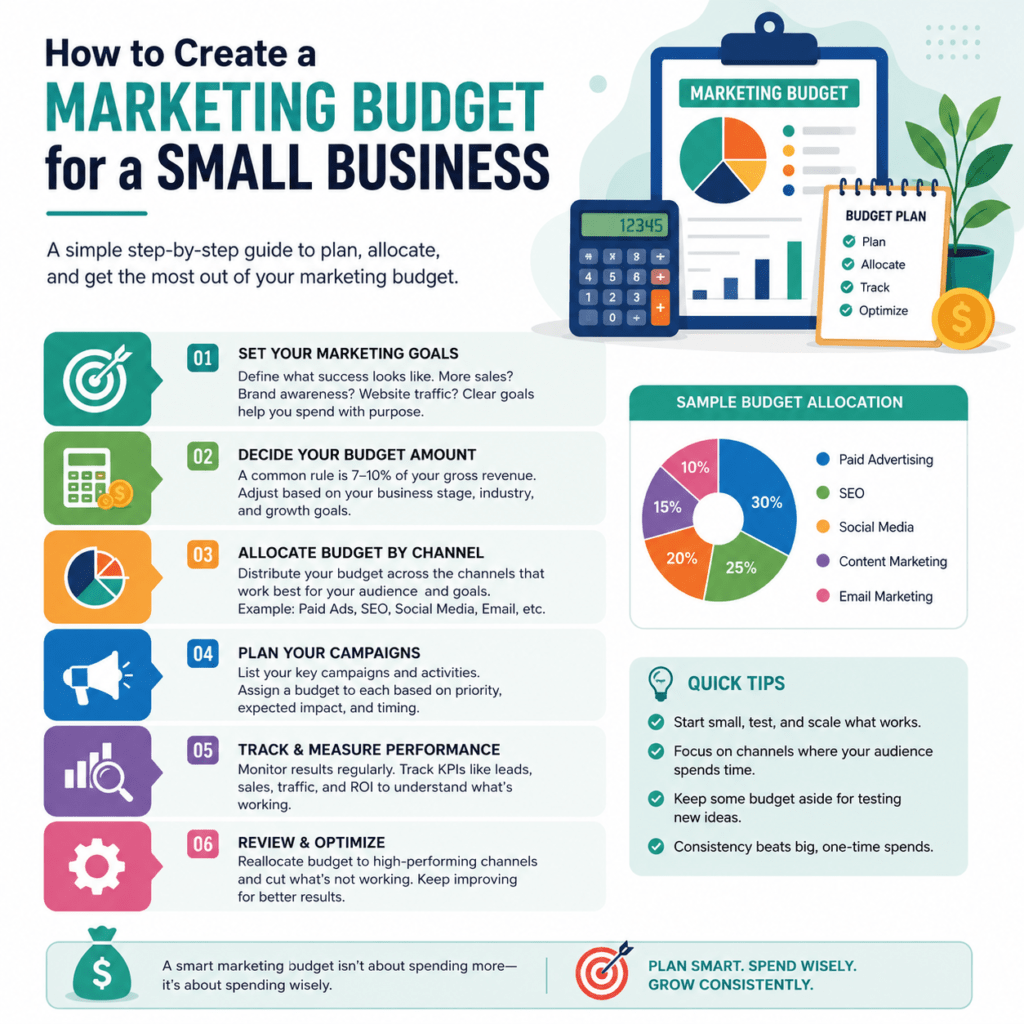
Table of Contents
What Is a Marketing Budget?
A marketing budget is the amount of money a business plans to spend on marketing activities during a specific period.
It can include:
- Advertising
- SEO
- Content creation
- Social media
- Website development
- Design
- Email marketing
- Marketing software
- Influencer collaborations
- Events
- Promotional campaigns
Your marketing budget for a small business should be connected to your broader business objectives.
For example, a new business may prioritize brand awareness and customer acquisition, while an established local business may focus more heavily on leads and customer retention.
Why Small Businesses Need a Marketing Budget
Small businesses usually have limited resources.
That means every marketing decision matters.
A budget helps you:
| Benefit | Why It Matters |
|---|---|
| Control spending | Prevents unnecessary expenses |
| Set priorities | Focuses money on important activities |
| Test channels | Creates room for experimentation |
| Measure ROI | Connects spending with outcomes |
| Plan ahead | Reduces last minute decisions |
| Scale winners | Allows investment in channels that work |
The source material emphasizes defining a clear objective before choosing tactics and ensuring each marketing activity has a reason for existing.
How to Create a Marketing Budget
1. Identify Your Business Goals
Start with the question:
What do I want marketing to achieve?
Possible goals include:
- Generate leads
- Increase sales
- Build brand awareness
- Increase website traffic
- Launch a new product
- Enter a new market
- Generate appointments
- Improve customer retention
A goal such as “get more visibility” is difficult to measure.
A goal such as “generate 50 qualified enquiries in three months” gives you a clearer direction.
2. Understand Your Current Financial Position
Before deciding your marketing budget, understand what your business can realistically afford.
Review:
- Revenue
- Fixed expenses
- Operating costs
- Profit margins
- Cash flow
- Customer value
- Existing marketing expenses
Do not copy another company’s marketing budget simply because it appears successful.
Your budget needs to fit your own financial situation.
3. Choose the Right Marketing Channels
You do not need to invest in every channel.
Consider where your customers actually discover and evaluate businesses.
For example:
| Business | Potential Priorities |
|---|---|
| Dental Clinic | Local SEO, Google Ads, content |
| Real Estate | SEO, Google Ads, social media |
| Local Business | Local SEO, reviews, social media |
| Ecommerce | Paid ads, SEO, email |
| Influencer | Social media, content, partnerships |
| Digital Agency | SEO, content, Google Ads, LinkedIn |
The right choice depends on your audience and objectives.
4. Allocate Your Budget
Once you understand the priorities, divide the budget.
For example, suppose a small business has ₹50,000 available each month.
A possible allocation could be:
| Activity | Example Allocation |
|---|---|
| Google Ads | ₹15,000 |
| SEO and content | ₹12,000 |
| Social media | ₹8,000 |
| Design and creative | ₹5,000 |
| Testing | ₹5,000 |
| Tools and analytics | ₹5,000 |
| Total | ₹50,000 |
This is only an example.
There is no universal percentage that every small business should follow.
5. Set a Testing Budget
Do not spend your entire budget only on activities you already believe will work.
Reserve some money for testing.
You can test:
- Different advertising audiences
- New content formats
- New landing pages
- New offers
- New keywords
- Different CTAs
The purpose is to learn.
Once you have enough evidence, you can shift more money toward the activities producing stronger results.
Measure Marketing Performance
Your budget becomes much more useful when you measure performance.
Track metrics such as:
- Leads
- Qualified leads
- Conversion rate
- Cost per lead
- Customer acquisition cost
- Sales
- Revenue
- Return on investment
Traffic alone does not necessarily indicate business value. The source material recommends focusing on metrics connected to the original business goal, including qualified leads, conversion rate, cost per acquisition, engagement quality, and revenue influenced by campaigns.
Common Budgeting Mistakes
Spending Without a Goal
Every significant expense should have a reason.
Copying Competitors
Their budget, audience, margins, and business model may be completely different.
Spending Everything on Advertising
Long term activities such as SEO, content, website optimization, and customer retention can also contribute value.
Ignoring Testing
A small testing budget can help you discover better opportunities.
Measuring Vanity Metrics
Likes and impressions can provide context, but they should not replace meaningful business outcomes.
Changing Direction Too Quickly
Give campaigns enough time to generate useful evidence.
The source material warns against changing direction every few days and recommends using measurement to decide what to improve, stop, test, or scale.
Practical Example
Suppose a dental clinic has ₹60,000 available for monthly marketing.
Instead of spending everything on social media advertisements, the clinic could divide the budget between:
Local SEO → Google Ads → Educational content → Creative production → Testing
The clinic can then measure appointment enquiries, qualified leads, and cost per acquisition.
After several months, it may discover that Google Ads produces immediate enquiries while SEO produces increasingly valuable organic traffic.
The business can then adjust the budget based on evidence.
That is much more effective than deciding the budget once and never reviewing it.
Frequently Asked Questions
How much should a small business spend on marketing?
There is no universal amount. Your budget should depend on revenue, margins, growth goals, customer value, competition, and available cash flow.
What should be included in a marketing budget?
Advertising, SEO, content, social media, software, design, website improvements, partnerships, and promotional activities can all be included.
Should a new business spend more on marketing?
A new business often needs to invest in awareness and customer acquisition, but spending should remain within a financially sustainable level.
Should I spend my entire marketing budget every month?
Not necessarily. Maintaining a testing and contingency reserve can provide flexibility.
How often should a marketing budget be reviewed?
Review performance regularly and conduct a deeper budget review monthly or quarterly depending on the size and complexity of the business.
Conclusion
Creating a marketing budget for a small business is not about finding one perfect number.
It is about creating a system for making better spending decisions.
Start with your business goals. Understand what you can afford. Choose channels that match your audience. Allocate your resources carefully. Reserve money for testing. Then measure the results and adjust your spending based on evidence.
The most important lesson is simple:
Do not ask only how much you can spend. Ask what you expect that spending to achieve.
A thoughtful marketing budget gives a small business more control, better visibility into performance, and a clearer path toward sustainable growth.