
How to Choose the Right Marketing Channels for Your Business
A practical guide to evaluating SEO, social media, paid advertising, email, content, and other marketing channels based on your audience and business goals.
Introduction
One of the hardest marketing decisions is deciding where to spend your time and money.
There are countless options:
SEO, Instagram, Google Ads, YouTube, email, LinkedIn, content marketing, influencer marketing, referrals, local marketing, and more.
The challenge is not finding a marketing channel.
The challenge is finding the right marketing channels for your business.
A channel that performs well for a SaaS company may not work the same way for a dental clinic. A real estate company may need strong local search visibility, while an influencer may depend heavily on social platforms and video content.
The right choice starts with the audience and business objective.
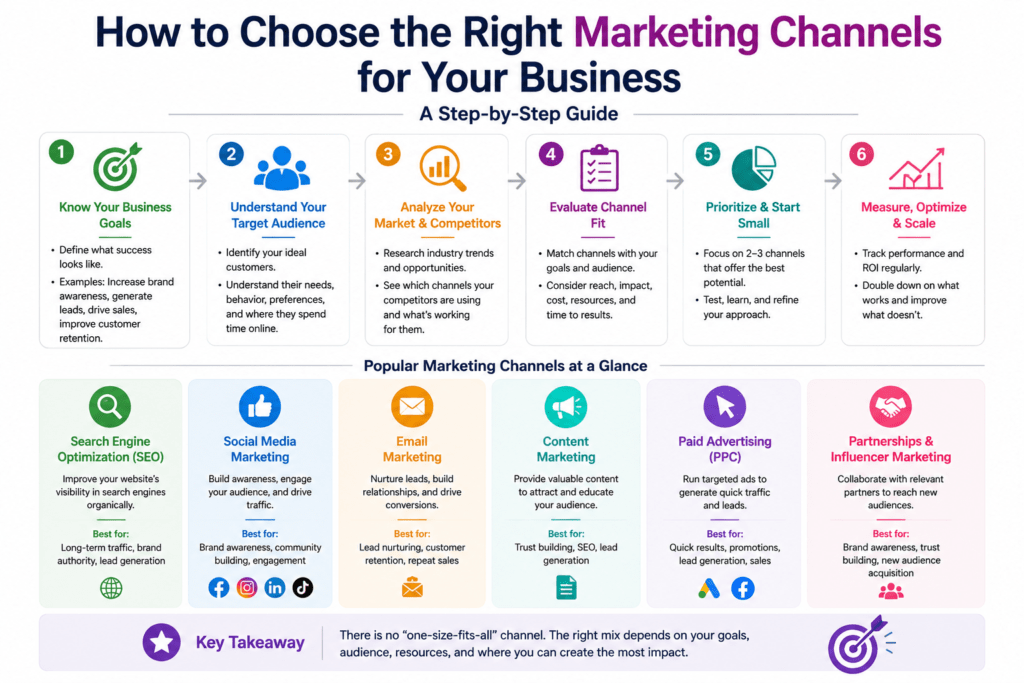
Table of Contents
What Are Marketing Channels?
Marketing channels are the platforms, methods, and pathways businesses use to reach potential and existing customers.
They can be divided into several broad categories.
| Channel | Common Purpose |
|---|---|
| SEO | Organic search visibility |
| Google Ads | Search based paid traffic |
| Social Media | Awareness and engagement |
| Nurturing and retention | |
| Content Marketing | Education and authority |
| Influencer Marketing | Audience access and trust |
| Referral Marketing | Customer driven growth |
| Local Marketing | Geographic visibility |
The best marketing channels for your business depend on how your audience discovers and evaluates solutions.
Why Channel Selection Matters
Businesses have limited resources.
If you invest everything in the wrong platform, you may generate activity without meaningful results.
Channel selection affects:
- Customer acquisition cost
- Reach
- Lead quality
- Conversion rate
- Brand visibility
- Customer retention
- Marketing efficiency
A channel should therefore be evaluated based on business relevance rather than popularity.
How to Choose Marketing Channels for Your Business
1. Start With the Audience
Ask:
Where does my customer spend time?
Where do they search for information?
Whom do they trust?
How do they compare options?
What triggers a purchase?
The source material recommends building a clear understanding of customer problems, motivations, questions, objections, and the language they naturally use.
2. Define Your Goal
Different channels can support different goals.
| Goal | Potential Channels |
|---|---|
| Brand awareness | Social media, video, PR |
| Organic growth | SEO, content |
| Lead generation | Google Ads, landing pages, SEO |
| Customer retention | Email, community |
| Local discovery | Local SEO, Google Business Profile |
| B2B leads | LinkedIn, SEO, email |
| Ecommerce sales | Google Ads, social, email |
Start with the business goal, then choose the channel.
3. Consider the Customer Journey
Think about how customers move from discovery to decision.
A possible journey might be:
Google Search → Blog → Service Page → Review → Consultation
Another might be:
Instagram → Profile → Website → Product Page → Purchase
Your channel strategy should support this journey.
The source material recommends mapping work from discovery to action, including attracting people, educating them, creating trust, making the next step obvious, and following up consistently.
Compare Major Marketing Channels
SEO
SEO can help businesses attract people actively searching for information or services.
It is particularly useful when search demand exists around your products, services, problems, or locations.
SEO can be valuable for:
- Real estate
- Dental clinics
- Local businesses
- Professional services
- Ecommerce
- Digital agencies
Google Ads
Google Ads can help businesses reach users who are already searching for relevant products or services.
It can be useful when:
- Search demand exists
- Leads have strong value
- You have a clear offer
- Landing pages are prepared
- Conversion tracking is available
Social Media
Social platforms can support awareness, engagement, community building, and content distribution.
They can be particularly useful for:
- Influencers
- Consumer brands
- Personal brands
- Restaurants
- Fashion businesses
- Creative businesses
Email Marketing
Email can be useful for nurturing prospects and retaining customers.
It can support:
- Follow up
- Promotions
- Education
- Product updates
- Customer retention
Content Marketing
Content can help businesses answer customer questions, demonstrate expertise, and support search visibility.
Examples include:
- Blogs
- Guides
- Videos
- Webinars
- Case studies
The source material emphasizes that content should answer real questions, be useful and accurate, and help people make better decisions.
Match Channels to Business Goals
A useful decision framework is:
Small Local Business
Prioritize:
Local SEO + Google Search + Reviews + Social Media
Dental Clinic
Prioritize:
Local SEO + Search Ads + Educational Content + Reviews
Real Estate Business
Prioritize:
SEO + Search Ads + Local Content + Social Media + Lead Follow Up
Influencer
Prioritize:
Social Media + Video + Content + Partnerships + Email
Digital Marketing Agency
Prioritize:
SEO + Content Marketing + LinkedIn + Google Ads + Case Studies
These are starting points rather than universal formulas.
Test Before Scaling
You do not need to commit a huge budget immediately.
Start small.
Test:
- Audience
- Offer
- Message
- Channel
- Landing page
- Conversion process
Then measure the outcome.
Useful metrics may include:
- Qualified leads
- Conversion rate
- Cost per lead
- Customer acquisition cost
- Sales
- Revenue
- Engagement quality
The source material recommends using measurement to determine what to improve, stop, test, or scale rather than reacting to individual results.
Common Mistakes
Choosing a Channel Because It Is Popular
Popularity does not guarantee relevance.
Using Too Many Channels
A small, well managed strategy can outperform a scattered one.
Ignoring Customer Intent
Understand how people use each platform.
Scaling Before Testing
Prove that the message and offer work before increasing spending.
Measuring Vanity Metrics
Followers and impressions do not automatically equal customers.
Ignoring the Next Step
A channel can generate attention, but your website, landing page, offer, and sales process need to continue the journey.
Practical Example
Imagine a local dental clinic has a limited monthly marketing budget.
Instead of spending on every platform, it could prioritize:
Local SEO → Google Search Ads → Educational Blog Content → Review Generation → Simple Appointment Landing Page
Why?
Because the audience is searching for dental services, comparing providers, reading information, and looking for ways to contact a clinic.
The strategy follows the customer journey rather than the popularity of individual platforms.
Frequently Asked Questions
What are marketing channels?
Marketing channels are platforms and methods businesses use to reach, communicate with, convert, and retain customers.
How do I choose the right marketing channels for my business?
Start with your audience and business goals. Understand where customers search, what influences their decisions, and which channels can realistically support your objectives.
Should a small business use every marketing channel?
No. It is usually better to focus on a manageable set of channels that are relevant to the target audience.
Which marketing channel is best for lead generation?
There is no universal answer. SEO, Google Ads, social media, email, referrals, and content can all generate leads depending on the industry and customer journey.
How much should I spend on marketing channels?
Your budget depends on customer value, business stage, competition, cash flow, and channel economics. Start with a manageable amount and scale based on evidence.
Conclusion
Choosing the right marketing channels for your business is not about being present everywhere.
It is about being present where your customers are most likely to discover, evaluate, trust, and choose your business.
Start with the audience.
Define your objective.
Understand the customer journey.
Compare channels based on their strengths.
Test before scaling.
Then measure meaningful outcomes.
The right marketing mix will differ between a dental clinic, real estate company, influencer, local business, ecommerce store, and digital marketing agency.
Your strategy should reflect your customers rather than trends.