
What Is the Difference Between Digital Marketing and Social Media Marketing?
A simple guide to understanding where each strategy fits your business.
Introduction
If you are running a restaurant, real estate business, coaching institute, cafe, hotel, or local business, you have probably heard both terms: digital marketing and social media marketing. They sound similar, but they are not the same thing.
The simplest way to understand the difference between digital marketing and social media marketing is this: digital marketing is the broader field, while social media marketing is one part of it.
For example, a real estate company may use Google Search to attract people looking for properties, SEO to bring organic visitors, email to follow up with leads, and Instagram to showcase new properties. All of these activities come under digital marketing. Instagram marketing specifically comes under social media marketing.
Understanding this difference helps you spend your marketing budget more intelligently and choose the right channels for your business.
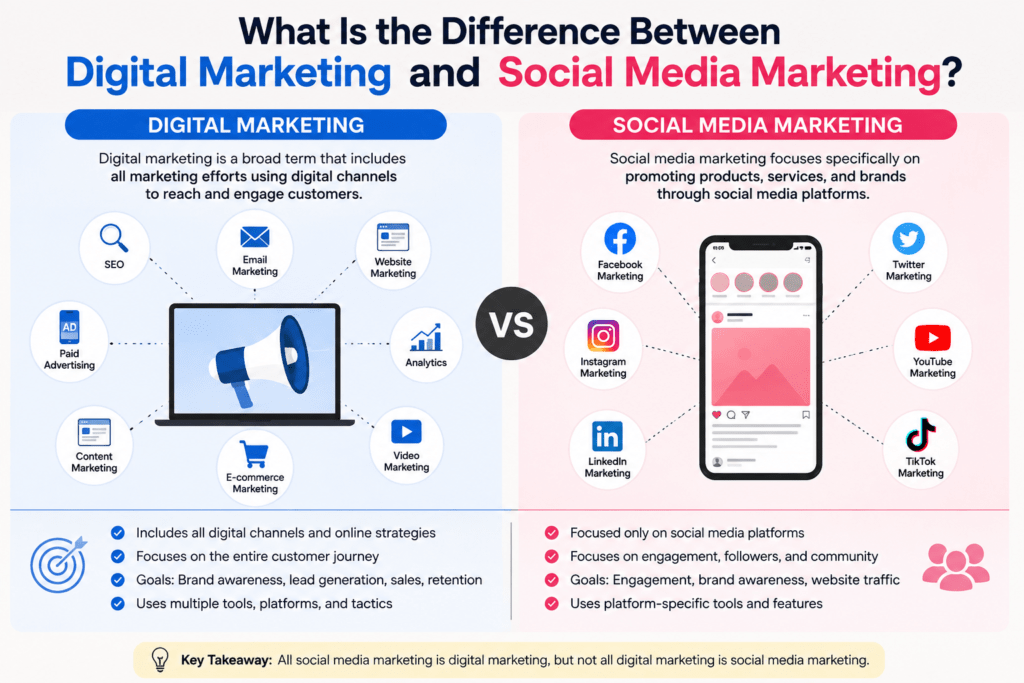
Table of Contents
- What is digital marketing?
- What is social media marketing?
- Digital Marketing vs Social Media Marketing
- Which strategy does your business need?
- Common mistakes businesses make
- Practical example
- Frequently Asked Questions
- Conclusion
1. What Is Digital Marketing?
Digital marketing refers to promoting a business, product, or service through digital channels.
It covers several activities, including:
| Digital Marketing Channel | Common Purpose |
|---|---|
| SEO | Increase organic search visibility |
| Google Ads | Reach people actively searching |
| Social Media Marketing | Build awareness and engagement |
| Email Marketing | Nurture existing leads and customers |
| Content Marketing | Educate and attract potential customers |
| Online Reputation Management | Build trust and credibility |
| Website Marketing | Convert visitors into enquiries or sales |
Think of digital marketing as a large umbrella. Social media marketing sits underneath that umbrella.
For instance, a coaching institute could publish useful SEO articles, run Google Ads for course related searches, collect enquiries through its website, and use Instagram Reels to answer student questions. Together, these activities form a digital marketing strategy.
What Is Social Media Marketing?
Social media marketing focuses specifically on platforms such as Instagram, Facebook, LinkedIn, YouTube, and other social networks.
Its purpose is not limited to selling. Good social media marketing can help a business:
- Build brand awareness
- Develop a recognizable identity
- Communicate with customers
- Share educational content
- Generate enquiries
- Build a community
- Support paid advertising campaigns
Consider a cafe. Posting photographs of new dishes, sharing customer experiences, creating short videos about the preparation process, and responding to comments are examples of social media marketing.
The important point is that social media is a channel. It should support the larger business objective rather than become the entire marketing strategy.
3. Difference Between Digital Marketing and Social Media Marketing
Here is the comparison in simple terms:
| Factor | Digital Marketing | Social Media Marketing |
| Meaning | Broad online marketing approach | Marketing through social platforms |
| Scope | Includes SEO, PPC, email, content, social media and more | Primarily focuses on social networks |
| Main channels | Search engines, websites, email, social platforms and advertising networks | Instagram, Facebook, LinkedIn, YouTube and similar platforms |
| Main goals | Traffic, leads, sales, awareness and retention | Awareness, engagement, community and leads |
| Audience intent | Can target active searchers and passive audiences | Often reaches people while they browse social content |
| Measurement | Depends on the channel | Usually focuses on reach, engagement, clicks and conversions |
A useful way to remember it is:
Digital marketing = the complete online marketing ecosystem.
Social media marketing = one important component of that ecosystem.
4. Which Strategy Does Your Business Need?
Most businesses do not need to choose between the two. They often work better together.
Real Estate Business
Use SEO and Google Ads to capture property related searches. Use Instagram and Facebook to display properties, explain the buying process, and build credibility.
Restaurant or Cafe
Social media can be highly useful for food photography, short videos, offers, customer content, and local awareness. Local SEO can help people discover the business when they search for nearby restaurants or cafes.
Coaching Institute
SEO and Google Ads can attract people actively searching for courses. Social media can demonstrate expertise through educational videos, student stories, faculty introductions, and useful tips.
Hotel
Search marketing can capture people already planning a stay, while social media can showcase rooms, experiences, facilities, and nearby attractions.
The best channel depends on how your customers make purchasing decisions.
5. Common Mistakes Businesses Make
One common mistake is believing that having an Instagram page means the business is doing digital marketing.
Another is focusing entirely on followers.
A business can have thousands of followers and still receive very few enquiries. At the same time, a smaller business with strong local SEO and useful content can attract customers who are actively looking for its services.
Businesses should therefore track meaningful outcomes such as enquiries, calls, website visits, bookings, purchases, and qualified leads rather than judging success only by likes.
6. Best Practice: Build Around Customer Intent
Before selecting a marketing channel, ask three questions:
Who is my customer?
What problem are they trying to solve?
Where do they look for a solution?
If customers search Google before contacting you, SEO and search advertising deserve attention.
If customers discover businesses through visual content, social media may play a bigger role.
For many small businesses, the strongest approach is a combination of both.
7. Frequently Asked Questions
What is the main difference between digital marketing and social media marketing?
Digital marketing is the broader practice of marketing through digital channels. Social media marketing specifically focuses on promoting a business through social networking platforms.
Is social media marketing part of digital marketing?
Yes. Social media marketing is one of the major components of digital marketing.
Which is better for a small business?
Neither is automatically better. The right choice depends on your audience, business model, location, budget, and customer behavior. Many small businesses benefit from combining social media with SEO and local search.
Can social media marketing increase sales?
Yes, but results depend on factors such as the offer, audience, content quality, targeting, trust, and conversion process. Social media can generate awareness, enquiries, website visits, and direct sales.
Is SEO part of social media marketing?
No. SEO is a separate digital marketing discipline focused primarily on improving visibility in search engine results. It can, however, work alongside social media marketing.
Do businesses need both digital marketing and social media marketing?
Many businesses benefit from both because they serve different purposes. Digital marketing provides the wider strategy, while social media can help build awareness, relationships, and engagement.
8. Conclusion
The difference between digital marketing and social media marketing becomes much easier to understand when you look at them as a whole and a part.
Digital marketing includes multiple online channels such as SEO, paid advertising, websites, email, content, and social media. Social media marketing focuses specifically on social platforms and the audiences using them.
For a small business, the goal should not be to be everywhere. Start by understanding how your customers search, compare, trust, and finally contact a business. Then choose the channels that support those behaviors.
A strong marketing strategy is not simply about posting more content. It is about reaching the right people with the right message at the right stage of their decision.