
What Is Answer Engine Optimization and How Does It Work?
A practical beginner’s guide to AEO, AI search visibility, conversational queries, citations, structured content, and the future of search.
Introduction
Why does one landing page generate more enquiries than another? Why does one advertisement receive more clicks? Why do some email subject lines perform better than others?
Instead of guessing, marketers can test different versions and compare the results. This is where A/B testing becomes useful.
A/B testing is a method of comparing two versions of a marketing asset to understand which version performs better against a specific objective. The asset could be a landing page, advertisement, email subject line, call to action, headline, form, or another element of a digital experience.
For beginners, the concept is simple. Create two versions, expose them to comparable audiences, measure the results, and use the evidence to make a better decision.
However, good testing requires more than changing a button color and watching the numbers. You need a clear goal, a sensible hypothesis, an appropriate audience, and meaningful measurement.
The source material emphasizes that A/B testing works best when it is connected to a clear business objective, audience understanding, and measurable outcomes rather than being treated as an isolated tactic.
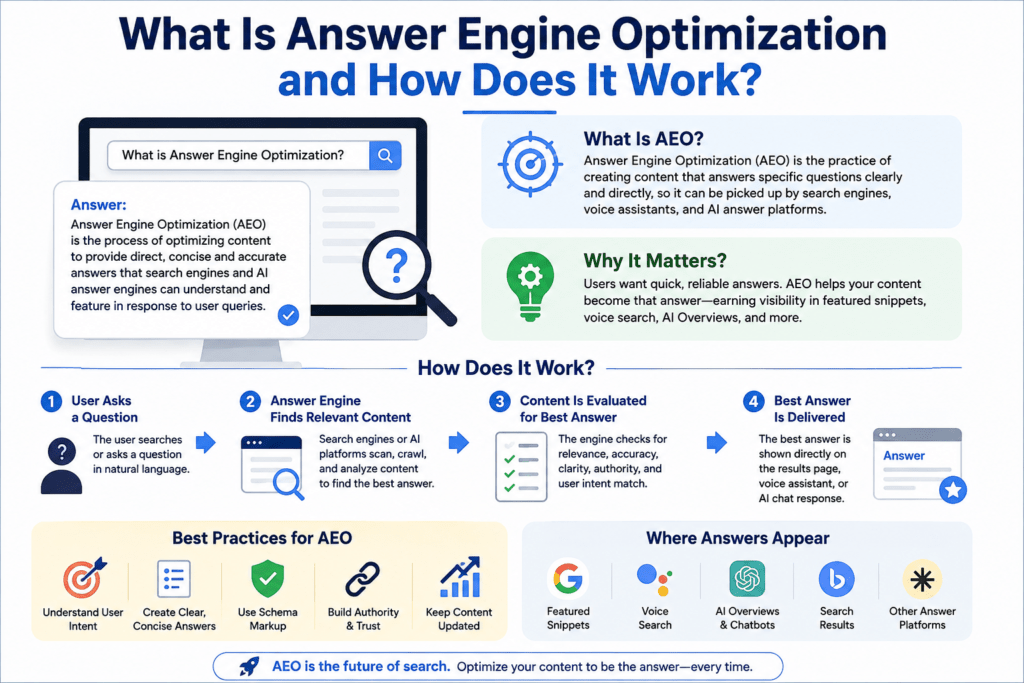
Table of Contents
What Is Answer Engine Optimization?
Answer Engine Optimization is the process of making your content easier for AI powered answer engines to retrieve, understand, summarize, and cite.
Traditional SEO mainly focuses on earning visibility in search results and encouraging users to click a webpage.
AEO focuses on another outcome: becoming a useful source inside the answer itself.
For example, imagine someone asks:
“What are the best digital marketing strategies for a small business?”
A traditional search may show a list of articles.
An answer engine may generate a concise response and cite several sources.
The objective of an AEO strategy is to make your content clear, credible, and useful enough to become one of those sources.
How Does AEO Work?
Answer engines need to identify information that is relevant to a question and useful enough to include in a response.
A practical AEO process can be understood as:
User question → Information retrieval → Content interpretation → Source selection → Generated answer → Citation or attribution
For this reason, content needs to be easy for machines and humans to understand.
Current AEO guidance commonly emphasizes clear answers, strong structure, useful context, authoritative information, structured data, and trustworthy references.
Understand the Question
AEO starts with understanding conversational search intent.
People may ask complete questions such as:
- What is SEO?
- How does keyword research work?
- Which digital marketing strategy is best for a small business?
- How much does SEO cost?
- What is the difference between SEO and AEO?
Your content should answer these questions directly rather than forcing visitors to search through several paragraphs to find the key information.
Provide Clear Answers
A section should make its main point obvious.
For example:
What is Answer Engine Optimization?
Answer Engine Optimization is the practice of structuring content so AI powered answer engines can retrieve, understand, and cite it when generating direct responses.
Then provide deeper explanation.
This structure makes the information easier to understand and potentially easier for automated systems to extract.
Why Is AEO Important?
The biggest reason is that the way people discover information is expanding.
Search visibility can now involve:
| Search Experience | Typical User Interaction |
|---|---|
| Traditional search | Browse ranked webpages |
| Featured snippets | Read a direct answer |
| AI Overviews | Read an AI generated summary |
| ChatGPT | Ask conversational questions |
| Perplexity | Ask questions and review cited sources |
| Gemini | Interact through conversational search |
AEO therefore complements existing SEO rather than simply replacing it. Multiple current industry sources describe AEO and SEO as overlapping but distinct approaches.
For a business, being present in an AI answer can increase awareness even when the user does not interact with a traditional search result in the same way.
AEO vs Traditional Search
The easiest way to understand the difference is to compare their primary goals.
| SEO | Answer Engine Optimization |
| Focuses on search rankings | Focuses on inclusion in generated answers |
| Targets webpages and search results | Targets AI answer and citation surfaces |
| Optimizes for organic visibility | Optimizes for retrieval, clarity, and attribution |
| Clicks are an important outcome | Citations and mentions can become important outcomes |
| Uses keywords and search intent | Uses questions, entities, context, and answer structure |
| Builds authority for ranking | Builds authority and source confidence for citation |
The two approaches overlap considerably.
A technically healthy website with useful, authoritative, well structured content can provide a strong foundation for both.
Key Elements of Answer Engine Optimization
1. Create Direct Answer Sections
Answer the main question near the beginning of the relevant section.
Do not hide the answer behind a long introduction.
2. Use Clear Headings
Turn genuine customer questions into useful headings.
For example:
What Is Local SEO?
How Does Local SEO Work?
Why Is Local SEO Important for Small Businesses?
This creates a clear relationship between question and answer.
3. Demonstrate Expertise
AI systems need reliable information.
Your content should include accurate explanations, practical examples, original insights, and appropriate supporting evidence.
For health, finance, legal, and other sensitive subjects, trustworthy sources and expert review become particularly important.
4. Build Strong Entity Connections
Make it clear who your business is, what it does, where it operates, and what topics it is associated with.
A local dental clinic, for example, can clearly communicate:
- Clinic name
- Services
- Location
- Specializations
- Professional credentials
- Contact details
- Relevant educational content
This creates a clearer digital identity.
5. Use Structured Data Where Appropriate
Structured data can help search engines understand webpage content and entities.
It should support the actual content on the page rather than being added simply because a particular schema type sounds useful.
6. Build Authority Beyond Your Own Website
AEO is not only an onsite exercise.
AI systems may use information from multiple sources, so brand mentions, reputable publications, industry references, reviews, and relevant third party sources can contribute to broader online visibility.
How Businesses Can Start With AEO
A small business does not need to redesign its entire marketing strategy overnight.
Start with content that already performs well.
Step 1: Identify Important Customer Questions
Use:
- Google Search Console
- Keyword research
- Customer conversations
- FAQs
- Reviews
- Sales questions
- Social media comments
Step 2: Create Question Focused Content
Build articles and pages that answer specific questions clearly.
Step 3: Improve Existing Pages
Add concise definitions, practical explanations, tables, FAQs, examples, and relevant evidence where they genuinely improve the page.
Step 4: Strengthen Brand Information
Make your company, services, expertise, location, and relevant entities easy to understand across your website.
Step 5: Continue With SEO Fundamentals
Do not abandon technical SEO, internal linking, crawlability, website quality, and useful content.
AEO is better understood as an additional layer of search visibility rather than a replacement for SEO.
Common AEO Mistakes
Treating AEO as a Magic Shortcut
There is no guaranteed formula that forces an AI system to cite a page.
Writing Only for Machines
Content should remain useful, natural, and trustworthy for people.
Giving Vague Answers
An answer engine needs clear information. Avoid saying a lot without actually answering the question.
Ignoring Evidence
Unsupported claims reduce trust and can weaken the usefulness of your content.
Forgetting Traditional SEO
AEO and SEO increasingly overlap. A website that cannot be discovered, understood, or trusted still faces visibility problems.
Creating Artificial FAQ Content
Do not create dozens of meaningless questions simply to insert keywords.
Questions should reflect genuine user needs.
Practical Example
Imagine a dental clinic wants to improve its visibility in AI powered search.
Instead of publishing only promotional pages, the clinic could create detailed resources such as:
- What is a root canal treatment?
- How long does a root canal take?
- How should you prepare for a dental implant?
- What questions should you ask before choosing a dentist?
- What factors affect dental treatment costs?
Each section can answer the question directly before providing additional context.
The clinic can also maintain accurate information about its services, location, professionals, and credentials.
This creates a stronger information ecosystem around the brand.
Frequently Asked Questions
Answer Engine Optimization is the practice of structuring content so AI powered answer engines can retrieve, understand, and potentially cite it in generated responses.
No. SEO primarily focuses on visibility in traditional search results, while AEO focuses more on inclusion and attribution within direct or AI generated answers. However, the two strategies share many foundations.
No. AEO should generally complement SEO. Strong technical foundations, useful content, authority, and accessibility remain important for both approaches.
Answer specific questions clearly, structure content logically, demonstrate expertise, provide supporting evidence, strengthen entity information, and maintain strong SEO fundamentals.
No. The broader concept can apply to several AI and answer experiences, including ChatGPT, Perplexity, Gemini, and Google AI Overviews.
Conclusion
Answer Engine Optimization reflects an important change in how people can discover information online.
Traditional SEO asks:
How can I rank my webpage?
AEO adds another question:
How can I become a trusted source within the answer itself?
That requires clear answers, useful structure, strong expertise, trustworthy information, identifiable entities, and a technically accessible website.
The most sensible strategy is not to choose between SEO and AEO. Build strong SEO foundations and then structure your content so it can also serve conversational and AI powered search experiences.
As answer engines continue to evolve, businesses that make their information clear, useful, credible, and easy to interpret will be in a stronger position to compete for visibility.