
Best Keyword Research Tools for Beginners: Find the Right Keywords Without the Guesswork
A beginner friendly guide to choosing and using keyword research tools for SEO, content planning, and digital marketing.
Introduction
Writing a blog without knowing what people are searching for can feel like opening a shop in a street nobody visits. You may have excellent content, but finding the right audience becomes difficult.
This is why keyword research tools are important for beginners. They help you discover keyword ideas, estimate search demand, understand competition, study competitors, and identify topics that have a realistic chance of attracting visitors.
The good news is that you do not need an expensive SEO subscription on your first day. Several tools can help beginners start with basic keyword research, while more advanced platforms provide deeper competitor and search results data. Google Keyword Planner, Ahrefs, Semrush, Ubersuggest, and KWFinder are among the commonly used options, while Google Search Console is particularly useful once your website already has search visibility.
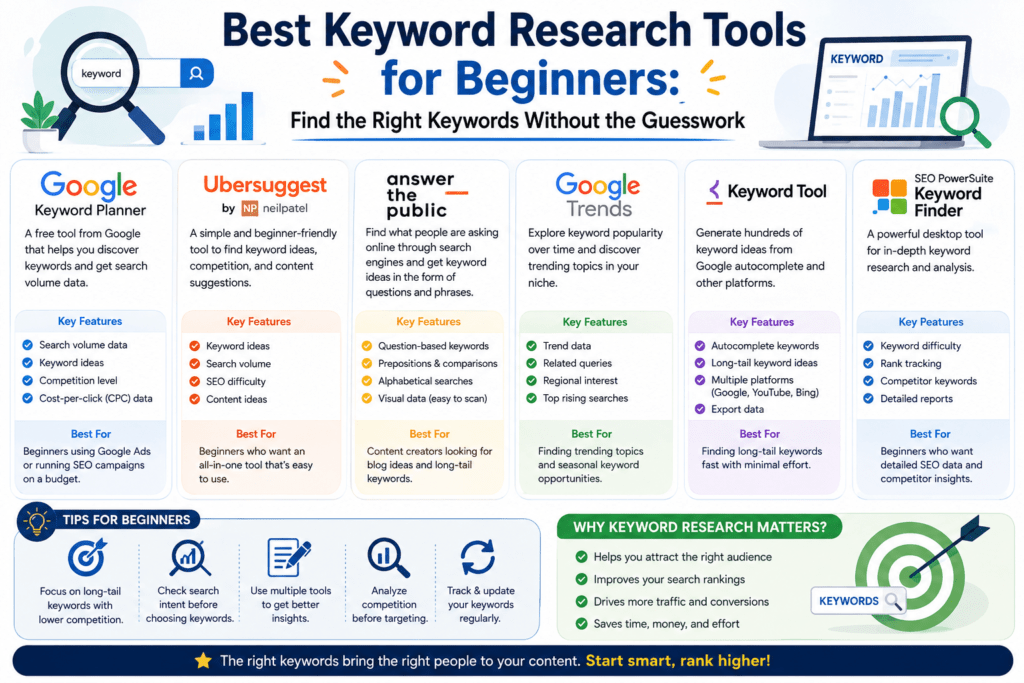
Table of Contents
What Is Keyword Research?
Keyword research is the process of finding and evaluating the words and phrases people use when searching online.
For example, a dental clinic owner might start with the broad idea “dentist.” Research could reveal more specific searches such as “dentist near me,” “root canal treatment cost,” or “best dental clinic in Pune.”
Each search can represent a different need and intent.
A useful keyword research process looks beyond search volume. You should also consider relevance, competition, search intent, business value, and whether your website can realistically compete for the term.
This is where keyword research tools save time. Instead of guessing hundreds of search phrases manually, you can use software to discover and compare potential opportunities.
Why Keyword Research Tools Matter
Good keyword research tools help answer several practical questions:
| Question | What the Tool Can Help You Understand |
|---|---|
| What are people searching for? | Keyword ideas |
| How popular is a keyword? | Search volume |
| Is the keyword competitive? | Difficulty estimates |
| What are competitors targeting? | Competitor keywords |
| What questions do users ask? | Question based keywords |
| Is the topic worth targeting? | Search intent and opportunity |
The important point is that the numbers are estimates, not guarantees.
A keyword showing high volume does not automatically mean it will generate customers. A lower volume phrase can sometimes be more valuable because it matches a specific service and strong buying intent.
Best Keyword Research Tools for Beginners
1. Google Keyword Planner
Google Keyword Planner is one of the easiest keyword research tool for a beginner to start, particularly because it is closely connected to Google’s advertising ecosystem.
It provides keyword ideas, geographic targeting, search volume information, and advertising related metrics. It can be especially useful for businesses researching both SEO and paid search.
For example, a real estate business can compare searches around “flats for sale in Mumbai,” “2 BHK in Mumbai,” and other related terms.
Best for: Beginners, local businesses, advertisers, and basic keyword discovery.
2. Ubersuggest
Ubersuggest is designed with simplicity in mind and can be useful for bloggers, small businesses, and people learning SEO.
It provides keyword suggestions, search volume estimates, competition information, and basic competitor research. Recent comparisons continue to position it as a budget friendly option for people who need a straightforward SEO workflow.
A beginner can enter one topic, review related phrases, and shortlist keywords for future blog posts.
Best for: Beginners, bloggers, freelancers, and small businesses.
3. Ahrefs Keywords Explorer
Ahrefs is a more advanced platform and is commonly used by SEO professionals who need deeper keyword, competitor, backlink, and SERP information.
Its keyword research features allow users to examine search demand, keyword difficulty, related terms, and other metrics. Current 2026 comparisons continue to rate Ahrefs highly for detailed keyword and competitive research.
The downside is that beginners may find the platform more complex than simpler tools.
Best for: Serious SEO work, agencies, advanced marketers, and competitor research.
4. Semrush Keyword Magic Tool
Semrush is an all in one marketing platform with strong keyword research and competitor analysis capabilities.
Its Keyword Magic Tool can generate keyword ideas and organize them using filters such as intent and topic relationships. It also connects keyword research with other SEO, content, and advertising workflows.
For a growing digital marketing team, having several marketing functions inside one platform can be useful.
Best for: Digital marketers, agencies, content teams, and businesses managing multiple SEO activities.
5. KWFinder
KWFinder from Mangools is known for a relatively simple interface and is often recommended for beginners who find larger SEO platforms overwhelming.
It focuses strongly on keyword discovery, long tail keywords, keyword difficulty, and SERP analysis. Recent comparisons highlight its beginner friendly workflow and suitability for smaller budgets.
If you are mainly interested in finding realistic keywords rather than learning a complicated SEO platform, it can be a practical option.
Best for: Beginners, bloggers, freelancers, and small businesses.
6. Google Search Console
Google Search Console is different from most keyword research tools because it provides first party performance data for your own website.
Once your website receives search impressions, Search Console can show the queries that are already bringing your pages visibility.
This creates an important opportunity. Instead of always looking for completely new keywords, you can find queries where your website already appears and improve the relevant page.
Best for: Website owners who already have organic search data.
How to Choose the Right Tool
Do not choose a tool simply because another SEO professional recommends it.
Start with your actual requirement.
| Your Need | Suitable Starting Point |
| Basic keyword ideas | Google Keyword Planner |
| Simple beginner research | Ubersuggest |
| Advanced SEO research | Ahrefs |
| SEO and marketing workflows | Semrush |
| Easy long tail research | KWFinder |
| Existing website data | Google Search Console |
You can also combine tools rather than depending on one platform.
For example, use Google Keyword Planner for initial ideas, Search Console for existing performance data, and a paid platform when you need deeper competitive research.
Frequently Asked Questions
Keyword research tools are SEO platforms that help users discover search terms and evaluate factors such as search volume, competition, keyword difficulty, related queries, and search intent.
Google Keyword Planner, Ubersuggest, and KWFinder are practical starting points for beginners because they are relatively easy to understand.
Some provide free access or limited free features. Google Keyword Planner and Google Search Console are particularly useful free starting points, while many advanced platforms use paid plans or limited trials.
Look at relevance, search intent, search volume, keyword difficulty, competition, business value, and the quality of the current search results.
Yes. Long tail keywords are usually more specific and can make it easier to match content with a particular search intent.
Conclusion
The best keyword research tools are not necessarily the ones with the largest databases or the most complicated dashboards. The best tool is the one that helps you understand your audience and make better content decisions.
Start simple. Learn how search volume, keyword difficulty, search intent, related keywords, and competitor results work. Then move to advanced platforms when your SEO needs become more demanding.
For a beginner, the goal should not be to collect hundreds of keywords. It should be to find the right keywords that are relevant to your audience, realistic for your website, and connected to a genuine business or content objective.
When you combine useful keyword research tools with human judgment, clear search intent, and helpful content, keyword research becomes much more than an SEO task. It becomes a foundation for a smarter content strategy.