
A/B Testing in Digital Marketing: A Beginner's Guide to Smarter Decisions
Learn how A/B testing works, what to test, how to measure results, and how businesses can use controlled experiments to improve digital marketing performance.
Introduction
Why does one landing page generate more enquiries than another? Why does one advertisement receive more clicks? Why do some email subject lines perform better than others?
Instead of guessing, marketers can test different versions and compare the results. This is where A/B testing becomes useful.
A/B testing is a method of comparing two versions of a marketing asset to understand which version performs better against a specific objective. The asset could be a landing page, advertisement, email subject line, call to action, headline, form, or another element of a digital experience.
For beginners, the concept is simple. Create two versions, expose them to comparable audiences, measure the results, and use the evidence to make a better decision.
However, good testing requires more than changing a button color and watching the numbers. You need a clear goal, a sensible hypothesis, an appropriate audience, and meaningful measurement.
The source material emphasizes that A/B testing works best when it is connected to a clear business objective, audience understanding, and measurable outcomes rather than being treated as an isolated tactic.
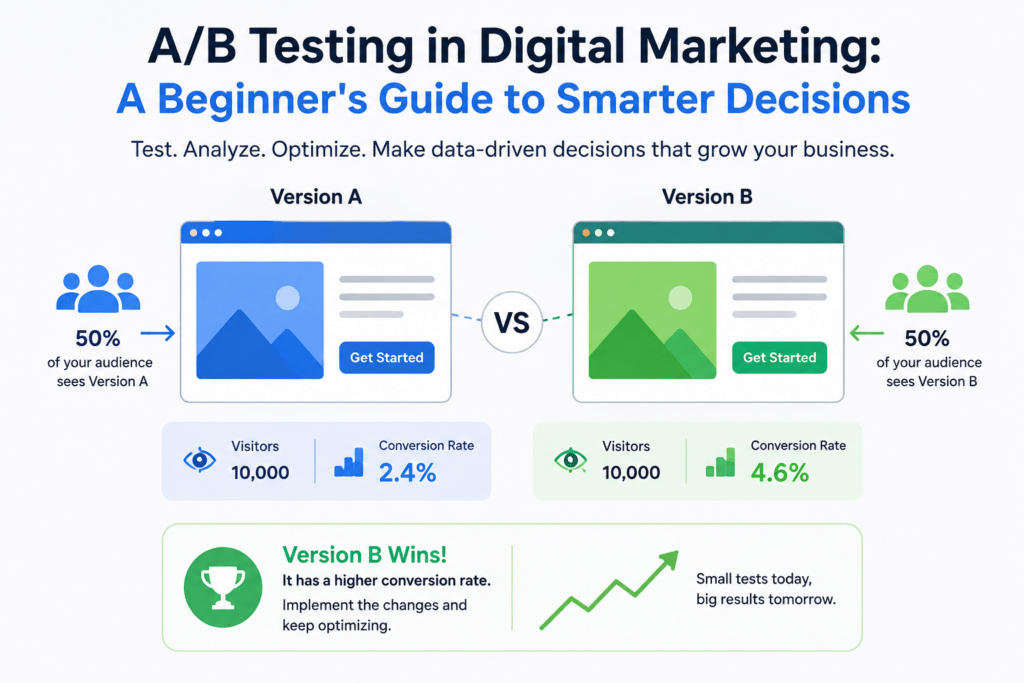
What Is A/B Testing?
A/B testing is a controlled comparison between two versions of an element to determine which one produces a better result.
The original version is usually called the control.
The modified version is called the variation.
For example:
Version A: “Book a Consultation”
Version B: “Get Your Free Consultation”
If visitors are randomly divided between the two versions and the second version generates more qualified enquiries, you have evidence that the variation performed better under the conditions of the test.
The important part is that the test should have a clear purpose.
You are not testing simply because testing sounds sophisticated.
You are testing because you want to answer a specific question.
Why Is A/B Testing Important?
A/B testing can help businesses replace assumptions with evidence.
Instead of saying:
“I think customers will prefer this headline.”
You can ask:
“Does this headline produce a better result with our target audience?”
That shift can make marketing decisions more practical.
Potential benefits include:
- Better conversion rates
- Improved landing pages
- More effective advertisements
- Stronger email performance
- Better user experience
- More informed content decisions
- Reduced guesswork
The source material stresses that measurement should connect directly to the original marketing goal and lead to decisions about what to improve, stop, test, or scale.
How Does A/B Testing Work?
A basic A/B test follows a simple process:
Goal → Hypothesis → Control → Variation → Test → Measurement → Decision
Step 1: Define the Goal
Start by deciding what you want to improve.
For example:
- More leads
- More sales
- Higher click through rate
- More registrations
- More appointment bookings
- Lower cost per acquisition
A goal should be specific enough to measure.
A business that wants more website leads might choose completed enquiry forms as the primary measurement.
Step 2: Create a Hypothesis
A hypothesis explains what you expect to happen and why.
For example:
“Changing the headline to clearly mention the customer’s main benefit will increase enquiry submissions.”
This gives the test a logical reason.
Step 3: Create Two Versions
Keep one version as the control and change a specific element in the variation.
Ideally, test one major variable at a time when you are trying to understand its specific effect.
Step 4: Run the Test
Expose comparable audiences to the different versions and collect enough data to make a meaningful comparison.
Step 5: Analyze the Results
Compare the relevant metrics.
Do not judge the test only by the number of clicks if the actual goal is qualified leads.
Step 6: Make a Decision
Depending on the result, you may:
- Keep the original
- Adopt the variation
- Continue testing
- Identify a new hypothesis
What Can You Test?
There are many elements that can be tested.
| Element | Example |
|---|---|
| Headline | Benefit focused vs descriptive |
| CTA | “Contact Us” vs “Book a Consultation” |
| Landing page | Short vs detailed |
| Form | Fewer fields vs more fields |
| Advertisement | Image A vs Image B |
| Email subject | Direct vs curiosity focused |
| Product page | Different layouts |
| Pricing presentation | Different formats |
The best test depends on the problem you are trying to solve.
If people visit a landing page but do not submit the form, changing the Instagram caption may not address the real issue.
Understand the customer journey first.
How to Create an A/B Test
Understand Your Audience
Before choosing what to test, study your customers.
Look at their:
- Questions
- Problems
- Motivations
- Objections
- Search behavior
- Feedback
- Website behavior
The source material recommends reviewing customer conversations, search queries, comments, reviews, and sales questions to identify patterns.
Identify the Problem
Suppose an online store receives plenty of product page traffic but few purchases.
The problem may involve:
- Unclear product information
- Weak trust signals
- Confusing navigation
- Poor mobile experience
- Complicated checkout
- Unclear shipping information
The test should investigate a reasonable hypothesis about the problem.
Change One Meaningful Variable
Do not change the headline, images, CTA, pricing, layout, and form simultaneously if you want to understand which change affected performance.
Changing several things creates ambiguity.
Metrics to Measure
The right metric depends on the objective.
| Goal | Useful Metric |
| Generate leads | Qualified leads |
| Increase sales | Purchases or revenue |
| Improve email performance | Clicks or conversions |
| Improve landing page | Conversion rate |
| Improve advertising | Cost per acquisition |
| Increase engagement | Meaningful engagement |
Traffic alone does not tell you whether the audience is valuable. The source material recommends considering metrics such as qualified leads, conversion rate, cost per acquisition, engagement quality, returning visitors, email clicks, and revenue influenced by a campaign.
Practical Example
Imagine a dental clinic has a landing page for dental implant consultations.
The existing CTA says:
“Contact Us”
The marketing team believes visitors may respond better to a more specific action.
They create a variation:
“Book a Dental Implant Consultation”
The test is measured using completed appointment requests rather than simply button clicks.
If the variation generates more qualified appointment requests under comparable conditions, the clinic has useful evidence that the new CTA deserves further consideration.
The next test might examine another part of the patient journey.
This creates a continuous learning process rather than a one time experiment.
Common A/B Testing Mistakes
Testing Without a Clear Goal
Do not start an experiment without knowing what success means.
Changing Too Many Things
If you change everything at once, it becomes difficult to identify what caused the result.
Focusing on Vanity Metrics
A higher click rate is not necessarily better if those clicks do not contribute to the business objective.
Stopping Too Quickly
Early results can change as more data becomes available. Avoid making decisions based on a tiny sample or one unusual period.
Copying Competitors
Another business’s winning variation may not work for your audience.
The source material specifically warns against copying competitors, changing direction too frequently, and measuring vanity metrics without business context.
Ignoring the Experience After the Click
A successful advertisement can still produce poor results if the landing page or next step is confusing.
Marketing should remain connected from the initial interaction through the next customer action.
Frequently Asked Questions
A/B testing is the process of comparing two versions of a marketing asset or experience to determine which version performs better against a specific objective.
It helps marketers make decisions using evidence rather than relying entirely on assumptions or personal preferences.
You can test headlines, CTAs, landing pages, advertisements, email subject lines, forms, layouts, product pages, and other measurable elements.
SEO is not mandatory for every business, but it can be extremely valuable when customers actively search for the products, services, or information you provide.
When the purpose is to understand the effect of a specific variable, changing one meaningful element at a time makes the result easier to interpret.
Conclusion
A/B testing gives marketers a practical way to learn what works with their audience instead of relying entirely on assumptions.
The process starts with a clear objective, moves to a reasonable hypothesis, compares controlled variations, measures meaningful outcomes, and uses the results to guide the next decision.
The most important lesson is that testing should be connected to the complete customer journey.
Understand the audience. Identify the problem. Create a useful hypothesis. Test carefully. Measure the result. Then improve the next step.
The source material captures this broader principle clearly: marketing becomes more predictable when businesses choose a focused objective, understand their audience, build useful assets, distribute them consistently, and measure the outcome.