
AEO vs SEO: What Is the Difference? A Complete Guide for Businesses
Understand the difference between Answer Engine Optimization and Search Engine Optimization(AEO VS SEO), where they overlap, and how businesses can prepare for traditional and AI powered search.
Introduction
Search is no longer limited to a page of blue links.
People can still use traditional search engines to find webpages, but they can also ask conversational questions and receive AI generated answers. Google currently provides AI Overviews and AI Mode, while other platforms provide conversational answers with links and citations. Google itself notes that AI responses can contain mistakes and encourages users to verify important information.
This change has made AEO vs SEO an important topic for businesses.
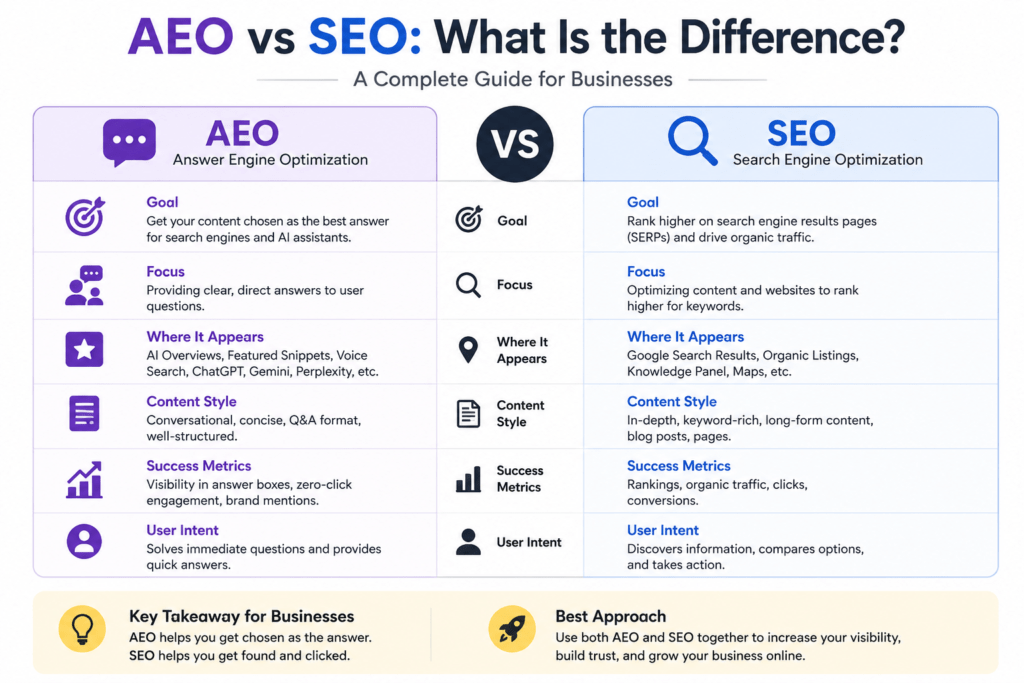
SEO focuses on improving a website’s visibility in traditional organic search results. AEO, or Answer Engine Optimization, focuses on making information easier for answer engines to retrieve, understand, and potentially cite within generated answers.
The two are not competing strategies. They overlap heavily and are best treated as complementary parts of a broader search strategy.
What Is SEO?
SEO stands for Search Engine Optimization.
It is the process of improving a website so search engines can discover, understand, and rank its pages for relevant searches.
SEO commonly involves:
- Keyword research
- Helpful content
- On page optimization
- Technical SEO
- Internal linking
- Website structure
- Link building
- Local SEO
- Search intent
- User experience
The traditional SEO objective is straightforward:
Appear prominently in organic search results and earn relevant visits to your website.
For example, a dental clinic may optimize pages for searches related to dental implants, root canal treatment, or dentists in its service area.
What Is AEO?
AEO stands for Answer Engine Optimization.
In the context of AEO vs SEO, AEO is focused more heavily on answer based search experiences where a system may synthesize information from multiple sources and provide a direct response.
AEO strategies commonly emphasize:
- Direct answers
- Question based content
- Clear headings
- Structured information
- Strong topical authority
- Entity clarity
- Reliable sources
- Content that can be easily interpreted and extracted
Recent industry explanations generally describe AEO as optimizing for citations or mentions inside AI generated answers, while SEO is primarily focused on rankings and organic clicks.
Google’s current AI search experiences also rely on web information and provide links for users who want to explore sources further.
AEO vs SEO: The Main Difference
The easiest way to understand AEO vs SEO is to look at what each is trying to achieve.
| SEO | AEO |
|---|---|
| Focuses on organic search rankings | Focuses on visibility within answer experiences |
| Aims to earn clicks to webpages | Aims to become a source, citation, or mentioned answer |
| Uses keywords and search intent | Uses questions, entities, context, and answer structure |
| Optimizes webpages for ranking | Optimizes information for interpretation and extraction |
| Measures rankings, clicks, traffic, and conversions | Can also consider citations, mentions, and AI referral visibility |
| Strong technical foundations matter | Strong technical foundations also matter |
The important point is that these differences do not mean you need two completely separate websites.
Many of the fundamentals are shared.
Where AEO and SEO Overlap
A major mistake is treating AEO vs SEO as an either or decision.
A high quality website can support both.
Useful Content
Both approaches depend on content that genuinely answers user needs.
Search Intent
Understanding why someone searches remains important whether the destination is a webpage or an AI generated answer.
Technical Accessibility
Search systems need to be able to access and interpret website information.
Authority
Trustworthy and relevant information remains important.
Internal Linking
A clear website structure helps connect related information and strengthen topical relationships.
Strong Brand Identity
A clear entity and consistent information about your business can support broader search visibility.
Current comparisons of AEO and SEO similarly describe them as complementary rather than mutually exclusive.
Key Differences in Strategy
1. How You Structure Answers
Traditional SEO content can be comprehensive and detailed.
AEO adds another useful consideration: make important answers easy to identify.
Instead of beginning a section with several paragraphs of background, answer the question first and then explain it in more depth.
For example:
What is Local SEO?
Local SEO is the process of improving a business’s visibility for relevant location based searches.
Then provide examples, techniques, and supporting information.
This answer first structure can make content easier for both people and information retrieval systems to understand.
2. How You Think About Keywords
SEO has traditionally placed significant emphasis on keywords and related search terms.
AEO requires broader thinking around questions, entities, context, and conversational phrasing.
Someone may search:
SEO services
But they may ask an answer engine:
What SEO services does a small business actually need?
Both queries relate to the same subject, but the second requires a more conversational and explanatory response.
3. How You Measure Success
SEO commonly uses:
- Rankings
- Organic clicks
- Impressions
- Organic traffic
- Conversions
- Leads
- Revenue
AEO adds possible indicators such as:
- AI citations
- Brand mentions
- Inclusion in generated answers
- AI referral traffic
- Visibility for conversational questions
Measurement is still developing because AI search experiences change quickly.
That means businesses should avoid relying on a single new metric.
Which One Should Businesses Focus On?
For most businesses, the sensible answer is:
Both.
SEO remains important because traditional search continues to send users to websites. At the same time, AI powered search experiences are becoming another way people discover information.
Google describes AI Overviews as a core Search feature and AI Mode as a more conversational experience that can explore multiple subtopics and provide helpful links to the web.
This means businesses should not abandon the fundamentals that already make a website useful.
Instead, build strong SEO foundations and structure content so it also works well for conversational and answer based search.
How to Optimize for Both
Create Clear, Useful Content
Answer real customer questions thoroughly.
Use Descriptive Headings
Make the subject of each section obvious.
Provide Direct Answers
Give concise answers before adding deeper explanations.
Build Topic Clusters
Create connected pages covering a subject from different angles.
Strengthen Expertise
Use practical examples, original insights, credible information, and real experience where appropriate.
Maintain Accurate Business Information
Keep your company name, services, locations, contact details, and other important information consistent.
Improve Technical SEO
Make sure important pages are accessible, indexable, fast, mobile friendly, and logically structured.
Continue Building Authority
Relevant mentions, useful content, credible references, and strong industry relationships can support both traditional and AI search visibility.
Common Mistakes
Treating AEO as a Replacement for SEO
AEO is not a reason to abandon traditional SEO.
Writing Only for AI Systems
Content should be useful to people first.
Creating Fake Question Sections
Do not add meaningless FAQs just to target conversational queries.
Ignoring Evidence
Clear and credible information is more valuable than unsupported claims.
Chasing Every AI Trend
Search technology is changing quickly. Build durable fundamentals instead of constantly rebuilding your strategy around every new feature.
Measuring Only Traffic
AI generated answers may change how users discover information, so traffic should be considered alongside broader business outcomes and visibility indicators.
Practical Example
Imagine a small dental clinic wants to improve its search visibility.
Its SEO strategy could focus on:
- Dental implant pages
- Local SEO
- Technical performance
- Keyword research
- Internal linking
- Helpful treatment guides
To make the same content more suitable for answer based search, the clinic could also structure articles around real patient questions:
What is a dental implant?
How long does a dental implant take?
What should you ask before choosing a dental clinic?
Each section can provide a direct answer followed by evidence, examples, and additional context.
The result is not an “SEO website” and an “AEO website.”
It is one useful, trustworthy website designed to serve different search experiences.
Frequently Asked Questions
SEO primarily focuses on earning visibility and rankings in traditional organic search results, while AEO focuses on becoming a useful source that can be surfaced or cited within answer based and AI search experiences.
No. Current guidance and industry analysis generally treat AEO and SEO as complementary. Strong SEO foundations remain important for AI search visibility.
No. AEO can relate to multiple answer and AI search experiences, including Google AI Overviews, Google AI Mode, ChatGPT, Perplexity, Gemini, and similar systems.
Yes. Ranking in traditional search and being cited in an AI generated answer are different outcomes, so success in one does not automatically guarantee success in the other.
Start with strong technical SEO, useful and authoritative content, clear page structure, relevant internal links, strong topic coverage, direct answers to real questions, and consistent business information.
Conclusion
Understanding AEO vs SEO is less about choosing a winner and more about understanding how search is expanding.
SEO focuses heavily on earning visibility in traditional search results and bringing people to your website.
AEO focuses more on making your information useful and understandable within answer based search experiences, including AI generated responses and citations.
The foundations overlap significantly.
Useful content, clear structure, technical accessibility, strong authority, relevant internal links, and genuine expertise can support both.
For businesses, the practical approach is simple: keep building a strong SEO foundation while making your content increasingly clear, direct, trustworthy, and useful for conversational search.
Search may change its interface, but helping people find reliable answers remains the central goal.