
How to Build a Keyword Cluster for Your Website: A Practical SEO Guide
Learn how keyword clustering works, how to group related search terms, build topic clusters, improve website structure, and create a more effective SEO content strategy.
Introduction
Creating individual pages for individual keywords can quickly turn into a messy SEO strategy. You may end up with dozens of articles covering almost the same subject, while important topics remain unexplored.
A Keyword Cluster provides a more organized approach.
Instead of treating every search phrase as a completely separate target, you group closely related keywords around one central topic. These keywords can then be mapped to a main page and supporting pages based on search intent and the questions your audience is trying to answer.
For example, a digital marketing website could build a cluster around SEO with supporting topics such as keyword research, technical SEO, local SEO, link building, and on page optimization.
The result is a website where related pages support one another instead of competing for attention.
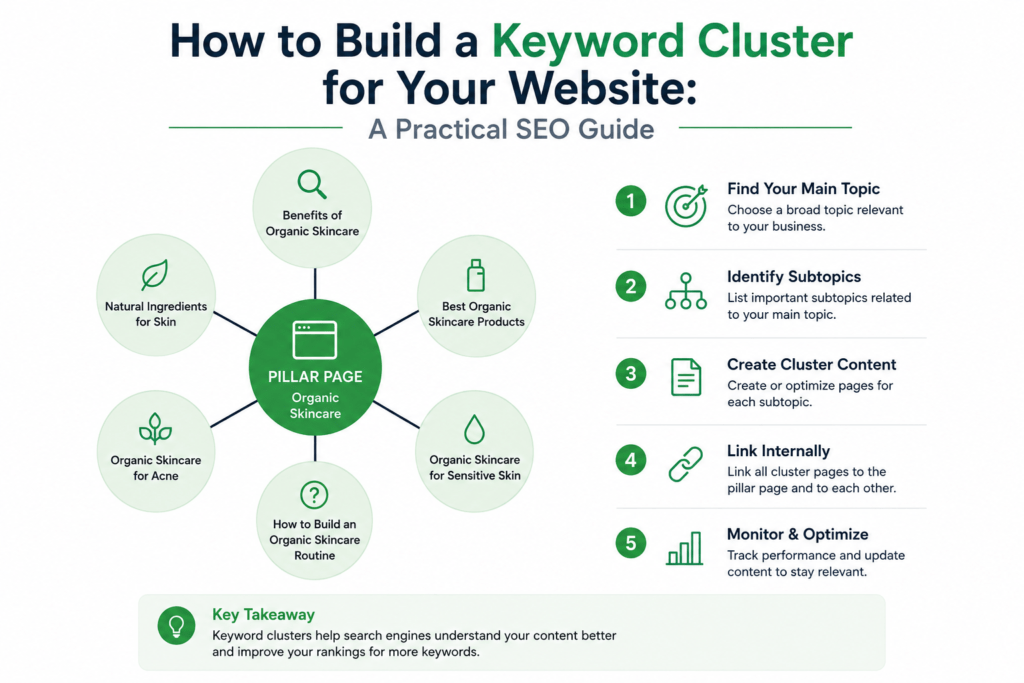
Table of Contents
What Is a Keyword Cluster?
A Keyword Cluster is a group of closely related search terms that represent the same broad topic or a connected set of user needs.
For example, suppose your main topic is:
Digital Marketing
A related cluster could contain:
- Digital marketing strategy
- Digital marketing for small businesses
- Digital marketing channels
- Digital marketing benefits
- Digital marketing examples
- Digital marketing tools
These phrases are different, but they are connected by the same broader subject.
Keyword clustering helps you decide which terms should be covered together and which deserve separate pages.
Why Keyword Clustering Matters for SEO
The biggest advantage of a Keyword Cluster is organization.
Instead of publishing random articles, you can create a connected content system.
A strong cluster can help you:
- Organize content
- Avoid unnecessary duplication
- Cover a topic more completely
- Improve internal linking
- Understand search intent
- Build topical depth
- Plan future content
- Connect supporting pages to important pages
The goal is not to force every related keyword onto one page.
The goal is to understand the relationship between searches and create the right page for each meaningful intent.
Keyword Cluster vs Keyword List
A keyword list is simply a collection of search terms.
For example:
- SEO
- Keyword research
- SEO tools
- Link building
- Technical SEO
- Local SEO
A Keyword Cluster goes one step further.
It asks:
Which keywords belong together?
Which terms represent the same search intent?
Which keywords require separate pages?
Which pages should link to each other?
This turns keyword research into a content architecture.
How to Build a Keyword Cluster
Step 1: Choose a Broad Seed Topic
Start with a topic that is directly connected to your business.
For a dental clinic:
Dental implants
For a real estate business:
Property investment
For an SEO agency:
SEO
For an influencer:
Instagram marketing
The seed topic becomes the starting point for your cluster.
Step 2: Collect Related Keywords
Use keyword research tools to find related terms.
Useful sources include:
- Google Keyword Planner
- Google Search Console
- Ahrefs
- Semrush
- Ubersuggest
- KWFinder
- Google autocomplete
- People Also Ask
- Related searches
- Competitor pages
Collect a broad list before deciding which terms belong together.
Step 3: Group Keywords by Meaning
Look beyond exact word matches.
Suppose you discover:
- How much does SEO cost?
- SEO pricing
- SEO services cost
- SEO agency pricing
These may represent closely related intent.
On the other hand:
- What is SEO?
- How does SEO work?
- SEO benefits
may belong to a broader informational cluster.
The important factor is not whether the keywords contain the same words.
It is whether they represent similar user needs.
How to Group Keywords by Search Intent
Search intent should be one of the strongest signals when building a Keyword Cluster.
| Intent | Example Keyword | Potential Page |
|---|---|---|
| Informational | What is SEO? | SEO guide |
| Informational | How does SEO work? | SEO guide |
| Commercial | Best SEO tools | Comparison article |
| Commercial | SEO agency pricing | Service guide |
| Transactional | Hire SEO agency | Service page |
| Local | SEO agency near me | Local service page |
Two keywords can be semantically related but still require different pages if their intent is different.
This is why keyword clustering should not be based purely on numbers or word similarity.
How to Create a Topic Cluster
A topic cluster usually contains a central page and supporting content.
Pillar Page
The pillar page covers the broad subject.
Example:
Complete Guide to SEO
Supporting Pages
Supporting pages cover narrower subjects.
- Keyword Research
- Technical SEO
- Local SEO
- Link Building
- On Page SEO
- SEO Content Strategy
The supporting pages can link back to the pillar page, while the pillar page can link to the relevant supporting resources.
This creates a logical structure.
Why Topic Clusters Work Well
A website becomes easier to understand when related pages are connected.
For example:
SEO Guide
↓
Keyword Research
↓
Keyword Research Tools
↓
Long Tail Keywords
Each page serves a specific purpose while remaining connected to the broader topic.
Keyword Mapping
Once your clusters are created, map each important keyword group to the right page.
This prevents multiple pages from accidentally targeting the same search intent.
A simple keyword map can look like this:
| Page | Primary Topic | Supporting Keywords |
| SEO Guide | SEO | Search engine optimization |
| Keyword Research Guide | Keyword Research | Keyword ideas, search intent |
| Link Building Guide | Link Building | Backlinks, off page SEO |
| Local SEO Guide | Local SEO | Local search, Google Business Profile |
Keyword mapping becomes particularly useful as your website grows because it gives your content team a clear reference point.
Practical Example
Imagine a real estate website wants to build a content cluster around property investment.
After research, it identifies:
- Property investment
- Property investment tips
- Best property investment locations
- Residential property investment
- Property investment mistakes
- Property investment for beginners
- Rental property investment
Instead of writing seven disconnected articles, the business could organize them into a structured content system.
Pillar Page
Complete Guide to Property Investment
Supporting Content
Property Investment Tips for Beginners
How to Choose a Property Investment Location
Common Property Investment Mistakes
Residential vs Rental Property Investment
These pages can then be connected through internal links.
The result is a more organized website and a clearer user journey.
Common Keyword Clustering Mistakes
Grouping Keywords Only Because They Look Similar
Two terms can contain similar words but have completely different intent.
Always inspect the actual search results.
Creating Too Many Pages
Not every keyword variation deserves its own article.
Some searches can be answered naturally on the same page.
Ignoring Search Intent
This is one of the biggest mistakes.
A user searching for information should not necessarily land on a sales page.
Forgetting Existing Content
Before creating a new page, check whether you already have a page that answers the same question.
Not Linking Related Pages
A cluster becomes much more useful when the pages are logically connected through internal links.
Chasing Search Volume
A keyword with lower volume can still be strategically valuable if it matches your audience and business objective.
Frequently Asked Questions
A Keyword Cluster is a group of related search terms that are connected by topic, meaning, or search intent and can be organized into a logical content strategy.
It helps businesses organize related keywords, avoid unnecessary content duplication, build topical depth, and create better internal linking structures.
There is no fixed number. A cluster can contain a few closely related terms or many terms covering a broader topic. Quality of relationship matters more than quantity.
No. Keywords with the same search intent can often be covered by one strong page. Separate pages are more appropriate when the search intent or user need is meaningfully different.
Keyword clustering groups related keywords together. Keyword mapping assigns those keyword groups to specific pages on your website.
Conclusion
A Keyword Cluster gives your SEO strategy structure.
Instead of treating every keyword as an isolated target, you can organize related searches around broader topics, understand their intent, map them to appropriate pages, and connect those pages through internal links.
Start with a broad topic. Collect related searches. Group them based on meaning and intent. Decide which keywords belong on the same page and which deserve separate content. Then build a logical internal linking structure.
The goal is not to create the largest collection of keywords.
It is to create a website that covers important topics thoroughly and makes those topics easy for both users and search engines to understand.
When keyword research, content planning, keyword mapping, and internal linking work together, your SEO strategy becomes much more organized and scalable.