
How to Create a Marketing Strategy for a New Business
A practical guide to defining your audience, positioning your brand, choosing marketing channels, setting goals, and building a strategy that can grow with your business.
Introduction
Starting a new business is exciting, but marketing can quickly become confusing.
Should you focus on Instagram? SEO? Google Ads? Content? Email? Local marketing?
The problem is usually not a lack of options. It is a lack of direction.
A marketing strategy for a new business gives you a framework for deciding what to do, who to target, where to reach them, and how to measure the results.
The goal is not to use every marketing channel available.
The goal is to identify the audience, understand its needs, define a useful position, choose appropriate channels, and create a system that can be measured and improved.
The source material emphasizes starting with a clear objective, understanding the audience, building useful assets, distributing them consistently, and measuring outcomes.
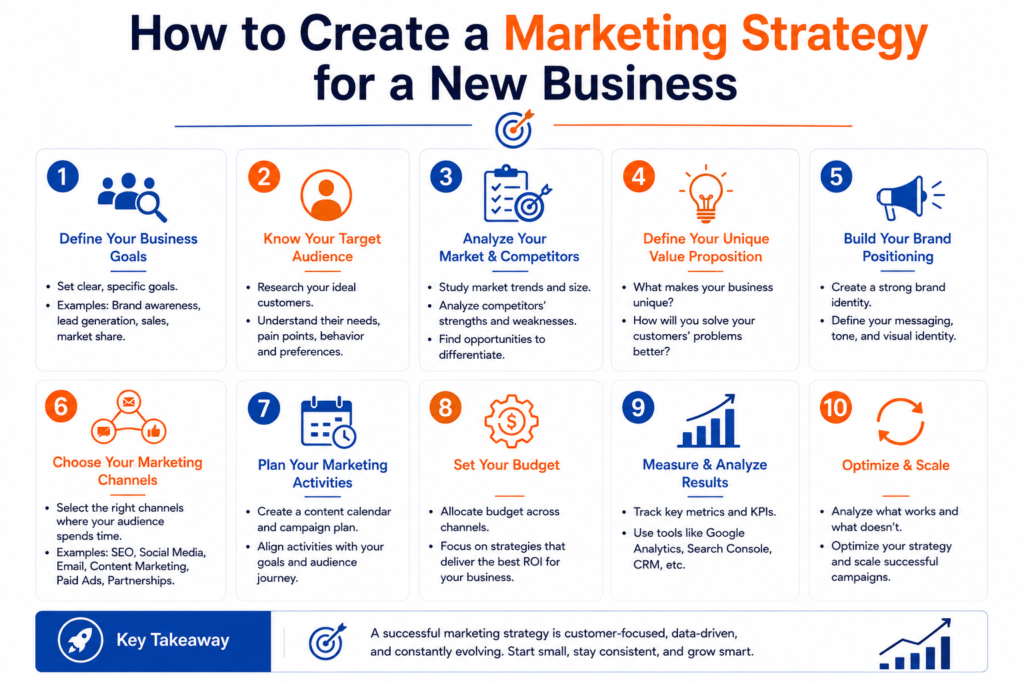
Table of Contents
What Is a Marketing Strategy?
A marketing strategy is a plan that explains how a business will attract, engage, convert, and retain customers.
A practical marketing strategy for a new business should answer:
- Who are we targeting?
- What problem do we solve?
- What makes us different?
- Where can we reach customers?
- What message should we communicate?
- What action should customers take?
- How will we measure success?
These decisions create direction.
Why New Businesses Need a Strategy
New businesses usually have limited:
- Budget
- Time
- Team capacity
- Brand awareness
- Customer data
That makes random marketing expensive.
A strategy helps you prioritize.
For example, a local dental clinic may benefit more from Google Search and local SEO than from spending a large budget on nationwide advertising.
A B2B consulting firm may gain more from LinkedIn and educational content than from chasing viral Instagram posts.
The right channel depends on the customer.
Step by Step Marketing Strategy
1. Define Your Target Audience
Start with the customer rather than the product.
Understand:
- Needs
- Problems
- Buying triggers
- Objections
- Budget
- Location
- Search behavior
- Preferred channels
Customer conversations, reviews, social media comments, search queries, and sales questions can provide useful insights.
2. Study Competitors
Look at:
- Their positioning
- Pricing
- Offers
- Content
- Social presence
- SEO visibility
- Customer reviews
- Strengths
- Weaknesses
Do not copy them.
Look for opportunities they are missing.
3. Define Your Positioning
Why should customers choose you instead of another option?
Your positioning should communicate:
Who you serve + what you offer + why it matters + what makes you different
For example:
Instead of:
“We provide digital marketing services.”
Try:
“We help small businesses build practical digital marketing systems focused on qualified leads.”
Specific positioning is easier to remember.
4. Set Marketing Goals
Your marketing strategy for a new business should have measurable goals.
Examples:
- Generate 50 qualified leads
- Reach 10,000 relevant users
- Generate 1,000 website visitors
- Book 20 consultations
- Achieve a specific sales target
Avoid vague goals such as “grow online.”
A useful objective gives the team a clear direction.
5. Choose Marketing Channels
Possible channels include:
- SEO
- Google Ads
- Social media
- Email marketing
- Content marketing
- Influencer marketing
- Referral marketing
- Local marketing
Choose based on where your customers actually spend time.
6. Create a Content Strategy
Content can help new businesses educate audiences and build credibility.
Examples include:
- Blog posts
- Videos
- Guides
- Case studies
- FAQs
- Social media posts
- Customer stories
Quality and relevance matter more than producing content simply to fill a calendar. The source material emphasizes creating useful information that answers real questions and helps people make better decisions.
7. Set a Marketing Budget
Divide your budget according to priority.
For example:
| Activity | Possible Focus |
|---|---|
| SEO | Long term visibility |
| Paid Ads | Faster traffic and leads |
| Content | Education and authority |
| Social Media | Awareness and engagement |
| Design | Brand consistency |
| Analytics | Measurement |
You do not need to spend heavily on every channel at the beginning.
8. Measure Results
Track the metrics that connect to your goals.
Depending on the strategy, this may include:
- Leads
- Conversion rate
- Cost per lead
- Sales
- Revenue
- Organic traffic
- Engagement quality
- Customer acquisition cost
The source material recommends comparing results over time and using measurement to decide what to improve, stop, test, or scale.
Common Mistakes
Trying Every Channel
More platforms do not automatically mean better marketing.
Targeting Everyone
A narrow audience can make your message stronger.
Changing Direction Every Week
Give your strategy enough time to produce useful evidence.
Ignoring Customer Feedback
Your customers can reveal opportunities that market reports may miss.
Measuring Vanity Metrics
Followers and impressions are useful context, but they should not replace meaningful business outcomes.
Frequently Asked Questions
What is a marketing strategy for a new business?
It is a structured plan that defines your target audience, positioning, goals, channels, messaging, budget, and measurement approach.
What should a new business market first?
Start with the problem you solve and the audience you serve. Then choose the channels where that audience is most likely to discover and evaluate your offer.
How many marketing channels should a startup use?
There is no fixed number. Start with a manageable set of channels that align closely with your customers and business goals.
Is digital marketing enough for a new business?
It can be a major part of the strategy, but offline referrals, partnerships, events, networking, local marketing, and other activities may also be valuable depending on the business.
How long does a marketing strategy take to work?
The timeline varies by channel, competition, budget, offer, audience, and execution. Some paid campaigns can produce results quickly, while SEO and content marketing often require more time.
Conclusion
A strong marketing strategy for a new business begins with clarity.
Understand the customer. Study competitors. Define your position. Set measurable goals. Choose suitable channels. Create useful content. Set a realistic budget. Then measure what happens.
Do not confuse activity with progress.
Publishing every day, running multiple ads, or creating social media accounts does not automatically create growth.
A good strategy tells you why each activity exists and how it contributes to the larger business objective.