
How to Map the Customer Journey for a Digital Marketing Campaign
Learn how to map every customer touchpoint, understand what people need at each stage, choose the right marketing activities, and improve the path from discovery to conversion.
Introduction
A customer rarely sees one advertisement and immediately becomes a buyer.
They may discover your business through Google, visit your website, follow your social media profile, read a blog, compare your service with competitors, check reviews, speak with your team, and finally take action.
This is why understanding the customer journey is important when planning a digital marketing campaign.
Instead of looking at SEO, social media, advertising, email, and landing pages as separate activities, journey mapping connects them into one experience.
The source material emphasizes that marketing becomes more predictable when each activity connects to the next step in the customer journey.
For a digital marketing campaign, this means understanding what your audience needs before, during, and after each interaction.
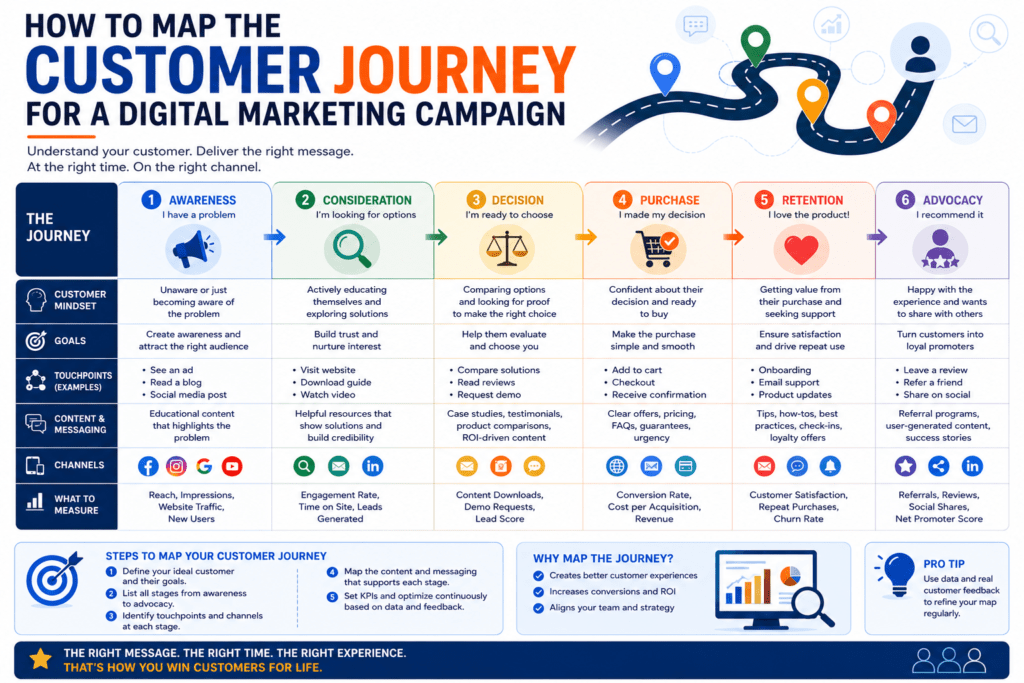
Table of Contents
What Is a Customer Journey?
The customer journey is the series of interactions a person has with a business before, during, and after becoming a customer.
A simplified journey might look like:
Awareness → Research → Consideration → Decision → Purchase → Retention
Not every customer follows this exact path.
Some people may buy quickly.
Others may spend weeks researching.
The purpose of mapping is to understand the common paths and identify what customers need at each stage.
Why Customer Journey Mapping Matters
A digital campaign can generate plenty of traffic and still produce disappointing results.
Why?
Because the campaign may attract people without giving them a logical next step.
For example:
Advertisement → Homepage
may not provide enough information.
A more connected path could be:
Advertisement → Relevant Landing Page → Case Study → Consultation
The second journey gives the customer a clearer progression.
The source material recommends mapping work from discovery to action by attracting the right people, educating them, creating trust, making the next step obvious, and following up consistently.
Main Stages of the Customer Journey
Awareness
The customer becomes aware of a problem, need, product, or business.
Useful channels may include:
- SEO
- Social media
- Advertising
- Videos
- Educational content
At this stage, the goal is usually attention and understanding.
Research
The customer starts looking for information.
They may compare:
- Prices
- Features
- Services
- Reviews
- Alternatives
- Providers
Useful content includes guides, FAQs, comparisons, and educational articles.
Consideration
The customer now has several options and is deciding which one appears most suitable.
Trust becomes particularly important.
Useful assets can include:
- Testimonials
- Reviews
- Case studies
- Expert explanations
- Demonstrations
- Transparent service information
Decision
The customer is ready to take action.
The next step should be clear:
Book
Buy
Call
Request a Quote
Schedule a Consultation
Retention
The journey does not necessarily end after a purchase.
Follow up, customer service, useful information, and ongoing communication can influence repeat business and referrals.
How to Map the Customer Journey
Step 1: Define Your Customer
Start with one important customer segment.
Use actual audience research rather than assumptions.
The source material recommends studying problems, motivations, questions, objections, reviews, search queries, customer conversations, and sales questions.
Step 2: Define the Customer’s Goal
Ask what the person is trying to achieve.
A customer looking for a dentist wants different information from someone researching digital marketing services.
Step 3: List the Touchpoints
Write down every meaningful interaction.
| Stage | Touchpoint | Customer Need |
|---|---|---|
| Awareness | Google Search | Discover solution |
| Research | Blog | Learn |
| Consideration | Service page | Evaluate |
| Trust | Reviews | Reduce uncertainty |
| Decision | Landing page | Take action |
| Retention | Stay connected |
Step 4: Identify Questions
At every stage, ask:
What is the customer likely to ask now?
For example:
Awareness:
“What is SEO?”
Research:
“How does SEO help a small business?”
Consideration:
“Which SEO agency should I choose?”
Decision:
“How can I book a consultation?”
This creates a natural content and campaign structure.
Identifying Customer Touchpoints
A touchpoint is any meaningful interaction between the customer and your business.
Examples include:
- Google Search
- Blog posts
- Social media
- Advertisements
- Website pages
- Emails
- Reviews
- Phone calls
- Sales conversations
- Customer support
A strong campaign considers what happens between these touchpoints.
For example, a social media advertisement may generate attention, but the landing page must continue the same message.
The source material warns against ignoring the experience after the initial click or view.
Matching Content to Each Stage
Your content should reflect the customer’s level of awareness.
| Stage | Content Example |
|---|---|
| Awareness | Educational blog |
| Research | Detailed guide |
| Consideration | Comparison or case study |
| Decision | Service page or consultation |
| Retention | Email or customer resource |
This approach prevents the common mistake of showing the same message to every person.
Measuring Campaign Performance
A customer journey should be measurable.
Depending on your objective, track:
- Traffic
- Engagement
- Leads
- Qualified leads
- Conversion rate
- Cost per lead
- Customer acquisition cost
- Sales
- Revenue
- Repeat customers
The source material recommends connecting measurement to the original objective rather than relying only on traffic or vanity metrics.
Look for Drop Off Points
Suppose:
10,000 people visit your website
1,000 view your service page
100 submit an enquiry
10 become customers
The biggest opportunity may exist at one specific stage.
Perhaps the service page is unclear.
Perhaps the form creates too much friction.
Perhaps the leads are poor quality.
Mapping helps you investigate the problem.
Practical Example
Imagine a dental clinic wants to increase treatment bookings.
A mapped customer journey could look like:
Google Search → Educational Article → Treatment Page → Patient Reviews → Appointment Page → Consultation
At each stage, the clinic can provide different information.
The article explains the treatment.
The service page explains the clinic’s offering.
Reviews build trust.
The appointment page provides a clear action.
This is more effective than sending every visitor directly to a generic homepage.
Common Mistakes
Assuming Every Customer Follows the Same Journey
Different audiences can have very different decision processes.
Ignoring Existing Customers
Retention is part of the customer experience.
Creating Too Many Touchpoints
More steps do not automatically create a better experience.
Using the Same Message Everywhere
The message should adapt to the customer’s level of awareness.
Measuring Only Traffic
Traffic does not tell you what happens after someone arrives.
Ignoring the Next Step
Every major interaction should make the next useful action clear.
Frequently Asked Questions
What is a customer journey in digital marketing?
The customer journey is the sequence of interactions and decisions a person experiences as they move from discovering a business to considering, purchasing, and potentially returning.
Why is customer journey mapping important?
It helps businesses understand customer needs, identify friction points, improve marketing messages, and create a more connected path toward conversion.
What are the main stages of a customer journey?
Common stages include awareness, research, consideration, decision, purchase, and retention.
How do I map a customer journey?
Define the customer segment, understand the customer’s goal, list touchpoints, identify questions and objections, match content to each stage, and measure the results.
What is a customer touchpoint?
A customer touchpoint is an interaction between a customer and a business, such as a search result, advertisement, social media post, website page, email, review, phone call, or sales conversation.
Can small businesses use customer journey mapping?
Yes. Even a simple map can help small businesses understand where customers discover them, what information they need, and what may prevent them from taking action.
Conclusion
Mapping the customer journey helps transform a collection of marketing activities into a connected campaign.
Instead of thinking only about attracting traffic, you start looking at the entire experience.
Where does the customer discover you?
What information do they need next?
What creates trust?
What causes hesitation?
What makes the next action easy?
What happens after conversion?
These questions can improve SEO, advertising, social media, landing pages, content, sales processes, and customer retention.
The source material emphasizes that marketing becomes more predictable when activities connect from discovery through education, trust, action, and follow up.
A good customer journey map does not need to be complicated.
It needs to reflect how real customers behave.