
Touchpoints in the Customer Journey: What Marketers Should Track
Understand the important interactions customers have with your brand, which touchpoints to monitor, what data to collect, and how marketers can improve the journey from discovery to conversion.
Introduction
A customer rarely makes a purchase after seeing just one advertisement or visiting one webpage. They may discover your business through Google, visit your website, see an Instagram post, read a review, receive an email, and eventually contact your team.
Each of these interactions is a customer journey touchpoint.
Understanding these touchpoints helps marketers see how people move through the buying process. It also reveals where customers become interested, where they lose confidence, and where they finally take action.
For a local business, dental clinic, real estate company, ecommerce brand, influencer, or digital marketing agency, tracking the right touchpoints can provide valuable information about what customers actually experience.
The objective is not to track everything.
It is to track the interactions that help explain customer behavior and contribute to meaningful business outcomes.
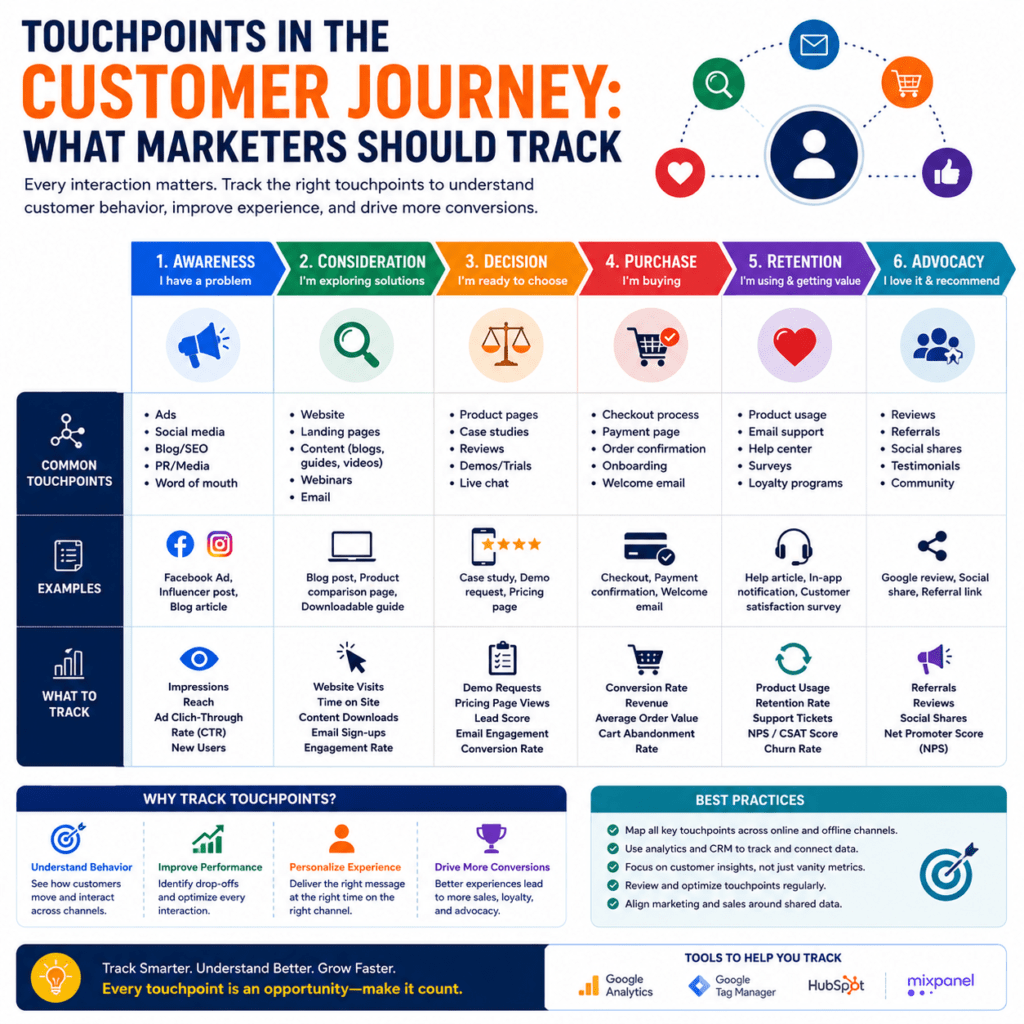
Table of Contents
What Are Customer Journey Touchpoints?
Customer journey touchpoints are the different interactions a customer has with a business during their relationship with the brand.
These interactions can happen before, during, or after a purchase.
Examples include:
- Google search results
- Blog posts
- Social media content
- Online advertisements
- Website pages
- Landing pages
- Reviews
- Emails
- Phone calls
- Sales conversations
- Customer support
- Follow up messages
A touchpoint can be digital or offline.
For example, a person may discover a dental clinic through Google, visit its website, call the clinic, attend an appointment, and later receive a follow up message.
That is an entire journey made up of several touchpoints.
Why Should Marketers Track Touchpoints?
Tracking customer journey touchpoints helps marketers understand what happens between awareness and conversion.
Without this information, a business may know that it generated 100 leads but not understand why some customers converted while others disappeared.
Touchpoint analysis can help identify:
| What You Can Learn | Why It Matters |
|---|---|
| Where customers discover you | Helps prioritize acquisition channels |
| What content they consume | Helps improve content strategy |
| Where they leave | Reveals friction |
| What creates trust | Improves messaging |
| What drives conversions | Supports optimization |
| What happens after purchase | Supports retention |
The aim is to connect individual interactions with the broader customer journey.
Types of Customer Journey Touchpoints
Search Touchpoints
Customers may discover your brand through search engines.
Examples include:
- Organic search results
- Local search
- Branded searches
- Search advertisements
For a local dental clinic, searches such as “dentist near me” can represent an important discovery touchpoint.
Social Media Touchpoints
Customers may interact through:
- YouTube
- Other relevant platforms
These interactions can include viewing a post, commenting, sending a message, or visiting a profile.
Website Touchpoints
Your website can contain several touchpoints:
- Homepage
- Service pages
- Product pages
- Blog posts
- Landing pages
- Contact page
- Pricing page
- FAQ pages
Each page can serve a different customer need.
Trust Touchpoints
Reviews, testimonials, case studies, credentials, and recommendations can influence customer confidence.
For service businesses, these touchpoints can be especially important before a prospect contacts the company.
Sales Touchpoints
A phone call, consultation, product demonstration, proposal, or sales email can influence whether a prospect moves forward.
Post Purchase Touchpoints
The relationship does not necessarily end after the sale.
Customer support, follow up emails, onboarding, feedback requests, and loyalty programs can affect retention and referrals.
What Touchpoints Should You Track?
Not every touchpoint needs the same level of attention.
Focus on interactions connected to your business goals.
Website Visits
Track which pages customers visit and how they move between pages.
Landing Page Performance
Review visits, engagement, form submissions, and conversions.
Social Media Interactions
Look beyond likes.
Consider comments, direct messages, profile visits, link clicks, and meaningful engagement.
Search Queries
Search data can reveal what customers are looking for before they reach your website.
Email Engagement
Depending on the campaign, useful measurements can include opens, clicks, replies, and conversions.
Lead Sources
Identify where enquiries come from.
For example:
| Lead Source | Leads | Qualified Leads |
|---|---|---|
| Google Search | 50 | 20 |
| 70 | 10 | |
| Referral | 15 | 12 |
| Google Ads | 40 | 18 |
This example shows why lead quantity alone can be misleading.
Instagram generated more leads, but referrals produced a much higher proportion of qualified prospects.
How to Track Customer Touchpoints
Use Analytics Tools
Website analytics can help you understand traffic sources, page behavior, and conversions.
Connect Marketing Platforms
Connect advertising, CRM, email, analytics, and website data where practical.
This creates a clearer picture of the customer’s path.
Use CRM Data
Record:
- Lead source
- Contact history
- Sales stage
- Follow up
- Conversion status
- Customer value
Collect Customer Feedback
Ask customers what influenced their decision.
A simple question such as:
“How did you first hear about us?”
can reveal useful information.
You can also ask:
“What made you choose us?”
and:
“What information helped you make your decision?”
Customer conversations, reviews, search queries, comments, and sales questions can reveal patterns that help marketers understand what the audience needs.
Touchpoints by Customer Journey Stage
Different stages require different types of measurement.
| Journey Stage | Common Touchpoints | Useful Metrics |
|---|---|---|
| Awareness | Search, social, ads | Reach, impressions |
| Research | Blogs, guides, videos | Engagement, returning visitors |
| Consideration | Reviews, case studies | Page engagement, enquiries |
| Decision | Landing pages, forms | Conversion rate |
| Purchase | Checkout, sales call | Sales, revenue |
| Retention | Email, support | Repeat purchases, retention |
This prevents marketers from judging every touchpoint using the same metric.
How to Identify Weak Touchpoints
Suppose an advertisement generates thousands of clicks but the landing page produces almost no enquiries.
The advertisement may not be the main problem.
The landing page could have:
- Weak messaging
- Poor relevance
- A confusing CTA
- Too many form fields
- Insufficient trust information
- A poor mobile experience
This is why the entire journey needs to be considered.
Marketing should feel connected from the first interaction through the next action.
Look for Drop Offs
Ask where customers stop moving forward.
For example:
10,000 visitors → 2,000 service page views → 300 enquiries → 30 customers
The large reduction at one stage can provide a clue about where further investigation is needed.
Practical Example
Imagine a real estate company wants to understand why many website visitors do not become enquiries.
The marketing team maps the journey:
Google Search → Property Article → Property Listing → Pricing Information → Reviews → Enquiry Form → Sales Call
The analysis shows that many visitors view pricing information but leave before reaching the enquiry form.
The company could investigate whether pricing is unclear, whether visitors need additional information, or whether the next action is difficult to find.
This is the value of tracking customer journey touchpoints.
Instead of saying “the website is not converting,” the team can investigate a specific part of the journey.
Common Mistakes
Tracking Everything
Too much data can make it difficult to identify what actually matters.
Measuring Only Traffic
Traffic shows reach but does not automatically show business value.
Ignoring Offline Interactions
Phone calls, meetings, referrals, and sales conversations can be important touchpoints.
Treating Every Customer the Same
Different customer segments may follow different journeys.
Ignoring Post Purchase Experiences
Retention and referrals are also influenced by customer interactions after conversion.
Not Acting on the Data
Measurement is useful only when it leads to a decision about what to improve, test, or scale.
Frequently Asked Questions
What are customer journey touchpoints?
Customer journey touchpoints are the interactions a person has with a business before, during, and after becoming a customer.
Why are customer journey touchpoints important?
They help marketers understand how people discover, evaluate, trust, purchase from, and interact with a business.
What customer touchpoints should marketers track?
Important touchpoints can include search, social media, website pages, advertisements, reviews, emails, sales conversations, customer service, and post purchase communication.
How do I identify the most important touchpoints?
Start with your business objective and customer journey. Then identify the interactions that influence discovery, consideration, conversion, and retention.
Should I track every customer interaction?
No. Focus on interactions that provide useful information about customer behavior or contribute to meaningful business outcomes.
Can small businesses track customer journey touchpoints?
Yes. Even basic tracking of lead sources, website behavior, customer questions, reviews, calls, and conversions can provide valuable insights.
Conclusion
Customer journey touchpoints give marketers a clearer view of how people interact with a business.
Instead of looking at SEO, social media, advertising, content, email, and sales as separate activities, you can connect them into one customer experience.
Track where customers discover you.
Understand what information they consume.
Identify what builds trust.
Find where they drop off.
Measure what leads to meaningful action.
Then use those insights to improve the journey.
The goal is not to collect the largest amount of data. It is to understand the interactions that matter and use that understanding to create a smoother customer experience.