
How to Build a Full Funnel Marketing Campaign That Moves Customers From Awareness to Conversion
Learn how to connect awareness, consideration, conversion, and retention into one practical marketing campaign designed around your audience and business goals.
Introduction
A customer rarely makes a purchase after seeing just one advertisement or visiting one webpage. They may discover your business through Google, visit your website, see an Instagram post, read a review, receive an email, and eventually contact your team.
Each of these interactions is a customer journey touchpoint.
Understanding these touchpoints helps marketers see how people move through the buying process. It also reveals where customers become interested, where they lose confidence, and where they finally take action.
For a local business, dental clinic, real estate company, ecommerce brand, influencer, or digital marketing agency, tracking the right touchpoints can provide valuable information about what customers actually experience.
The objective is not to track everything.
It is to track the interactions that help explain customer behavior and contribute to meaningful business outcomes.
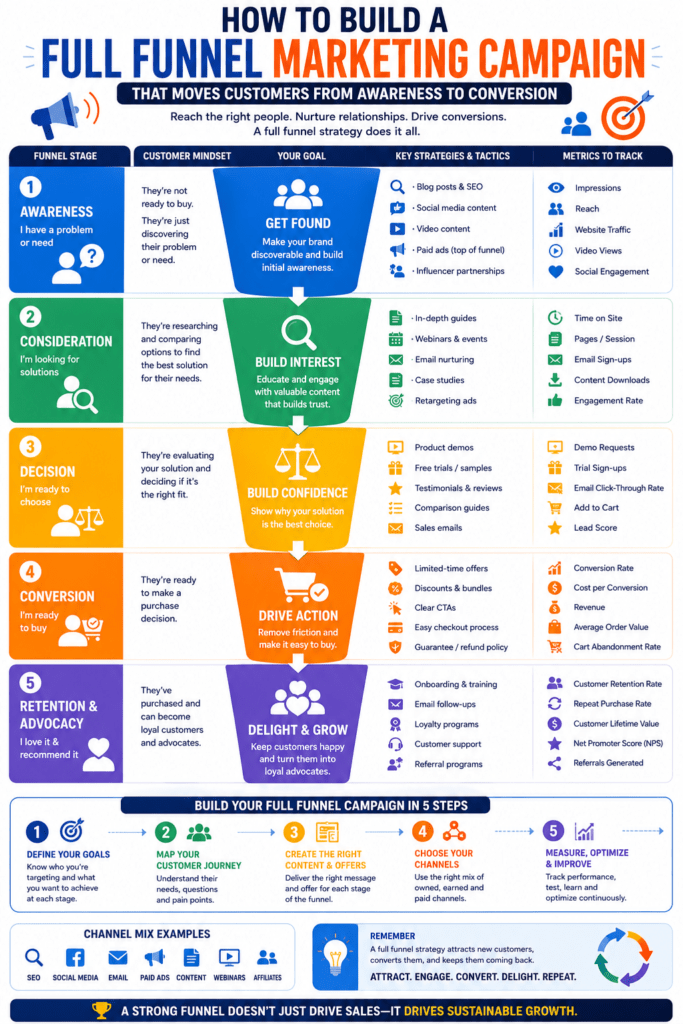
Table of Contents
What Is a Full Funnel Marketing Campaign?
A full funnel marketing campaign is a coordinated marketing strategy that addresses customers at different stages of their buying journey.
A typical structure is:
Awareness → Consideration → Conversion → Retention
Each stage has a different purpose.
| Stage | Main Objective |
|---|---|
| Awareness | Attract relevant people |
| Consideration | Educate and build trust |
| Conversion | Generate action |
| Retention | Encourage repeat business |
The strength of the approach comes from connecting these stages rather than treating them as independent campaigns.
Why Full Funnel Marketing Matters
Imagine a business runs an advertisement to 10,000 people and sends everyone to the same sales page.
Some people may be ready to purchase.
Others may have never heard of the brand.
The same message is unlikely to work equally well for both audiences.
A full funnel strategy solves this by adapting the message to customer readiness.
It helps businesses:
- Attract relevant audiences
- Educate prospects
- Build trust
- Generate leads
- Improve conversions
- Nurture prospects
- Retain customers
- Understand campaign performance
The source material emphasizes connecting marketing from discovery through education, trust, action, and follow up rather than relying on disconnected tactics.
The Main Funnel Stages
Top of Funnel
This is the awareness stage.
People may not know your business yet.
Useful activities include:
- SEO
- Educational content
- Social media
- Video
- Display advertising
- Awareness campaigns
The primary goal is to attract relevant attention.
Middle of Funnel
Now the prospect is interested and looking for more information.
Useful content can include:
- Detailed guides
- Case studies
- Webinars
- Reviews
- Comparisons
- Email sequences
The purpose is to build understanding and trust.
Bottom of Funnel
The prospect is closer to making a decision.
Useful assets include:
- Product pages
- Service pages
- Pricing information
- Testimonials
- Consultation pages
- Demos
- Offers
The goal is to make the next action easy.
Retention
After conversion, continue the relationship.
Use:
- Customer support
- Loyalty programs
- Educational content
- Follow up
- Relevant offers
Retention is important because customer value does not necessarily end with the first transaction.
How to Build a Full Funnel Marketing Campaign
Step 1: Define Your Business Goal
Start with the outcome.
For example:
Generate qualified dental appointment enquiries
or:
Generate qualified property buyer leads
or:
Generate consultations for SEO services
The source material recommends defining success before selecting tactics and ensuring every marketing activity has a clear reason for existing.
Step 2: Define Your Audience
Understand:
- Problems
- Goals
- Motivations
- Objections
- Buying behavior
- Preferred channels
- Search behavior
Customer conversations, comments, reviews, search queries, and sales questions can help identify recurring patterns.
Step 3: Map the Customer Journey
Write down how customers typically move through the buying process.
For example:
Google Search → Blog → Service Page → Case Study → Consultation → Customer
Now build marketing around those steps.
Step 4: Create Content for Each Stage
Do not use the same message everywhere.
Create content according to awareness level.
Awareness Content
Educational and problem focused.
Consideration Content
Evidence and comparison focused.
Conversion Content
Offer and action focused.
Retention Content
Support and relationship focused.
Top of Funnel Marketing
The top of the funnel should attract the right people.
For SEO, create useful articles that answer relevant questions.
For social media, create educational and engaging content.
For advertising, target audiences based on relevant problems, interests, search behavior, or business needs.
The goal is not to attract everyone.
It is to attract people who may eventually become customers.
Example
A digital marketing agency might publish:
“How Small Businesses Can Improve Their Google Visibility”
This can attract business owners who are beginning to think about SEO.
Middle of Funnel Marketing
Once people know your brand, they need reasons to trust you.
Provide:
- Case studies
- Reviews
- Detailed guides
- Expert explanations
- Comparisons
- Webinars
- Demonstrations
For example, the same digital marketing agency could publish:
“SEO vs Google Ads for Small Businesses”
This helps prospects compare approaches and understand which option may fit their needs.
Bottom of Funnel Marketing
At this point, the prospect needs a clear reason and a simple way to act.
A service page might include:
- Clear offer
- Benefits
- Relevant results
- Testimonials
- FAQs
- Pricing guidance
- CTA
- Contact form
For a dental clinic, the CTA could be:
Book a Consultation
For a real estate business:
Request Property Details
For a marketing agency:
Book a Free Consultation
Retention and Customer Growth
A full funnel campaign should not stop at the sale.
Existing customers can provide:
- Repeat revenue
- Referrals
- Reviews
- Testimonials
- Case studies
- Brand advocacy
Create useful follow up experiences.
Ask customers for feedback.
Provide relevant educational content.
Stay useful after the transaction.
Measuring Funnel Performance
Each stage should have relevant metrics.
| Stage | Metrics |
|---|---|
| Awareness | Reach, impressions, relevant traffic |
| Consideration | Engagement, returning visitors |
| Lead Generation | Leads, qualified leads |
| Conversion | Conversion rate, sales |
| Acquisition | Cost per customer |
| Retention | Repeat purchases, referrals |
The source material recommends evaluating marketing through metrics connected to the original objective, including qualified leads, conversion rate, cost per acquisition, engagement quality, returning visitors, and revenue.
Do not judge the entire campaign using only one metric.
Practical Example
Imagine a real estate company wants to generate more qualified buyers.
Its full funnel marketing campaign could be:
Awareness
Google Search and social media content around property buying.
Consideration
Detailed property guides, location information, buyer FAQs, and market insights.
Conversion
Property listings, reviews, financing information, and enquiry forms.
Sales
Phone consultation and property visit.
Retention
Follow up, customer support, referral requests, and future property updates.
Each stage supports the next.
Common Mistakes
Using One Message for Everyone
Customer readiness varies.
Focusing Only on Awareness
Brand visibility is useful, but the campaign also needs a path toward action.
Asking for a Sale Too Early
Some audiences require education first.
Ignoring Retargeting or Follow Up
People may need several interactions before making a decision.
Measuring Only Traffic
Traffic does not automatically equal qualified leads or revenue.
Disconnecting Campaigns
Your advertisement, landing page, content, sales process, and follow up should communicate a consistent message.
The source material specifically highlights the importance of keeping marketing connected from the first interaction through the next action.
Frequently Asked Questions
What is a full funnel marketing campaign?
A full funnel marketing campaign is a connected marketing strategy that addresses customers across awareness, consideration, conversion, and retention stages.
Why is full funnel marketing important?
It helps businesses provide the right message at different stages of the customer journey instead of treating every prospect the same way.
What are the stages of a full funnel campaign?
The common stages are awareness, consideration, conversion, and retention.
Which channels work for full funnel marketing?
SEO, social media, content marketing, Google Ads, email marketing, video, remarketing, referrals, and other channels can contribute depending on the audience and business.
How do I measure a full funnel campaign?
Measure each stage separately using relevant metrics such as reach, engagement, leads, qualified leads, conversion rate, customer acquisition cost, sales, and retention.
Can small businesses use full funnel marketing?
Yes. Small businesses can build a simple funnel using a few relevant channels instead of attempting to manage every possible marketing platform.
Conclusion
A full funnel marketing campaign gives businesses a structured way to move customers from awareness to action.
The most important idea is simple:
Not every customer needs the same message at the same time.
Someone discovering your brand needs information.
Someone comparing options needs trust and evidence.
Someone ready to buy needs a clear offer and an easy next step.
A connected funnel allows your SEO, social media, content, advertising, landing pages, sales process, and follow up to work toward the same goal.
Start with the customer.
Understand the journey.
Create content for each stage.
Measure what matters.
Then improve the areas where customers are dropping off.
That creates a marketing system that is more connected, measurable, and easier to improve over time.