

Native Linkage
A Digital Marketing Agency.
How Search Engines Work: What Happens Behind the Search Bar.
Understand how search engines discover, understand, and rank web pages, explained simply for beginners and business owners.
Introduction
Have you ever searched for something on Google and wondered why certain websites appear at the top while others are buried several pages down?
The answer becomes much easier to understand when you know how search engines work.
Search engines such as Google process an enormous amount of information every day. They discover web pages, understand their content, store useful information in their index, and then decide which results are most relevant to a particular search.
For someone learning SEO, understanding this process is more important than memorizing hundreds of SEO techniques. Once you understand what happens behind a search, things such as keywords, backlinks, technical SEO, content quality, and E E A T start making much more sense.
Let us break down how search engines work in simple terms.
What Is a Search Engine?
A search engine is a system that helps people find information on the internet.
Google, Bing, and other search platforms continuously discover and organize web pages so they can provide useful results when someone searches for something.
Think of a search engine like a massive library.
A library needs to:
- Discover new books.
- Understand what each book contains.
- Organize the books.
- Help visitors find the most relevant book.
Search engines perform a similar job, but on a much larger scale.
How Search Engines Work
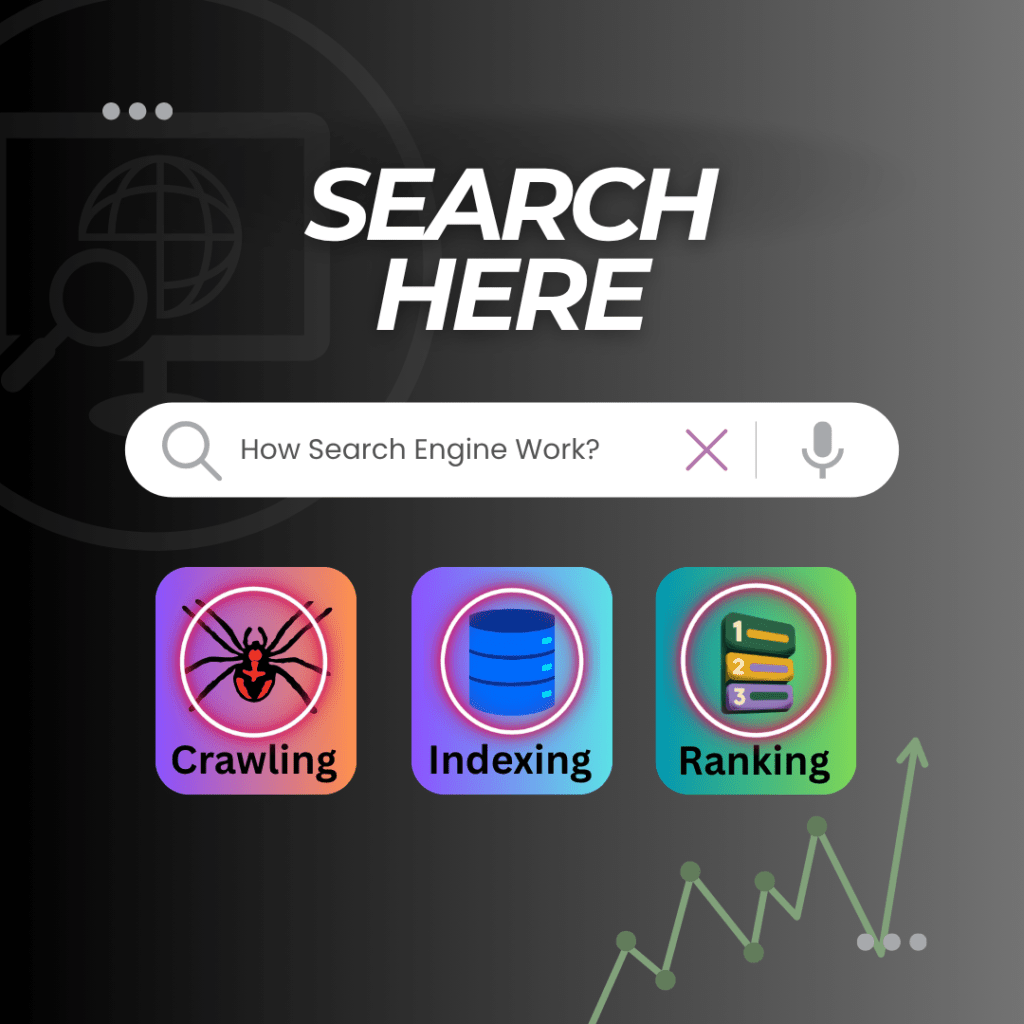
At a basic level, how search engines work can be understood through four major steps:
| Stage | What happens |
|---|---|
| Crawling | Search engines discover web pages |
| Indexing | Information from pages is analyzed and stored |
| Query understanding | The search engine understands what the user wants |
| Ranking | Relevant results are ordered and displayed |
These stages work together. A page generally needs to be accessible and understood by a search engine before it can have an opportunity to appear in organic search results.
Step 1: Crawling
Crawling is the process through which search engines discover web pages.
Search engines use automated programs commonly called crawlers or search engine bots. These programs visit websites and follow links to discover new or updated pages.
For example, imagine you publish a new page about dental implants.
A crawler may discover that page through:
- An internal link from another page.
- An XML sitemap.
- Links from external websites.
- Previously known website URLs.
Why crawling matters for SEO
If search engine crawlers cannot access an important page, that page may not be properly discovered.
Common technical issues include:
- Incorrect robots.txt instructions.
- Broken internal links.
- Poor website structure.
- Server errors.
- Accidentally blocking important pages.
A useful SEO habit is to regularly check whether important pages can actually be crawled.
Step 2: Indexing
After discovering a page, the search engine needs to understand and store information about it.
This process is known as indexing.
During indexing, search engines can analyze elements such as:
- Page content.
- Main topic.
- Title.
- Images and their context.
- Links.
- Structured data.
- Other relevant signals.
Think about a real estate website with a page titled “2 BHK Flats in Bhopal.”
The search engine may understand that the page is related to residential property, Bhopal, two bedroom apartments, pricing, location, and related information.
If the page meets the search engine’s requirements for inclusion, information about it can become part of the search index.
Being indexed does not guarantee a high ranking.
Step 3: Understanding Search Queries
When someone types a search into Google, the search engine first needs to understand the query.
Consider these searches:
“dentist near me”
The person may be looking for a nearby dental clinic.
“how much does dental cleaning cost”
The person is probably looking for information about pricing.
“best exercises after knee surgery”
The person is looking for health related information.
The words themselves are important, but search engines also try to understand the meaning and intent behind the query.
This is why modern SEO is not simply about repeating a keyword.
Good content should answer the actual question behind the search.
Step 4: Ranking Search Results
Once a search engine understands the query, it needs to select and order relevant pages.
This is where search ranking becomes important.
Search engines consider many signals when determining which pages may be useful for a particular query.
These can include:
- Relevance of the content.
- Quality and usefulness of the information.
- Website and page experience.
- Links and references from other websites.
- Technical accessibility.
- Context of the search.
- Signals related to trust and authority.
The exact systems used by search engines are complex and continually updated. There is no single formula that guarantees the first position.
What Influences Search Rankings?
Understanding how search engines work also means understanding what makes content useful.
Helpful and Relevant Content
A page should solve the visitor’s problem rather than simply target a keyword.
For example, a real estate article targeting “property buying guide” should explain important considerations such as location, budget, documentation, financing, and property inspection.
E E A T
E E A T stands for:
| Element | Meaning |
|---|---|
| Experience | First hand knowledge or practical experience |
| Expertise | Demonstrated knowledge of the subject |
| Authoritativeness | Recognition and credibility |
| Trustworthiness | Accuracy, transparency, and reliability |
E E A T is particularly important for topics that can significantly affect people’s health, finances, safety, or important decisions.
A doctor’s website, for example, can strengthen trust by clearly presenting professional credentials, author information, medical sources, and accurate patient information.
Technical SEO
Technical SEO helps search engines access and understand a website.
Important areas include:
- Mobile usability.
- Page speed.
- Website security.
- Clear site architecture.
- Internal linking.
- XML sitemaps.
- Proper indexing controls.
A Simple Real World Example
Suppose a dental clinic creates two pages about teeth whitening.
Page A contains 300 words that repeatedly mention “teeth whitening” but provides little useful information.
Page B explains the procedure, possible benefits, limitations, who may not be suitable for it, common questions, aftercare, and information about the dental professional.
Page B provides substantially more useful information for someone researching the topic.
This illustrates an important SEO principle: search engines aim to connect users with useful results, not simply pages containing the highest number of keywords.
Common SEO Mistakes
Beginners often misunderstand how search engines work and make mistakes such as:
- Repeating keywords unnaturally.
- Publishing very thin content.
- Ignoring search intent.
- Creating pages that are difficult to navigate.
- Copying information from competitors.
- Ignoring technical SEO.
- Publishing content without checking factual accuracy.
- Focusing only on rankings instead of helping visitors.
A better approach is to ask a simple question before publishing:
“If I were the person searching this query, would this page genuinely help me?”
That question can improve both content quality and user experience.
Frequently Asked Questions
Search engines discover web pages through crawling, analyze and store information through indexing, understand search queries, and then rank relevant pages for users.
Crawling is the process where search engine bots discover and visit web pages to understand their content and structure.
Indexing is the process of analyzing and storing information about discovered web pages so they can potentially appear in search results.
No. Indexing only means that a page can be considered for search results. Ranking depends on relevance, quality, technical factors, and other signals.
Search intent helps you understand what a person actually wants when they enter a query. Content that clearly satisfies that need is more useful to the visitor.
Conclusion
Understanding how search engines work gives you a much stronger foundation for learning SEO.
The process can be remembered in four simple words:
Crawl. Index. Understand. Rank.
Search engines discover pages, understand and organize their information, interpret what users are looking for, and then present relevant results.
For businesses such as real estate companies, dental clinics, doctors, and local service providers, this understanding helps create websites that are useful to both people and search engines.
SEO is not about trying to trick a search engine. It is about making your website easier to discover, understand, trust, and use.
Table of Contents
Share this article
>> Related Blogs



How to Build a Full Funnel Marketing Campaign That Moves Customers From Awareness to Conversion
Read More »>> Find Us
Email Us
nativelinkage@gmail.com
Call Us
+91 7000368505
Our Location
46, st.no. 01, Dwarka Nagar, Bhopal Madhya Pradesh, 462010.
Need SEO Services?
Looking for SEO services in Bhopal or reliable SEO support remotely? Let’s work on improving your website’s visibility and helping your business reach the right people through search. Contact Native Linkage today to discuss your website, SEO goals, and the next steps for your business.