
Top 10 Social Media Growth Strategies for Brands
Top Strategies for Social Media Growth!
Introduction
Getting followers is easy. Getting the right people to notice your brand, trust it, and eventually become customers is much harder. That is where social media growth strategies for brands become important.
A restaurant may need more people to visit its location. A coaching institute may want more enquiries. A local business may simply need to become better known in its area. Each goal requires a different approach.
After working with digital marketing concepts across content, branding, SEO, and paid advertising, one thing becomes clear: social media growth rarely comes from posting randomly. It comes from having a clear audience, useful content, consistent communication, and a reason for people to engage.
Here are ten practical strategies that brands can actually use.
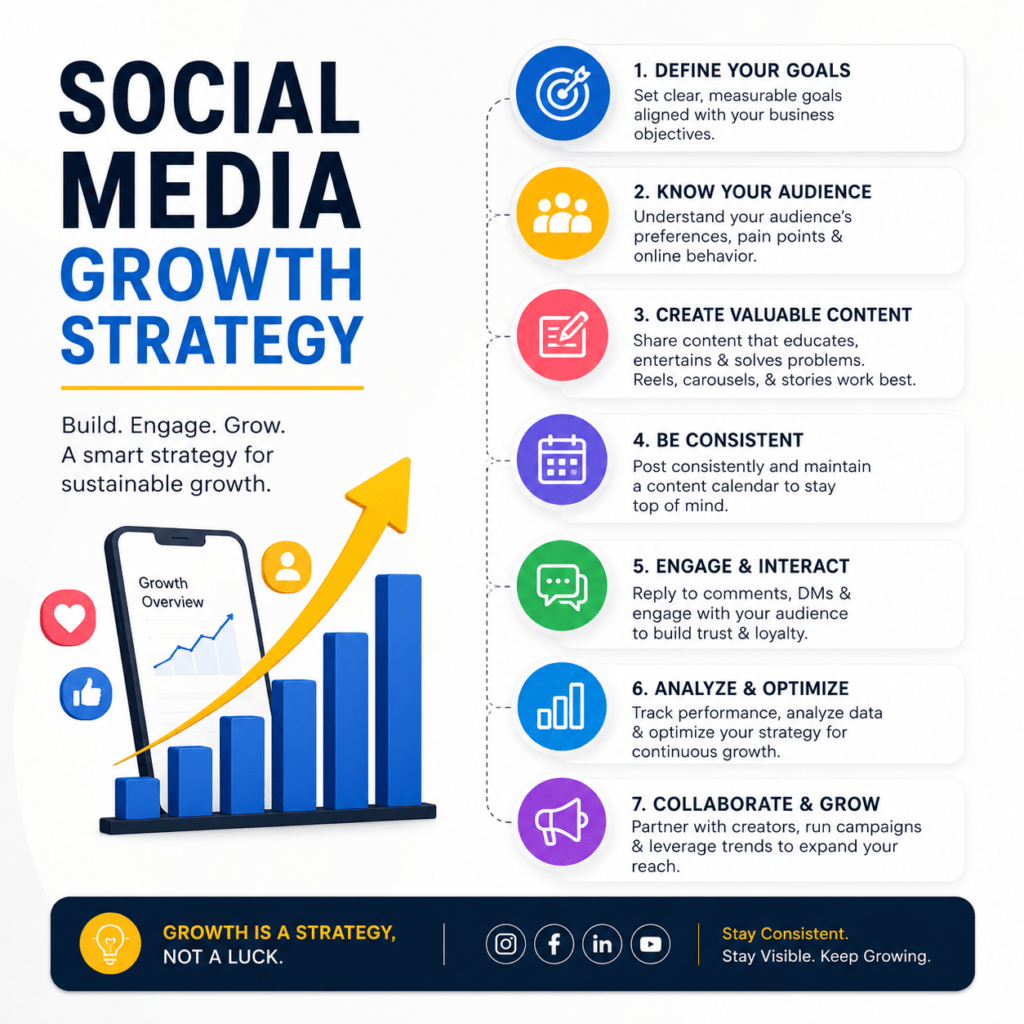
Table of Contents
- Define your target audience
- Set a clear social media goal
- Create content around customer problems
- Build a consistent content system
- Use short form video strategically
- Make your brand locally relevant
- Encourage genuine engagement
- Improve your profile for conversions
- Study your analytics regularly
- Combine organic and paid growth
1. Define Your Target Audience
Before creating content, understand who you want to reach.
A cafe targeting college students should communicate differently from a hotel targeting business travelers. Similarly, a coaching institute needs content that addresses students and parents.
| Business | Useful audience insight |
|---|---|
| Restaurant | Location, food preferences, occasions |
| Cafe | Age group, lifestyle, local interests |
| Coaching institute | Course needs, student concerns |
| Hotel | Travel purpose, budget, location |
| Local business | Area, buying habits, customer needs |
The more specific your audience is, the easier it becomes to create relevant content.
2. Set a Clear Social Media Goal
Do not measure success only through followers.
Your goal could be website visits, enquiries, bookings, store visits, brand awareness, or sales. Choose one primary goal and connect your content to it.
For example, a restaurant could measure profile visits, direction requests, table bookings, and enquiries instead of focusing only on follower growth.
3. Create Content Around Customer Problems
People rarely follow a business simply because it exists. They follow because the content gives them something useful, interesting, or relatable. Strong hooks, clear storytelling, and useful information can support long term Social Media Growth.
A digital marketing agency can explain common advertising mistakes. A cafe can share food pairing ideas. A coaching institute can explain how students can prepare for exams.
A useful rule is simple: teach something, solve something, or show something worth remembering.
4. Build a Consistent Content System
Consistency does not mean posting three times every day. It means maintaining a predictable quality and message.
Create a few content categories and rotate them.
| Content type | Example |
| Educational | Tips and tutorials |
| Trust building | Reviews and testimonials |
| Behind the scenes | Team and process |
| Product focused | Features and demonstrations |
| Community | Local events and customer stories |
6. Make Your Brand Locally Relevant
Local businesses have an advantage that large brands cannot easily replicate: community connection.
Use location specific topics, local events, customer stories, neighborhood references, and relevant location tags.
A cafe in Indore, for example, could create content around local food preferences or popular weekend activities. This can make the account feel connected to its audience rather than looking like a generic business page.
7. Encourage Genuine Engagement
Social media is not a notice board. It is a conversation.
Reply to comments, answer questions, acknowledge customer feedback, and participate in relevant discussions.
One practical approach is to end selected posts with a simple question. Instead of asking people to engage with every post, give them a genuine reason to share their opinion.
8. Improve Your Profile for Conversions
Your profile should quickly answer three questions:
What do you offer?
Who do you help?
What should I do next?
Use a clear profile image, understandable description, relevant contact information, and a useful link.
For a restaurant, that link might lead to a menu or reservation page. For a coaching institute, it could lead to an enquiry form.
9. Study Your Analytics Regularly
Analytics tell you what your audience actually responds to.
Look at reach, watch time, saves, shares, comments, profile visits, website clicks, and enquiries.
Do not automatically repeat a post just because it received many likes. A post with fewer likes but several enquiries may be far more valuable to a business.
10. Combine Organic and Paid Growth
Organic content builds trust over time, while paid campaigns can help distribute strong content to a specific audience.
A sensible approach is to first identify content that performs well organically. Then consider putting advertising budget behind content that supports a clear business objective.
This is one of the most practical strategies for social media growth because content and advertising can support each other rather than operating separately.
Common Mistakes Brands Should Avoid
Many businesses make the same mistakes:
- Posting without knowing the target audience
- Copying competitors too closely
- Focusing only on follower count
- Ignoring comments and messages
- Changing the brand style constantly
- Posting promotional content too frequently
- Never reviewing analytics
Growth becomes easier when these basic problems are addressed first.
Frequently Asked Questions
The most useful strategies include defining a clear audience, creating helpful content, maintaining consistency, using short form video, engaging with customers, analyzing performance, and connecting social media activity with business goals.
There is no universal number. A brand should choose a posting schedule it can maintain without reducing content quality. Consistency is generally more useful than posting heavily for a short period.
Small businesses can focus on local content, customer stories, educational posts, short videos, community engagement, and strong profile optimization. Their local connection can become a major advantage.
Neither metric should be viewed alone. Businesses should connect social media performance with meaningful outcomes such as enquiries, website visits, bookings, store visits, and sales.
Yes, when used with a clear objective. Paid campaigns can help brands reach specific audiences, while organic content helps build credibility and ongoing engagement.
Conclusion
Effective social media growth strategies for brands are not about finding one perfect posting trick. Sustainable growth comes from understanding your audience, producing useful content, staying consistent, building relationships, and measuring what actually contributes to business results.
For a restaurant, that may mean more reservations. For a coaching institute, it may mean more enquiries. For a local business, it may simply mean becoming the first name people remember when they need a particular product or service.
Start with one clear audience, one measurable goal, and a content system you can maintain. Then improve based on what your audience tells you through its behavior.